
Recent attacks on Jewish institutions in Montreal may be part of a much broader wave of extremist violence targeting Jews across Canada and North America, according to a new federal intelligence report that reveals Canadian authorities have disrupted four ISIS inspired plots against Jewish targets since October 7, 2023.
The report, prepared by the Integrated Threat Assessment Centre, a component of the Canadian Security Intelligence Service, does not identify the four planned attacks or directly connect the shootings and firebombings in Montreal to ISIS. It does, however, place the violence experienced by Montreal’s Jewish community within a growing threat environment involving ISIS inspired extremists, Iran linked organizations and criminals recruited to attack Jewish targets.
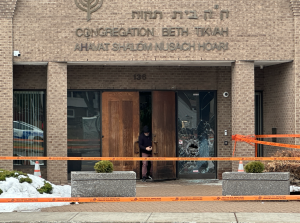
Montreal has already experienced much of what the report warns about. On November 9, 2023, bullets struck both Yeshiva Gedola and Azrieli Talmud Torah. Three days later, at approximately 5 a.m., Yeshiva Gedola was shot at a second time. The Belz school housed inside the Young Israel of Montreal synagogue was struck by gunfire in May 2024, while Congregation Beth Tikvah, Federation CJA offices and Temple Emanu El Beth Sholom have all been targeted in arson or attempted arson attacks.
The Beth Tikvah case also bears similarities to the criminal proxy threat identified by Canadian intelligence. Mohamed Ilyess Akodad, who pleaded guilty to attacking the synagogue and a nearby Federation CJA building in December 2024, told a Montreal court that he had been offered $15,000, driven to the targets and supplied with the materials used in the attacks. The people who allegedly selected the Jewish buildings, offered the money and directed the operation have not been publicly identified.
The June 29 assessment, titled Global Events and Antisemitism Inspiring Domestic Threats, warns that violent extremist and criminal threats against Jewish communities are likely to continue. It also says the repeated targeting of Jews, even when individual attacks do not meet the legal definition of terrorism, is creating an atmosphere in which violence against Jews becomes increasingly normal and may push susceptible individuals toward violent extremism.
The three page report was obtained by Global News. It says the four disrupted plots were inspired by the Islamic State, while a fifth case involved a Canadian who travelled to Israel. The report does not identify the suspects, the intended targets or the cities in which the attacks were supposed to occur.
Publicly known cases provide some indication of what Canadian authorities have been confronting.
In August 2025, the RCMP arrested a Montreal minor who investigators said intended to carry out at least one attack on behalf of ISIS. The initial RCMP announcement did not identify the intended victims, but the CSIS public report for 2025 later disclosed that the youth intended to target Jewish people and police in Montreal.
The arrest was part of a growing number of terrorism investigations involving minors. CSIS has warned that extremist propaganda, violent online communities and encrypted communications are drawing increasingly young Canadians into terrorism related activity. The agency said five minors were arrested in Canada in 2023, two in 2024 and four in 2025 in connection with violent extremism cases.
Another plot with a direct Quebec connection involved Muhammad Shahzeb Khan, a Pakistani citizen living in Canada who was arrested near Ormstown in September 2024 while attempting to travel to the United States.
American prosecutors said Khan planned to use automatic weapons to carry out a mass shooting at a prominent Jewish centre in Brooklyn on or near October 7, 2024. He told undercover officers that New York was an ideal target because of its large Jewish population and said he wanted the attack to be the largest on American soil since September 11.
Khan was extradited to the United States in June 2025 and pleaded guilty on April 8, 2026, to attempting to commit terrorism across national boundaries. He is scheduled to be sentenced on August 12 and faces a maximum sentence of life in prison.
In Ottawa, two teenagers were arrested in December 2023 and February 2024 in connection with an ISIS inspired plot against the Jewish community. Court documents alleged that the youths considered using an explosive device to attack Jewish people at a rally on Parliament Hill. CSIS Director Daniel Rogers later described it as a planned mass casualty attack against the Jewish community in the national capital. One of the youths was found guilty of terrorism charges in April.
The ITAC report does not confirm whether those cases account for three of the four disrupted plots. Its refusal to identify the cases makes it impossible to establish a complete public record of what was planned, how close the suspects came to carrying out the attacks or how authorities stopped them.
The report says no comparable plot was discovered during the first six months of 2026. Intelligence officials do not consider that evidence that the danger has passed. ITAC expects violent extremist and criminal threats against Jewish communities in Canada and other Western countries to continue at a steady rate for at least the next six months.
The ISIS inspired plots are only one part of the warning.
The report also says groups connected to Iran will likely continue directing threats toward Jewish communities and American and Israeli interests in Canada and the West. Canadian intelligence is particularly concerned that foreign organizations may recruit local criminals to conduct attacks, allowing the people who select the targets and finance the operations to remain hidden.
The organization receiving the most attention is the Islamic Movement of the Companions of the Right, also known as Harakat Ashab al Yamin al Islamiya. American authorities allege that the group operates as part of Kata’ib Hizballah, an Iraqi militia backed by Iran’s Islamic Revolutionary Guard Corps.
According to the Canadian assessment, 83 per cent of the attacks planned or claimed by the organization targeted Jewish communities or Israeli interests. The group claimed responsibility for two shootings in Canada, but ITAC cautioned that neither attack has been definitively connected to it. Canadian authorities have not publicly linked the shootings to Iran.
American prosecutors have charged Mohammad Baqer Saad Dawood Al Saadi, an Iranian and Iraqi national accused of operating for Kata’ib Hizballah and the Revolutionary Guard. Prosecutors allege that Al Saadi and his associates helped plan, direct or claim responsibility for at least 18 attacks in Europe and two additional attacks in Canada. The allegations have not been proven in court.
The United States alleges that the network recruited people to carry out shootings, stabbings and arsons, sometimes providing instructions while attacks were underway. Videos were then allegedly used to promote the organization and claim responsibility.
That model presents a different problem from a traditional terrorist cell. A criminal recruited for money may have no previous connection to an extremist organization, no history of ideological activity and little information about the people financing the attack. Even if the person who carries out the violence is arrested, those who ordered it can remain out of sight.
While Akodad’s account of the Beth Tikvah attack does not establish any foreign connection, it does show that Jewish institutions in Montreal have already been selected for an attack carried out through a paid intermediary. The person who set the fire was identified and prosecuted, but the people he says hired him have not been identified and could very well be foreign agents.
The federal report also points to a broader pattern of shootings and arsons against Jewish institutions following the outbreak of the latest conflict involving Iran on February 28. Three synagogues in the Toronto area were struck by gunfire during the first week of March. Ten bullets were fired at Shaarei Shomayim in North York, while Temple Emanu El and Beth Avraham Yoseph were also targeted.
In Montreal, the most recent synagogue attack occurred shortly after midnight on June 5. Police allege that a man smashed a window at Temple Emanu El Beth Sholom in Westmount and attempted to start a fire inside. Firefighters extinguished the flames before they spread and police arrested a 38 year old suspect nearby.
Rabbi Lisa Grushcow said the synagogue’s cameras, monitoring and security measures may have prevented the building from being destroyed. The same synagogue had been defaced with a swastika in February 2025.
Montreal police recorded 322 suspected hate crimes or hate incidents targeting Jewish residents, institutions and property between October 7, 2023 and May 31, 2026. There were 104 incidents involving Muslim targets during the same period.
Nationally, Statistics Canada recorded 788 police reported hate crimes targeting Jews in 2025. That represented a 16 per cent decline from the previous year, but Jews were still the victims of 71 per cent of all hate crimes motivated by religion. Jewish Canadians represent approximately one per cent of the country’s population.
ITAC said the reduction in the annual number did not reflect the renewed increase in attacks following the beginning of the conflict with Iran. The report found that harassment, threatening rhetoric, assaults, arsons and shootings against Jewish communities had increased again, particularly in the Greater Toronto Area.
Despite the four disrupted plots and the continuing violence against Jewish institutions, Canada’s national terrorism threat level remains at medium. The rating means officials consider a terrorist attack a realistic possibility.
ITAC concluded that the growing number of threats had not been matched by a sufficient increase in demonstrated terrorist capabilities or completed attacks to justify raising the national level. Canada continues to experience between one and three completed extremist attacks per year, according to the assessment.
Former RCMP assistant commissioner Ches Parsons criticized that conclusion, saying the report separated terrorism, hate crimes and ordinary criminal violence into categories that failed to reflect their combined effect on Jewish Canadians. Parsons described that separation as a “statistical firewall” between the official threat assessment and the reality facing the Jewish community.
The legal distinction between a hate crime, a criminal attack and terrorism remain important to police, prosecutors and intelligence agencies. It is a far less meaningful distinction to a Jewish school struck by bullets; a synagogue attacked with fire or a community centre forced to increase security simply to remain open.
The federal report does not provide the answer to who has been behind the attacks in Montreal. All it does is makes the need to find that answer much more urgent.



Leave a Reply