
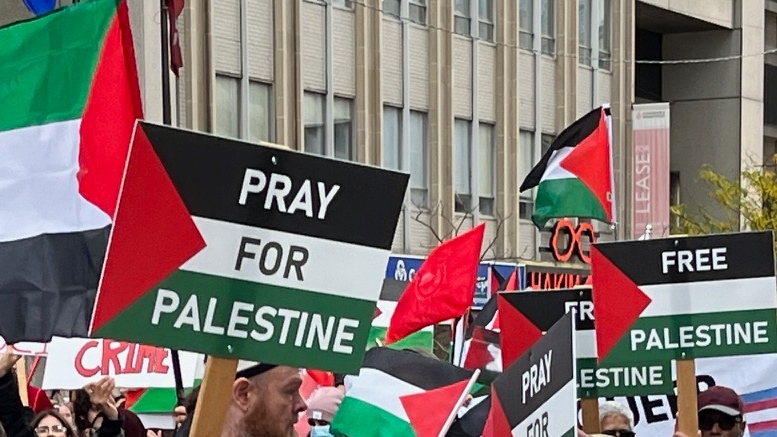
A Toronto man who became a familiar face at pro-Palestinian demonstrations has been charged with a terrorism offence after police alleged he acted for the benefit of, and in association with, Hamas.
Toronto Police announced that Ahmad Hassan Hajahmad, 33, was arrested Monday and charged with participating in or contributing to the activity of a terrorist group under Section 83.18 of the Criminal Code.
The charge stems from two demonstrations held near Bay Street and Front Street West on May 25 and September 7, 2024. Police allege Hajahmad used microphones and amplification equipment to call for harm against Israelis and members of the Jewish community.
The investigation stretched nearly two years and was conducted jointly by the Toronto Police Hate Crime Unit and the RCMP’s Integrated National Security Enforcement Team (INSET), Canada’s national security and counterterrorism unit.
Investigators executed a search warrant at a Toronto residence in March 2025, seizing electronic devices that ultimately formed part of the evidence supporting the terrorism charge. Police have not released details of what was recovered, and a publication ban remains in effect.
Unlike most Criminal Code offences, terrorism prosecutions require the approval of both the federal Attorney General and the Attorney General of Ontario before charges can be laid. That approval was granted on July 20, clearing the way for Hajahmad’s arrest the following day.
The case is one of the first in Canada to move beyond allegations of hate speech or public disorder at anti-Israel demonstrations and into the realm of terrorism.
Since the Hamas massacre in Israel on October 7, 2023, Jewish organizations have repeatedly warned that demonstrations across Canada have become increasingly hostile, with chants glorifying Hamas, calls for violence and intimidation directed at Jews. While police have laid charges in isolated incidents involving vandalism, assaults and hate crimes, this is among the first prosecutions alleging that protest activity itself was carried out for the benefit of a listed terrorist organization.
The charge carries a maximum sentence of 10 years in prison if convicted.
The prosecution is expected to draw national attention as it moves through the courts, with investigators expected to reveal what evidence led them to conclude that Hajahmad’s alleged activities crossed the line from political activism into participation in a terrorist organization.





Leave a Reply