
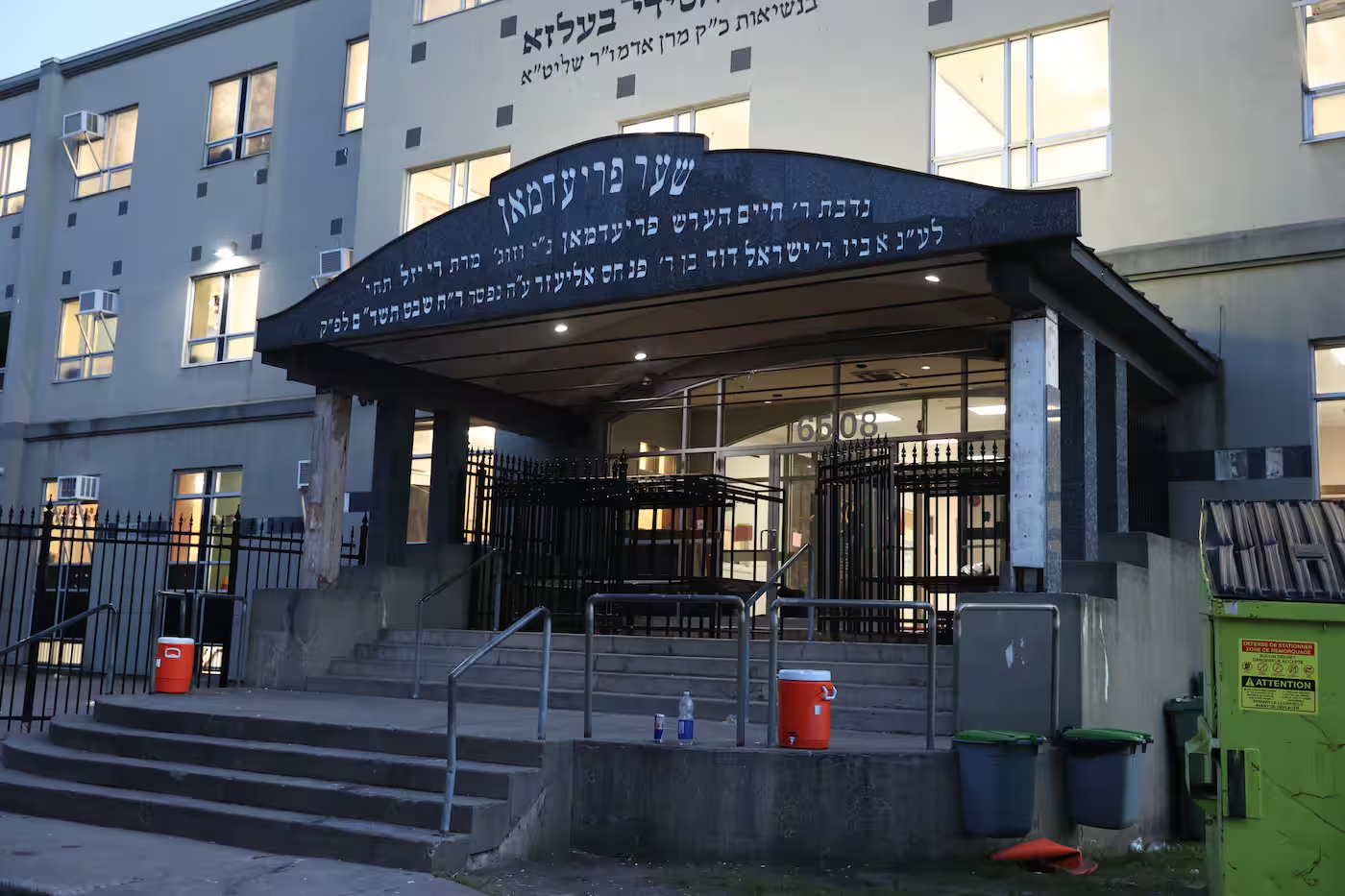
Quebec has ordered three campuses of Montreal’s École communautaire Belz to close, potentially leaving 582 boys without their school when classes are scheduled to resume at the end of August.
The decision, dated June 30, removes the English and French sections at the school’s Durocher campus and its secondary section on Hillsdale from the school’s permit. The three remaining Belz sections, which serve girls, are permitted to continue operating, although they have also been ordered to correct a number of deficiencies.
The Ministry of Education says the decision followed inspections which uncovered problems involving teacher qualifications, the Quebec curriculum, instructional time and the condition of the buildings.
According to documents obtained by TVA Nouvelles through proceedings before the Tribunal administratif du Québec, inspectors found classes without teachers, empty classrooms during periods when lessons were scheduled and students in prayer rooms during instructional time. The Ministry also alleges that some compulsory subjects were not receiving the required number of hours and that the school had not demonstrated that the Quebec curriculum was being fully taught.
The Ministry also raised concerns about who was doing the teaching. It says the school did not have enough legally qualified teachers, that some unqualified teachers had not been declared in its permit application and that inspectors encountered teachers who could not communicate in either French or English.
There were building issues as well. Inspectors reported inaccessible emergency exits, unsecured electrical wiring, damaged ceilings, blocked windows, cluttered rooms, uneven floors and broken equipment, along with dirt, dust and other signs of deterioration.
Belz is fighting the decision and has asked the Tribunal administratif du Québec to suspend it while the case is heard.
The school says Quebec’s decision is based on incorrect information, an inconsistent analysis and a penalty that is disproportionate to the problems identified. It also argues that it was not given enough information about some of the allegations to properly answer them before the government made its decision.
Belz disputes the Ministry’s characterization of its teaching staff as well. According to its filing, 18 of the 19 teachers responsible for the ministerial program at Durocher either hold a teaching authorization or have a government-issued tolerance allowing them to teach. At Hillsdale, it says all seven teachers are similarly authorized, three through regular teaching authorizations and four through tolerances.
A tolerance allows a school, under certain circumstances, to employ someone who does not hold a regular teaching authorization. That means the Ministry can technically maintain that some teachers are not legally qualified while Belz can maintain that they are legally permitted to be in the classroom. Both statements can be true.
The school also says building problems identified by the government have either been corrected or are in the process of being corrected.
For Belz families, the argument is now happening against the calendar. The school says its year begins August 30 and that there is nowhere within its remaining campuses to absorb 582 boys. It argues that forcing the sections to close before the tribunal can hear the full case would cause damage that could not easily be undone.
In 2011, the Commission consultative de l’enseignement privé reviewed the school as part of its permit renewal. At the time, Belz had 50 teachers. Only 27 held teaching authorizations, ten were working under employment tolerances and 13 had neither. Curriculum was an issue then too.
The Commission found problems with the school calendar and the delivery of required subjects. It noted that between 260 and 460 minutes were being devoted to Jewish studies as complementary services and identified subjects that were not being offered to some students as required under the provincial pedagogical regime.
At Durocher, the Commission reported that there was no science laboratory, library or computer laboratory. When Belz moved its secondary students to Hillsdale, the Commission noted that the move had taken place before the Minister had authorized it and said the new building still required a science laboratory, gymnasium and computer laboratory.
Despite those findings, Quebec did not close the school. The Commission recommended renewing its permit for one year while Belz continued working toward compliance.
Even that was not the beginning of the issue. Earlier government reviews dating back to 2008 were already raising concerns involving the Quebec curriculum, teacher qualifications and adequate facilities.
For years, the approach was essentially the same: identify the problem, impose conditions, renew the permit and give the school more time. That makes the June decision significant. Quebec has gone from trying to make Belz comply to telling three of its sections they can no longer operate.
And the timing is worth noting. Quebec has also just changed the rules governing secularism in subsidized private schools.
On April 2, the National Assembly adopted the Loi sur le renforcement de la laïcité au Québec. One provision of that law could eventually have a major impact on subsidized Jewish schools.
Beginning April 2, 2029, Quebec’s Private Education Act will state that a school cannot obtain government subsidy accreditation if the educational services it provides during the hours reserved for the provincial curriculum are based on religious standards or precepts, the transmission of religious beliefs or religious practice. The same provision also addresses the selection of students or staff according to religious criteria.
More importantly for schools that already receive government money, the Minister will have the power to revoke an existing school’s subsidy accreditation if the institution does not meet those conditions.
The current Belz case is proceeding under the existing Private Education Act and involves its permit to operate, teacher qualifications, curriculum, instructional time and facilities. The new secularism provisions dealing with subsidy accreditation do not take effect until 2029.
The Belz decision was not made under that new law, which does not take effect until 2029. But there is an obvious overlap in what Quebec is looking at: what happens during the hours a school says are being used to deliver the provincial curriculum.
The Ministry’s complaint that students were found praying during periods listed as instructional time goes directly to a question Quebec has now written into law for subsidized religious schools: what exactly is taking place during the hours set aside for the provincial curriculum?
To be clear, the new law does not say Jewish schools must stop teaching Judaism. It does not abolish Jewish studies, and it does not prohibit a private school from having a Jewish identity. What it does say is that the educational services Quebec requires during the hours devoted to those services cannot themselves be based on religious instruction or practice if the institution wants to retain government subsidy accreditation.
For a school where secular and religious education are kept in clearly separate blocks, that may be manageable, but for schools where the two are more closely intertwined, it could be considerably more complicated.
For Belz, the immediate fight is over its permit. In less than three years, there will be another question: whether the school can continue operating the way it does and still qualify for government subsidies.
Today, the argument is over whether its boys’ sections meet the existing requirements to hold a permit. By 2029, Belz and every other subsidized religious private school in Quebec will also have to satisfy a new set of conditions if they want to continue receiving government money.
Those are two different legal questions.
Quebec is placing considerably more attention on what happens inside publicly subsidized religious schools, who teaches there, what is taught during government-mandated instructional hours and where the line sits between a religious school receiving public money and the province’s increasingly strict interpretation of secularism.
The remaining Belz sections have not been given an unconditional pass either. Quebec has ordered corrective measures involving teachers, curriculum, instructional time, buildings and student records.
That raises a question extending beyond the 582 boys immediately affected. Is Belz simply the school whose longstanding compliance problems finally exhausted the Ministry’s patience, or is this the beginning of a much more aggressive period of scrutiny for Quebec’s religious schools?
For Belz, that question can wait. The immediate one cannot.
Its school year begins in less than three weeks, hundreds of boys are registered for classes in buildings Quebec says they cannot attend, and unless the tribunal intervenes, a dispute that has been simmering between Belz and the Ministry for close to two decades may finally have reached the point of no return.



Leave a Reply