
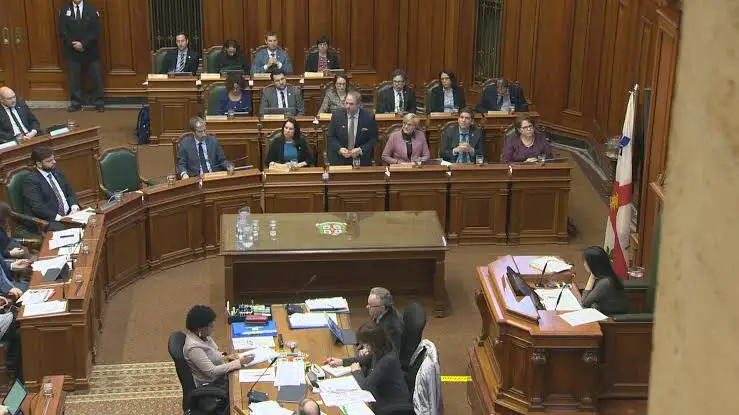
Montreal City Council overwhelmingly adopted an amended motion expressing solidarity with the Palestinian people Monday night, following a lengthy debate that saw Mayor Soraya Martinez Ferrada’s Ensemble Montréal administration remove some of the most controversial elements of the original Projet Montréal motion while leaving many of its accusations against Israel intact.
The amended motion passed by a vote of 54-6. Earlier in the evening, councillors voted 38-22 in favour of a series of amendments put forward by the mayor’s administration. Both votes were conducted by a show of hands, with the votes counted but individual councillors not identified as voting for or against either the amendments or the final motion.
The motion was brought forward by Projet Montréal councillors Nathalie Goulet, Ericka Alneus and Alex Norris. Goulet, who represents Ahuntsic, formally moved the motion, while Alneus, leader of the Official Opposition and councillor for Étienne-Desmarteau, and Norris, councillor for Jeanne-Mance, seconded it. The initiative had originally been introduced in June before being pushed to the August council meeting.
The original Projet Montréal motion called on Montreal to recognize and denounce what it described as an “apartheid regime” imposed on Palestinians and a “genocide” being committed against them. It also called on the City to suspend its institutional relationships with the Israeli government, Israeli institutions and Israeli municipalities until Israel returned to what the motion described as internationally recognized borders and ended violations of Palestinian rights and international law.
The proposal generated considerable controversy before Monday’s meeting. Pro-Palestinian organizations supported the motion, arguing that Montreal had taken positions on international issues in the past, including South African apartheid and Russia’s invasion of Ukraine. Jewish organizations opposed it, arguing that Projet Montréal was attempting to turn municipal council into a foreign-policy body while bringing an already divisive international conflict into Montreal City Hall.
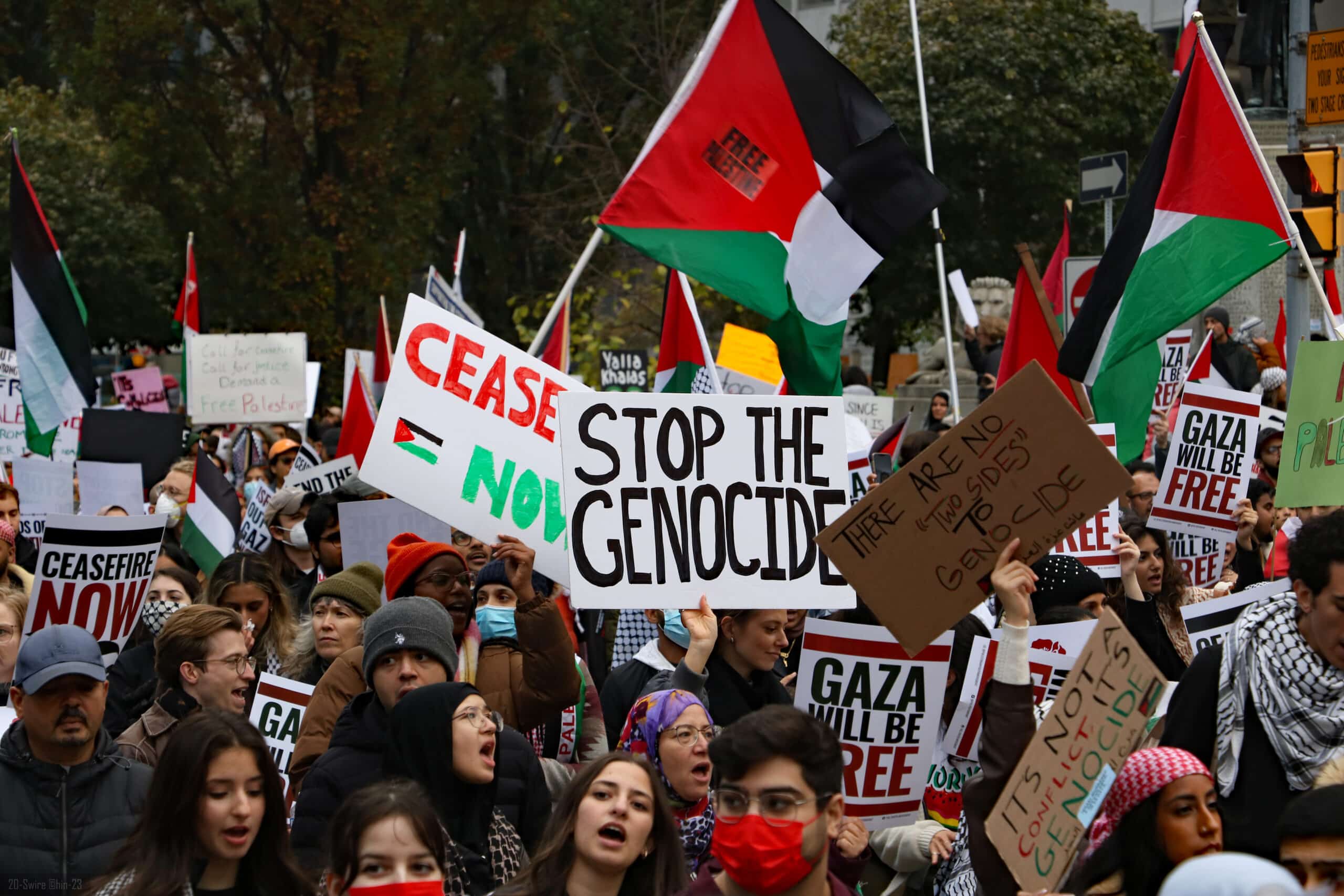
At least 70 pro-Palestinian demonstrators gathered outside City Hall ahead of the meeting demanding that Martinez Ferrada support the original motion. “Israël terroriste, Soraya complice!” or “Israel terrorist, Soraya accomplice,” demonstrators chanted outside the building.
Martinez Ferrada had already made clear that she opposed the original proposal and questioned whether Montreal City Council should be dealing with foreign policy. “It is not the role of the City of Montreal to dictate the government’s foreign policy,” she told reporters before the meeting.
She returned to the subject during the council debate. “Our fundamental disagreement remains,” Martinez Ferrada said. “I do not believe that city council should become the place where international conflicts are brought. That is not our responsibility.”
The mayor said her administration had worked on “significant amendments” intended to “protect the role of the institution” while allowing council to express concern about the humanitarian situation. Ensemble Montréal then presented amendments that removed the demand that Montreal suspend its institutional relationships with the Israeli government, Israeli institutions and Israeli municipalities. The amendments also removed the operative clause calling on Montreal itself to recognize and denounce “apartheid” and “genocide.”
Projet Montréal opposed the amendments, which passed 38-22. Once the amendments were adopted, Projet Montréal supported the rewritten motion and the final version passed 54-6.
Alneus later called passage of the motion a “historic gesture,” but was critical of the changes made by Ensemble Montréal. “I will not hide my disappointment at the significant modifications imposed by the administration, which we voted against and which considerably diluted our intention,” she said.
The final motion no longer has Montreal declaring that Israel is committing genocide, but the word and allegation remain in the document. It cites the September 2025 report of the United Nations Independent International Commission of Inquiry on the Occupied Palestinian Territory, which concluded that Israel was committing genocide against Palestinians in Gaza.
The International Court of Justice has not ruled that Israel committed genocide. The genocide conclusion cited in Montreal’s motion comes from the UN Commission of Inquiry. The motion separately refers to the proceedings before the ICJ concerning the application and interpretation of the Convention on the Prevention and Punishment of the Crime of Genocide.
Projet Montréal’s original motion would have had Montreal itself recognize and denounce genocide. Under the amended version, the City instead supports the work of international judicial bodies and organizations examining allegations of violations of international law in Gaza, including the ICJ proceedings.
The same changes were made to the apartheid language. Projet Montréal wanted Montreal to recognize and denounce what it called an apartheid regime. That declaration was removed, although the final motion retains a paragraph recalling Montreal’s opposition to South African apartheid in 1989 and the City’s welcoming of Nelson Mandela four months after his release from prison.
The final motion also cites the International Court of Justice’s July 2024 advisory opinion concerning Israel’s presence in the occupied Palestinian territories. The amended version says the Court recognized that Israeli policies and practices in the occupied Palestinian territories constitute an unlawful practice and that Israel is obligated to end its unlawful presence there as rapidly as possible.
The document notes that Israeli Prime Minister Benjamin Netanyahu is the subject of an International Criminal Court arrest warrant for alleged war crimes and crimes against humanity and says Prime Minister Mark Carney has affirmed that Canada would comply with its obligations arising from the warrant. Netanyahu has not been tried or convicted by the ICC.
The motion also cites Canadian sanctions against individuals and entities accused of facilitating or supporting extremist settler violence against Palestinian civilians in the West Bank and East Jerusalem, Canada’s opposition to settlement expansion and the interception by Israeli forces of humanitarian-aid vessels bound for Gaza in May 2026. It notes that civilians aboard the vessels included Canadian and Montreal residents and references the Canadian government’s criticism of their treatment.
Ensemble Montréal added language dealing with Hamas and the October 7, 2023 terrorist attack against Israel. The final text explicitly identifies Hamas as a terrorist organization recognized by the Government of Canada and states that Montreal unequivocally condemns terrorism, hostage-taking and violence against civilian populations. It also expresses compassion for all civilian victims of conflicts in the region and solidarity with Montrealers whose loved ones, families and communities are affected by conflicts in Palestine, Israel, Lebanon, Iran and elsewhere.
The motion provides little context about the years before October 7. There is no mention of the thousands of rockets and missiles fired toward Israeli civilian communities following Israel’s unilateral withdrawal from Gaza in 2005, Hamas’s seizure of control of Gaza or its subsequent rule of the territory. October 7 is condemned before the motion moves on to the conduct of Israel and the international allegations against it.
Ensemble Montréal also strengthened language concerning Montreal’s Jewish community and people of Israeli origin. The final motion states that Jewish communities and people of Israeli origin cannot be held responsible for actions of the State of Israel and acknowledges a troubling rise in antisemitism. It declares that antisemitism, Islamophobia, racism, discrimination, hate speech, intimidation and violence have no place in Montreal and affirms freedom of religion, freedom of expression, respect for diversity of opinion and everyone’s right to live safely.
Montreal’s Jewish community has faced a series of attacks since October 7. Jewish schools have been shot at, synagogues and other Jewish institutions have been attacked or vandalized and demonstrations have taken place outside Jewish institutions and in heavily Jewish areas of the city. Jewish community organizations have repeatedly raised concerns about harassment, intimidation and attacks directed at Jews in Montreal.
Members of Montreal’s Jewish community attended Monday’s meeting and used the public question period to object to the motion. Jewish organizations had also publicly opposed it before the vote. B’nai Brith Canada called on council to reject the original proposal, describing it as divisive and one-sided and arguing that international affairs were outside the proper role of municipal government.
The Centre for Israel and Jewish Affairs also opposed the original motion, arguing that Montreal City Council should focus on local issues rather than bringing the Israeli-Palestinian conflict into municipal politics.
Projet Montréal councillors defended the motion by pointing to positions Montreal has taken on international issues in the past. Goulet argued during the debate that events taking place outside Canada still affect people living in Montreal and that the City had a responsibility to speak about civilian suffering and human rights. Norris pointed to Montreal’s response to Russia’s invasion of Ukraine and argued that the City could not condemn violations committed by Russia while refusing to address allegations made against Israel.
Montreal formally opposed South African apartheid in 1989 and welcomed Nelson Mandela the following year. The City also took a public position following Russia’s invasion of Ukraine, including raising the Ukrainian flag and excluding Russian diplomats from some municipal events.
Montreal City Council is responsible for housing, roads, infrastructure, policing, public transit, economic development, parks, municipal taxation and other local services. Foreign policy, international sanctions and Canada’s relationships with foreign governments are responsibilities of the federal government.
The original Projet Montréal motion nevertheless asked councillors to recognize genocide and apartheid and suspend Montreal’s institutional relationships with Israel. Ensemble Montréal removed those provisions, but the amended motion still asks the governments of Canada and Quebec to demonstrate stronger leadership toward a peaceful resolution through diplomatic mechanisms, respect for international law and sanctions against parties and individuals responsible for serious violations of international humanitarian law and human rights.
The final motion also specifically declares Montreal’s “solidarity with the Palestinian people.” Israelis are included among civilian victims, Montrealers of Israeli origin are protected against collective blame and the rise in antisemitism is recognized. The motion does not contain an equivalent declaration of solidarity with the Israeli people.
The motion’s title similarly refers to Montreal’s “Solidarity with the Palestinian People and Civilian Victims of the Conflict in West Asia, Commonly Called the Middle East.” It lists conflicts affecting Palestine, Iran, Israel, Lebanon, Qatar, Syria and Yemen and recognizes that people from those communities live and work in Montreal.
The two votes Monday night showed the difference between what Projet Montréal wanted and what council was prepared to adopt. Ensemble Montréal’s amendments passed 38-22. The final amended motion passed 54-6. Because both votes were conducted by a show of hands and individual councillors were not named, the identities of the six councillors who opposed the final motion were not established during the meeting.
Montreal did not ultimately declare Israel guilty of genocide or apartheid and did not suspend institutional relationships with the Israeli government, Israeli institutions or Israeli municipalities. Those provisions disappeared with the Ensemble Montréal amendments.
The motion council adopted nevertheless cites the UN commission’s genocide conclusion, Montreal’s history of opposing South African apartheid, Netanyahu’s ICC arrest warrant, Israeli settlement activity and the interception of Gaza-bound vessels. It asks senior governments to consider sanctions against parties and individuals responsible for serious violations of international law while condemning Hamas as a terrorist organization, recognizing Israeli civilian victims, acknowledging rising antisemitism and saying Jews and Israelis cannot be held responsible for the actions of the Israeli government.
At the beginning of the debate on the motion, Martinez Ferrada told council that she did not believe City Hall should become a place where international conflicts are brought and said that doing so was not Montreal’s responsibility. By the end of the debate, City Council had spent a considerable amount of time talking about genocide allegations, international courts, Israeli settlements, Palestinian statehood, sanctions and the conduct of the war, and passing an ammendment and a resolution about it.


Leave a Reply