
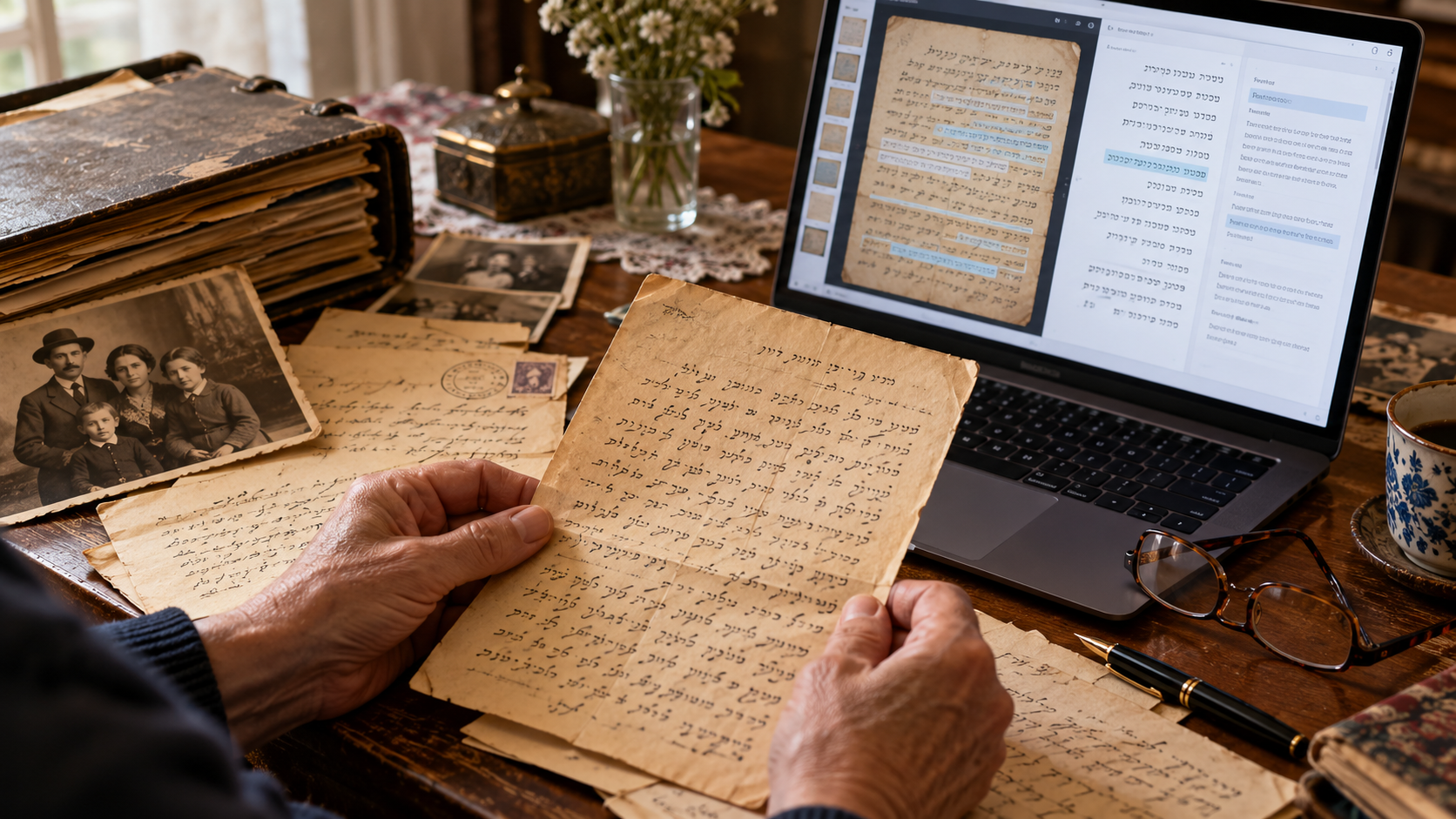
At a family reunion in California in 2013, Felicita Trueblood was handed a binder containing about 50 pages of old letters. They had been written between 1927 and 1934 by her great grandfather, Rabbi Pavel Malisoff, who lived in Konotop, Ukraine, then part of the Soviet Union. The letters had survived. The problem was that almost a century later, nobody in the family could read them.
Malisoff had written the letters in Yiddish, using Hebrew characters, to his son Solomon, who had left the Soviet Union for the United States and eventually changed his surname to Malis. They sat for decades in the home of one of Trueblood’s cousins in Palm Springs before appearing at the family reunion. Trueblood took responsibility for them, but quickly discovered that possessing a piece of family history and being able to understand it are two very different things. There were translators who could read handwritten Yiddish, but there were not many of them, and translating the entire collection would have been expensive.
Thirteen years later, a Facebook post led her to Vilnius, Lithuania, where researcher Sergii Gurbych had been working on a problem that probably exists in thousands of Jewish homes. Families have old letters, diaries, photographs with writing on the back, synagogue records and documents that survived immigration, war and the Holocaust, while the people capable of reading them slowly disappeared.
Gurbych, a researcher at Vilnius University’s Center for the Study of East European Jewish History, developed an artificial intelligence model specifically designed to recognize handwritten Yiddish. Ordinary optical character recognition can handle clean printed text reasonably well, but handwriting is another problem entirely. It changes from person to person, country to country and generation to generation. A Polish Jew writing Yiddish in the 1930s did not necessarily form letters the same way as a Lithuanian Jew, and neither necessarily wrote like someone living in New York.
To teach the computer, Gurbych used Jewish autobiographies from the 1930s, many of them submitted to YIVO from across Eastern and Central Europe. Some of the manuscripts had been sitting in the National Library of Lithuania and had never even been digitized. Pages of handwriting were paired with accurate transcriptions, giving the computer enough examples to begin recognizing patterns that are difficult even for people who know Yiddish.
The resulting Vilne Yiddish model has achieved around 95 per cent accuracy on material similar to what it was trained on. That still means approximately one mistake every 20 characters, and Gurbych is very clear that a human being still has to check the work. Different handwriting can also cause the accuracy to drop considerably. This is not a machine where somebody dumps grandma’s 1912 shopping list into one end and gets a perfect English translation five seconds later.
The university has since built the technology into a service called VILNISH, which works with historical handwritten and printed Yiddish and Hebrew material and can also assist with translation into English or Lithuanian. It is being offered not only to researchers and archives, but to ordinary people trying to work out what their grandparents and great grandparents left behind.
Trueblood contacted Gurbych in May. Within about a month, the letters her family had been unable to read for decades had been processed and translated. Suddenly Rabbi Malisoff was no longer simply a name attached to a stack of aging paper. He was talking again.
His letters described a Jewish world being slowly crushed under Stalin. Malisoff wrote of terrible poverty in Konotop, of people hungry, poorly clothed and without work, and of Jewish religious life disappearing around him. Shabbos observance, holidays, kosher food, circumcision and Jewish education were vanishing. His own family was breaking apart geographically as his 11 children moved elsewhere in the Soviet Union or left for Canada and the United States.
The letters also corrected a piece of family history. Trueblood’s relatives had long believed that Malisoff died after being tortured by Soviet authorities because he had received small amounts of money from relatives in California. His letters stopped in 1934, apparently reinforcing that version of what happened. But correspondence written afterward by his wife and children revealed that Malisoff had actually died of a heart attack at 74 and had received a proper memorial service.
For Trueblood, there was another layer to the discovery. She had grown up in San Diego largely disconnected from Jewish life. Her mother, Malisoff’s granddaughter, became a Christian Scientist and married a non Jewish man. A few generations after a rabbi in Ukraine was writing about the disappearance of Jewish religious life around him, his great granddaughter was living in California unable to read the language in which he had recorded it.
There is a strange irony in a computer being responsible for reconnecting those generations. Yiddish did not disappear from many Jewish families because the documents disappeared. In many cases the letters are still there, carefully stored in boxes and binders, passed from parent to child by people who knew they were important even after nobody remembered exactly what they said.
Gurbych’s computer cannot replace the people who once spoke the language. In Trueblood’s case, he did more than run pages through a machine. His knowledge of Jewish history and religion allowed him to explain biblical references, religious language and historical details that the computer alone could not provide. The artificial intelligence cracked open the door, but somebody still had to understand what was on the other side.
There are probably millions of pages like Malisoff’s scattered through Jewish homes and archives around the world, written by people who never imagined that their own descendants would one day stare at their handwriting and see a foreign language. Some contain ordinary family gossip, recipes, arguments and requests for money. Others may contain eyewitness accounts of Jewish communities that no longer exist.
For almost a century, Rabbi Pavel Malisoff’s letters waited in silence because the people who inherited them could no longer understand his words. Then a computer in Vilnius learned how to read his handwriting, and his great granddaughter finally heard from him.



Leave a Reply