
For years, Winnipeg’s Jewish population was said to be around 16,000. The number appeared regularly in community discussions and was repeated by Jewish leaders. There was just one problem. According to the latest available census figures, Winnipeg’s Jewish population was actually closer to 14,000.
On October 27, Bernie Bellan, editor of the Jewish Post and News, reported that the Jewish Federation of Winnipeg had presented a population figure of 13,940, based on the 2021 Canadian census. The number was disclosed during an October 22 presentation by Sharon Graham, the federation’s Community Planning and Allocations Lead.
Bellan, who has been challenging Winnipeg’s Jewish population estimates for years, also pointed to another discrepancy: In 2022, the federation’s former Chief Planning and Allocations Officer, Faye Rosenberg Cohen, had suggested that immigrants accounted for approximately one-third of Winnipeg’s Jewish community. Graham’s figures put that proportion at slightly less than one-fifth.
Perhaps more interesting was what Graham’s presentation revealed about the number of Jews leaving Winnipeg. Although the federation had promoted its success in attracting newcomers, the figures also showed considerable outward migration. Bringing Jews to Winnipeg was one thing. Keeping them there was another.
The population discrepancy was not exactly new information. As far back as December 2014, the Winnipeg Jewish Review had reported that the federation revised its Jewish population estimate from 16,000 to 13,690 following the 2011 National Household Survey.
The federation’s own 2023 demographic information subsequently placed Manitoba’s Jewish population at 14,805, including 910 living outside Winnipeg. That would leave approximately 13,895 in the city, yet somehow, the older figure of 16,000 continued to circulate.
The Winnipeg story prompted Montreal Jewish News to examine population figures across Canada, comparing Statistics Canada’s census data with numbers published by Jewish federations and other communal organizations. The results were interesting, although not always in the direction one might expect.
According to the 2021 Canadian census, 335,295 Canadians identified their religion as Jewish. When those who reported no religion but identified ethnically as Jewish are included, the number rises to 404,015. That puts Canada’s Jewish population at approximately 1.1% of the country’s total population.
The broader figure is generally accepted by Canadian Jewish federations and demographers. It is also the figure used by University of Toronto sociologist Robert Brym in his study, Canadian Jewish Population, 2023, published in the American Jewish Year Book.
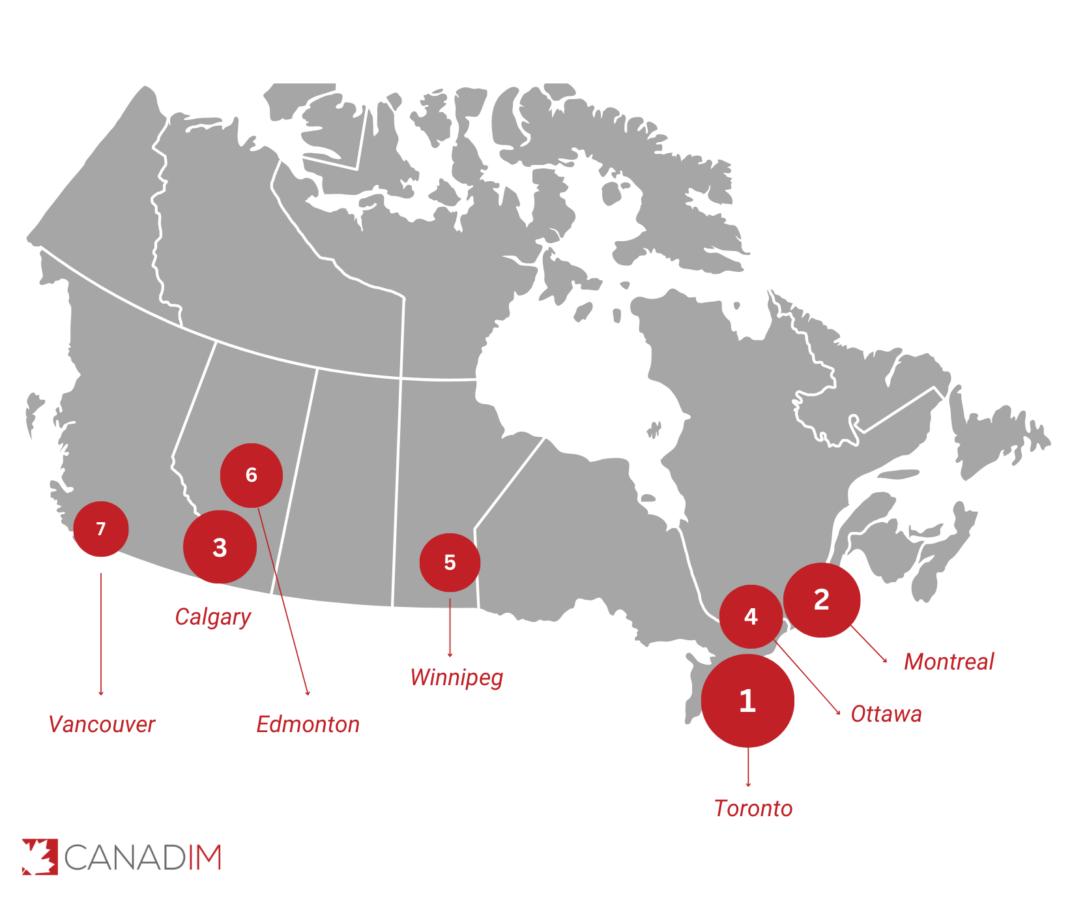
Brym’s research provides a breakdown of Jewish populations in metropolitan areas across Canada:
| Metropolitan area | Jewish by religion | Total Jewish population |
| Toronto | 165,765 | 186,900 |
| Montreal | 82,080 | 90,254 |
| Vancouver | 20,120 | 28,030 |
| Ottawa–Gatineau | 11,400 | 14,950 |
| Winnipeg | 11,170 | 13,945 |
| Calgary | 6,700 | 9,290 |
| Edmonton | 3,820 | 5,690 |
| Hamilton | 3,880 | 5,315 |
| Victoria | 2,740 | 4,385 |
| London, Ontario | 2,080 | 2,765 |
| Halifax | 1,775 | 2,735 |
Toronto and Montreal account for almost 69% of Canada’s Jewish population, while approximately 83% live in the country’s five largest Jewish metropolitan communities. Winnipeg, historically one of Canada’s major Jewish centres, has slipped to fifth place, behind Vancouver and Ottawa–Gatineau.
There is, however, a difference between a community losing its national ranking and actually losing population. Under Brym’s consistent demographic definition, Winnipeg’s Jewish population increased slightly between 2011 and 2021. The problem with the old 16,000 figure was that it did not correspond to the population subsequently established through census-based research.
Nationally, Canada’s Jewish population grew by approximately 4.8% between 2011 and 2021, from 385,345 to 404,015. That is modest growth over a decade, particularly compared with the increase in Canada’s overall population.
The figures published by Jewish federations are not uniformly exaggerated. Montreal’s Federation CJA, for example, uses a Jewish population of approximately 90,250, virtually identical to the census-derived figure of 90,254. Ottawa’s federation describes a community of approximately 15,000, compared with the census-derived 14,950. Edmonton’s federation has cited 5,690, exactly matching the corresponding figure in Brym’s study.
In British Columbia, the Jewish Federation reports approximately 40,000 Jews throughout the province, compared with 40,530 in the 2021 census analysis. That provincial total should not be confused with Vancouver’s metropolitan Jewish population of 28,030.
Other organizations are using lower figures. Calgary’s Jewish Federation describes its community as approximately 8,500, although the census-derived metropolitan population is 9,290.
The Atlantic Jewish Council has described the Jewish population of Atlantic Canada as approximately 4,000 to 5,000. The 2021 census-derived population of the four Atlantic provinces was approximately 6,000. The council’s estimate appears to be older, making it difficult to determine whether the difference reflects population growth or an earlier undercount.
Toronto presents a more substantial discrepancy. In June 2026, The Epoch Times, reporting on UJA Federation of Greater Toronto’s annual Walk with Israel, attributed to UJA a population estimate of approximately 220,000 Jews living in the Greater Toronto Area and surrounding communities. The census-derived Jewish population of metropolitan Toronto in 2021 was 186,900, approximately 33,100 fewer.
The figures are from different years, and the federation’s reported estimate includes surrounding communities whose boundaries were not specified in the report. Toronto has also experienced Jewish immigration since the census, including arrivals from Israel following October 7, 2023. Still, a difference of more than 33,000 is substantial. To establish whether it represents actual growth, a larger geographic area or a different population definition, UJA would need to provide the methodology behind the 220,000 estimate.
What becomes apparent from examining these figures is that Canadian Jewish organizations are not necessarily working with the same definitions, geographic boundaries or even census years. A number can remain in circulation long after the research behind it has become outdated.
There is another complication, one that can change a population estimate by tens of thousands. Statistics Canada asks respondents about both their religion and their ethnic or cultural origins. Someone who identifies as Jewish religiously is relatively straightforward to count. Someone who identifies as ethnically Jewish but has no religion is included under the standard Jewish population definition. A person who reports Jewish ancestry but identifies with another religion is generally excluded.
Using the first two categories gives Canada 404,015 Jews. Brym’s broader analysis, which also includes people with Jewish ethnic or cultural identification who belong to another religion, produces an extended population estimate of approximately 456,000. Those are considerably different numbers, drawn from the same census. This is especially significant in communities such as Vancouver, Edmonton and Victoria, where a relatively large proportion of those included in the standard Jewish population count reported no religion.
None of this tells us how many people belong to synagogues, send their children to Jewish schools, support Jewish charities or participate in organized Jewish life. Edmonton’s Jewish Federation acknowledged in a 2023 publication that it estimated only about one-quarter of the city’s Jewish population was affiliated with a synagogue.
There is nothing inherently wrong with a federation including unaffiliated Jews in its demographic estimates. A Jewish person does not cease being Jewish because he or she does not belong to a synagogue or make a donation to Federation. It does, however, mean that the population an organization says it serves and the population actively involved in its institutions may be quite different.
Other research, including the 2018 Survey of Jews in Canada and the 2026 Canadian Jewish Barometer, provides information about Jewish identity, religious practice, community involvement and attitudes. These surveys are useful for understanding the population, but they are not substitutes for a census and cannot independently establish how many Jews live in each Canadian city.
In Montreal, the overall number is relatively straightforward. Federation CJA’s analysis of the 2021 census puts the Jewish population at approximately 90,250, an increase of just 580 people since 2011. That was the first population increase recorded in Montreal’s Jewish community since the 1971 census, following four decades of decline. It was also an increase of only 0.6% over ten years.
The more interesting figures concern where Montreal’s Jews live and how the community is changing.
Between 2011 and 2021, Côte Saint-Luc lost approximately 930 Jewish residents, Hampstead lost 890, Snowdon lost 1,180 and Ville Saint-Laurent lost 1,330. Outremont, meanwhile, gained approximately 1,560 Jewish residents, while the Park Avenue and Park Extension area gained another 500. Smaller Jewish populations elsewhere in the Montreal metropolitan area recorded substantial growth.
Federation CJA’s January 2025 presentation also reported that Montreal’s ultra-Orthodox population had grown by approximately 4%, while the mainstream Jewish population had declined by 4%.
Age is another important factor. Nearly one-quarter of Montreal’s Jews were 65 or older in 2021, compared with 16.7% of the general Montreal population. In Côte Saint-Luc, more than one-third of Jewish residents were seniors. At the other end of the spectrum, Montreal’s youngest Jewish populations are heavily concentrated in ultra-Orthodox neighbourhoods. According to the federation’s demographic study, the median age of the Tosh Hasidic community in Boisbriand was just 14.7 years, while Outremont’s Jewish population had a median age of 17.6. Compare that with Chomedey Laval, where the median age of the Jewish population was 64.5.
These communities have very different needs. One requires additional classrooms, teachers and facilities for rapidly growing families. Another may require expanded senior services, transportation and assisted living.
The overall population of 90,250 tells us very little about those differences.
Montreal is also home to a sizeable Sephardic population. Federation CJA counted approximately 23,065 Sephardim, representing just over one-quarter of the city’s Jewish population. That community has its own geographic concentrations, linguistic characteristics and institutional needs.
The numbers suggest that Montreal’s Jewish community is not so much disappearing as changing, with population growth and decline occurring simultaneously in different neighbourhoods and religious groups. Whether the organized community’s institutions, spending priorities and representation have kept pace with those changes is a separate matter.
Our examination found considerable differences in how Jewish federations report their populations. Some use figures that closely match the census, while others publish estimates that are higher, lower or difficult to reconcile with the available data. The question is how often those figures are reviewed, and whether anyone bothers to challenge them.
The next opportunity to examine the numbers will come in October 2027, when Statistics Canada releases the religious and ethnocultural results of the 2026 census. Until then, newer population figures remain estimates.
Winnipeg didn’t lose 2,000 Jews. It lost a number that should have been retired years ago. The troubling part isn’t the discrepancy itself, but how easily a questionable figure became an accepted fact. One has to wonder how many other numbers in Canadian Jewish communal life would survive a serious examination.


Leave a Reply