
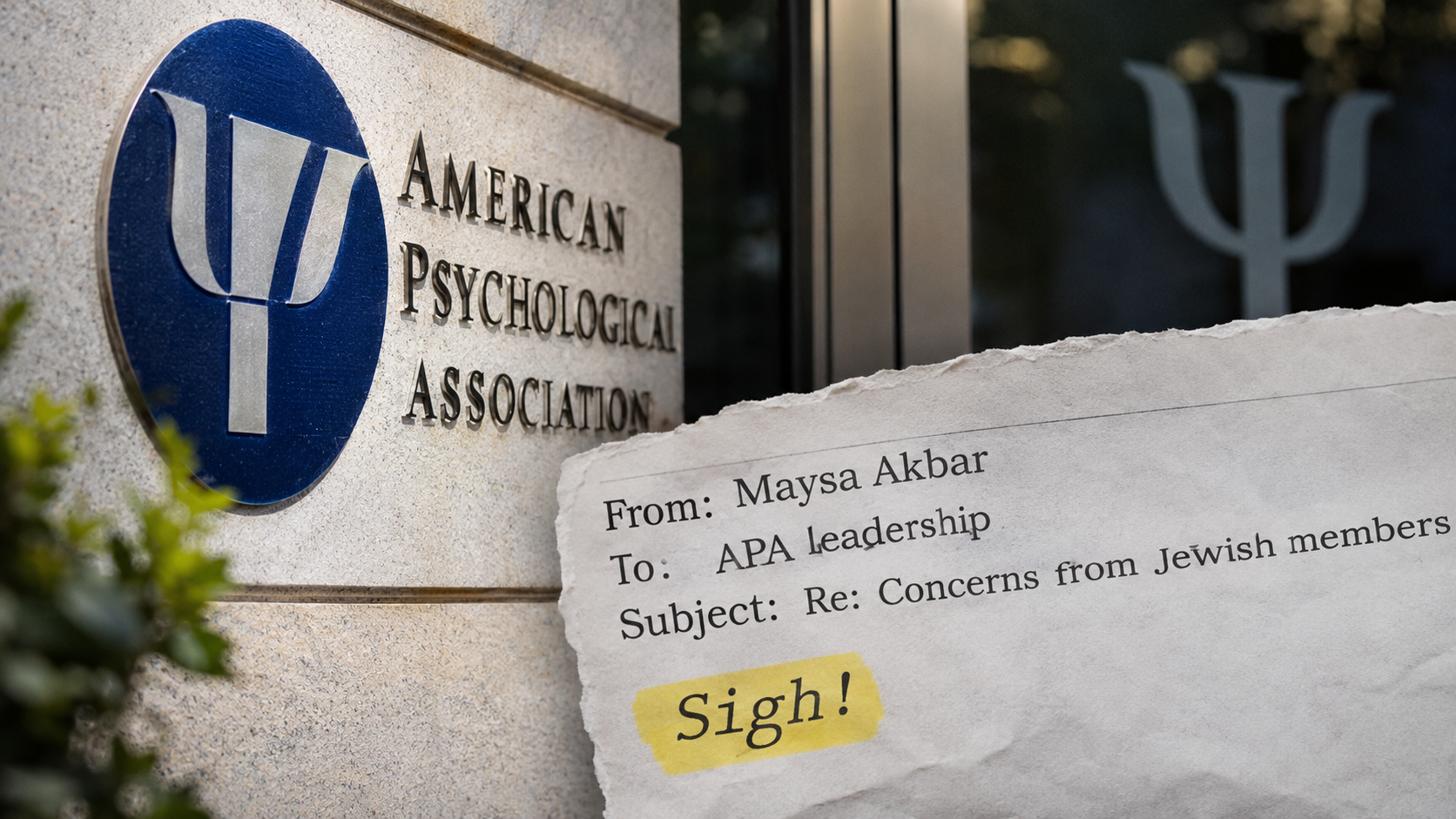
When Jewish psychologists complained about hostility toward Jews within the American Psychological Association, one of the organization’s senior diversity officials responded with a single word: “Sigh!”
That response, written by then chief diversity officer Maysa Akbar in June 2025, is among the internal communications uncovered in a 24-page congressional investigation released on October 29. The investigation, conducted by Republican majority staff of the U.S. House Committee on Education and Workforce, documents allegations of widespread anti-Jewish hostility within one of America’s most influential professional organizations, including efforts to minimize the October 7 Hamas massacre, resistance to recognizing Jewish psychologists as an ethnic minority and the publication of politically charged material in professional journals.
The American Psychological Association, commonly known as the APA, represents approximately 190,000 members, publishes more than 90 scientific journals and helps establish professional and ethical standards for psychologists. Its accreditation commission oversees more than 1,300 psychology training programs throughout the United States. The organization is now facing a congressional investigation, a separate federal civil rights investigation and a recommendation that its accreditation commission lose federal recognition for one year.
The problems documented in the congressional report go back to the immediate aftermath of October 7, 2023, when Hamas terrorists invaded Israel and murdered approximately 1,200 people. As the APA prepared its official response, its leadership consulted the American Arab, Middle Eastern and North African Psychological Association, known as AMENA-Psy. According to internal correspondence obtained by congressional investigators, representatives of that organization objected to describing the Hamas massacre as terrorism and urged the APA to include Palestinian suffering to balance its statement about Israel.
The APA eventually issued a statement on October 11 condemning the Hamas attack and expressing concern for civilians on both sides. However, the word terrorism was conspicuously absent. Internal drafts examined by investigators also showed discussions about equating the Hamas massacre with Israel’s military response. The congressional report states that the APA subsequently continued consulting AMENA-Psy on matters involving hostility toward Jews, even identifying the organization internally as a stakeholder on the subject.
One day after the APA released its statement, Cynthia de las Fuentes, who would become the association’s president in 2024, sent an internal email comparing Palestinians in Gaza to George Floyd, the Black man murdered by a Minneapolis police officer in 2020. She wrote that “George Floyd is representative of Gazans” and compared police conduct with what she described as the pursuit of Zionist objectives through methods similar to those employed by terrorist organizations. The email, reproduced in the congressional report, was part of an internal discussion about the APA’s response to the massacre.
The congressional investigation also uncovered internal correspondence showing how senior officials reacted when Jewish psychologists raised concerns about their treatment within the association. In addition to Akbar’s dismissive response, the report describes an exchange involving Kim Mills, then the APA’s senior director of strategic communications and public affairs, who complained about “the Jews who are so angry at us” following criticism of the association by the medical advocacy group Do No Harm.
The investigation found that the APA also declined to respond to a questionnaire from the Anti-Defamation League concerning its treatment of Jewish members. According to the report, Mills dismissed the questionnaire as an effort to find fault with the association. A letter from Democratic Congressman Ritchie Torres expressing concern about hostility toward Jews received a similarly dismissive internal reaction from a former APA president.
Perhaps one of the more extraordinary incidents involved a request from the Biden White House in 2024. Officials were seeking recommendations for trauma specialists who could be available during a screening of Screams Before Silence, a documentary examining the sexual violence committed by Hamas terrorists during the October 7 attacks. Rather than simply recommending psychologists with the appropriate expertise, internal APA correspondence shows officials worrying that participation could involve the association in the politics surrounding the documentary. One official suggested passing the request to the District of Columbia Psychological Association instead.
The controversy has extended into the APA’s own definition of who qualifies as an ethnic minority. The Association of Jewish Psychologists has been seeking formal recognition as an Ethnic Psychological Association, which would provide representation alongside other recognized minority psychology organizations. According to the congressional investigation, several existing associations and APA committees opposed the application, with some arguing that Jews benefit from white privilege and therefore should not receive the same recognition as other minority groups.
One opponent described the Jewish association’s application as rooted in anti-Black thinking. A representative of the Society of Indian Psychologists argued that Jews did not meet its understanding of a disadvantaged ethnic minority, while the APA’s Committee on Ethnic Minority Affairs argued that recognizing Jewish psychologists without taking stronger action concerning Palestinians could undermine solidarity among minority groups.
The debate even brought Sigmund Freud into the controversy. According to the report, one APA body questioned the reliance on the contributions of Freud and psychologist Albert Ellis, suggesting their work might reflect racial, economic and male privilege. Freud, the Jewish founder of psychoanalysis, fled Nazi-controlled Austria in 1938. Four of his sisters were murdered in the Holocaust.
The APA’s own voting records confirm that the Jewish association’s application remains unresolved. In February 2026, the APA Council of Representatives voted 137 to 17 to postpone a decision. In June, the organization’s Board of Directors endorsed the application, but when the matter returned to the council in August, members voted 108 to 53, with three abstentions, to refer it to another task force rather than grant recognition.
The dispute over Jewish representation has taken place alongside changes to the APA’s official policies concerning Jew hatred. In February 2026, the organization’s council voted 127 to 37 to replace its 2007 resolution on anti-Jewish prejudice with a new policy. Congressional investigators say the revised resolution weakened existing protections and included language about accusations of Jew hatred being used to suppress political expression. The APA maintains that its new policy strengthens protections for Jewish members, although the congressional report states that the Collaborative of Jewish Psychologists, an advisory group established by the association itself, did not approve the final resolution.
The investigation also examined the APA’s scientific publications, where the controversy has moved beyond internal political disagreements and into questions about academic standards. A 2025 article published in American Psychologist, the organization’s flagship scientific journal, introduced a concept described as Zionist psychologies while arguing that certain psychological approaches support Israel’s existence as a colonial project.
According to correspondence cited in the congressional report, when the journal’s editor in chief asked co-author Devin Atallah for references supporting that concept, Atallah replied that he did not have references to provide. He subsequently suggested that the editor educate himself about opposition to Zionism.
The article prompted criticism from within the journal’s editorial ranks. An editor working on a separate special issue dealing with prejudice against Jews resigned, arguing that the publication had accepted politically charged material lacking appropriate scholarly support while imposing stricter standards on work addressing hostility toward Jewish people.
The report also describes APA affiliated professional mailing lists and conferences where members allegedly defended Hamas, questioned accounts of its intentions toward Jews and portrayed expressions of solidarity with Israel as potentially threatening to other participants. Congressional investigators identified examples of professional development programming that promoted strongly anti-Israel political positions, including sessions connected to the Boycott, Divestment and Sanctions movement. The APA’s approval of continuing education activities became another point of criticism.
The controversy has attracted federal attention beyond Congress. On June 2, 2026, the U.S. Department of Health and Human Services Office for Civil Rights opened an investigation following a complaint alleging discrimination against Jewish members. The APA confirmed the investigation in its own public communications. The Louis D. Brandeis Center for Human Rights Under Law, which has been representing Jewish psychologists raising concerns about the organization, welcomed the congressional findings and called for further action.
The cost of dealing with the investigations has become substantial. According to the APA’s own August 2026 council meeting records, members voted 157 to 4, with two abstentions, to authorize more than $3 million in unbudgeted legal fees and related expenses associated with federal investigations. The council also required quarterly reports on the expenditure. The vote authorized the spending; the records do not establish how much had actually been paid.
Meanwhile, the APA’s Commission on Accreditation faces a separate challenge to its federal standing. On September 24, the National Advisory Committee on Institutional Quality and Integrity recommended that the U.S. Department of Education suspend the commission’s federal recognition for 12 months. The recommendation followed concerns raised about the association, including its treatment of Jewish members, and was opposed by the APA, which argues that removing recognition could seriously disrupt psychology education and access to federal funding.
The recommendation is not a final decision, and the commission continues to operate as a federally recognized accrediting body while the Department of Education considers the matter. The APA notes that departmental staff had recommended renewing its recognition, putting that recommendation at odds with the advisory committee’s subsequent vote.
APA President Wendi Williams and CEO Arthur Evans Jr. rejected the congressional report in an October 29 letter to members. The association says it has conducted listening sessions with more than 120 Jewish psychologists and stakeholders, established a Collaborative of Jewish Psychologists and introduced reforms intended to strengthen oversight of its professional divisions. In June, the organization acknowledged that its 54 divisions operate with considerable independence and that this arrangement had created difficulties in addressing complaints about professional communications and programming.
Those reforms include stronger oversight of division activities, changes to professional discussion forums and additional procedures for addressing member complaints. The APA says it condemns Jew hatred and is committed to ensuring that Jewish psychologists can participate fully and safely in the profession.
Congressional investigators, however, have documented a series of internal exchanges extending across several years, involving senior leadership, professional committees, scientific publications and the treatment of Jewish members seeking recognition. The association’s response has included policy revisions, administrative reforms and the creation of advisory bodies, while the federal investigations remain active.
The next formal recommendation concerning recognition of the Association of Jewish Psychologists is scheduled for February 2027. By then, the APA will have spent another six months considering whether Jewish psychologists should receive the same formal ethnic association status already available to other recognized minority groups within the organization.







Leave a Reply