




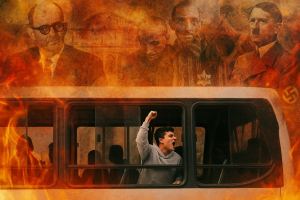
The video is short but devastating. A bus full of teenagers in Bariloche, celebrating their graduation trip, chanting “Hoy quemamos judíos.” Today we burn Jews. They are laughing, pounding on seats, enjoying themselves while calling for Jews to be burned. The adults in charge did not intervene. A coordinator from Baxtter, the company running the trip, was reported to have encouraged it. A parent sat close by and did nothing.
Escuela Humanos, the private school behind the group, scrambled once the video spread. They condemned the chant, tried to shift responsibility onto the tour operator. Baxtter issued its own apology, promised to dismiss the coordinator, and begged for forgiveness. President Javier Milei posted two words on social media, “Repudiable. Fin.” His Justice Minister filed a federal complaint. DAIA, the Jewish umbrella, is preparing legal action. Argentina’s consumer agency charged Baxtter and threatened fines in the billions of pesos. There are statements and threats of punishment, but none of them erase the sound of teenagers singing about burning Jews.
Jewish families from ORT Argentina, part of the same travel program, had to tell their children to conceal their Jewish symbols. One mother explained she forced her son to take off his Star of David necklace to avoid being singled out. That is what survival has come to mean for Jews in Argentina. Hide who you are and hope it is enough.
Argentina has lived with this for generations. After the war it opened its doors to Nazi fugitives. Adolf Eichmann, architect of the Final Solution, lived under the name Ricardo Klement in Buenos Aires until Mossad agents captured him in 1960. Josef Mengele, infamous for his experiments in Auschwitz, also slipped into the country and moved through its cities under false identities. Reinhard Kopps, a former SS officer, built his life in Bariloche, the same town where these students shouted about burning Jews. He admitted later that he helped other Nazis reach Argentina.
The most striking example came in 1994 when American journalist Sam Donaldson and an ABC News crew tracked down Erich Priebke, an SS officer who had participated in the massacre of 335 civilians at the Ardeatine Caves in Rome. Priebke had been living openly in Bariloche for decades. He walked the streets without fear, dined in public, and carried himself as if nothing had ever happened. Donaldson found him at a café, confronted him with cameras rolling, and Priebke calmly confirmed who he was and admitted what he had done. He showed no concern, no attempt to deny his past. It was only after that broadcast embarrassed Argentina internationally that authorities moved to arrest him. He was eventually extradited to Italy and convicted. Until that moment, he had been left alone, a war criminal living a quiet life in a tourist town.
The record did not improve in the 1990s. The bombing of the Israeli embassy in 1992 killed 29 and wounded hundreds. In 1994 the AMIA Jewish community center was blown apart, murdering 85. The investigations were contaminated by corruption and political interference. Prosecutor Alberto Nisman, who pushed too far and refused to bury the truth, was murdered in 2015. His body was found with a bullet to the head hours before he was scheduled to present evidence against Argentina’s leadership for covering up Iranian involvement in the AMIA attack. His death sent shockwaves through Argentina’s Jewish community and reinforced what many already knew: even those seeking justice could be silenced permanently. Only last year did an Argentine court officially declare the AMIA massacre a crime against humanity and acknowledge Iran and Hezbollah’s role. For the families of the murdered, it was another symbolic gesture without justice.
Antisemitic acts never stopped. Synagogues vandalized, cemeteries desecrated, Jewish students threatened. Reports documented a steep rise in 2023, much of it linked to imported hatred during the Gaza war. Each case is written off as isolated, but together they form a continuous pattern of danger.
So when a busload of high school students shouted about burning Jews, they were not inventing hatred. They were repeating lessons Argentina has offered for decades. Nazis were allowed to build new lives there. Bombers were never punished. Prosecutors were murdered. Jewish families learned to hide who they were. Children learned they could shout about killing Jews and nothing would happen to them.
For Jews in Montreal, watching this story feels personal. We know the conversations where you tell your children not to wear a kippa on the street, not to display a necklace with a Jewish star. We know how fast slogans turn into attacks. Argentina has failed its Jews again and again. The students on that bus are simply acting out what their country has taught them is possible. Their chant was not an aberration. It was Argentina showing the world what it has allowed to fester for generations.


Discover more from Montreal Jewish News
Subscribe to get the latest posts sent to your email.