





By Howie Silbiger
My whole life has been centered around media. I knew I wanted to work in radio from the time I was ten years old and I always believed that radio and television are the most important tools to get information to the masses on a large scale. Sure, the internet has taken over much of that role, but until recently I never realized how dead Montreal’s English media really is.
I’ll admit that I am not a great media watcher. I sometimes catch a local newscast and almost never watch the national one. I guess that makes me part of the problem. I stopped watching regularly when I started noticing holes in the reporting. Bias, selective storytelling, and sloppy production turned me off. The credibility that once defined Montreal’s English media is gone.
Recently, I tuned into the local broadcast and was shocked to see an anchor sitting in a cramped studio that looked like a basement bunker. Poor lighting, bare walls, and minimal energy. I remember when the six o’clock and eleven-thirty news were events. Reporters in the field, polished anchors, and proper studios. Those days are long gone. Now we get recycled stories, anchors squinting at teleprompters, and webcam interviews that look like they were shot on a teenager’s laptop.
When the municipal election ended, I wanted to watch the results on television. I’ve always loved seeing the tickers, hearing analysis, and watching the newsroom react as the numbers come in. Instead, every English station aired pre-recorded programming. The only exception was CTV News, which was showing a football game. Meanwhile, three French stations had full live coverage with reporters at every campaign headquarters.
CTV handed its English coverage to CJAD Radio. Once upon a time, CJAD was the gold standard of Montreal news. It was professional, fast, and well staffed. On election night, it was one host, Elias Makos, sitting with two analysts and very little else. They had no proper newsroom and no citywide presence. The once mighty English news station had to borrow reporters from The Suburban Newspaper just to fill the gaps. That is how far we have fallen. A station that used to dominate the city now relies on print journalists to help it survive one of the most important nights in civic life.
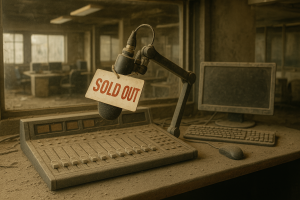
And then there’s CFQR 600 AM. When it was licensed, it was supposed to bring back English-language talk radio. It was meant to be the fresh, modern voice that would fill the void CJAD left when it shifted toward national filler and lifestyle chatter. CFQR went on air promising a blend of news, talk, and music that would reconnect Montreal’s English listeners to their city. To its credit, CFQR does have some live programming. A few hosts are on air daily, doing their best with limited resources and no major corporate backing. But most of the station is automated, with long stretches of pre-programmed content and little of the local engagement it was meant to deliver. The ambition was there, but the follow-through never came.
Between CJAD’s slow fade and CFQR’s struggle to live up to its promise, English Montreal is left with no full-service station that truly serves its audience. It is not just about entertainment; it is about relevance. When a community loses its media, it loses its mirror. It loses its voice.
So what happened? Is it a shrinking English-speaking population? Is it linguistic policy and decades of government pressure? Or is it major corporate owners who have decided that Montreal’s English market is not worth the investment? Whatever the reason, the result is clear. The once vibrant English media landscape of Montreal is now a hollow shell.
I grew up believing that radio and television could unite a city, inform its citizens, and hold power to account. I still believe that. But I now see how little remains of the English broadcast world that inspired me. Unless something changes, the silence will only grow louder. And for a community, silence is not neutrality. It is erasure.
That is why independent media has become so essential. True Talk Radio, True Rock Radio, and the Montreal Jewish News exist because mainstream English outlets abandoned their role. We do what they no longer do. We talk about what matters to the community, we ask the questions no one else will, and we do it without corporate filters. The legacy broadcasters might have the brand names, but we still have the voice.


Discover more from Montreal Jewish News
Subscribe to get the latest posts sent to your email.