


By Howie Silbiger
It is one thing to know that Argentina sheltered Nazi fugitives. It is another to watch it unfold, piece by piece, in government folders that were never meant to be widely seen. It took a forgotten basement in Buenos Aires to reveal, in black and red ink, what survivors have insisted for decades.
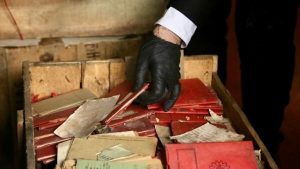
Buried under the Supreme Court of Argentina, sealed in wooden crates and left untouched for eighty years, officials have now uncovered Nazi notebooks, membership cards and propaganda that map out the fertile ground the Third Reich cultivated in South America. At the same time, Argentina has opened a separate digital vault of roughly eighteen hundred files on Nazi fugitives. Together, the paper and the pixels expose how one country welcomed men like Adolf Eichmann and Josef Mengele and then looked away as they lived comfortably after torturing and murdering millions during World War II.
The newly accessible files from the National Archives look like regular bureaucratic paperwork. They record, in dry detail, the postwar lives of former Nazis who settled in Argentina. Immigration forms. Intelligence reports. Internal correspondence about Adolf Eichmann, Erich Priebke and Josef Mengele, the Auschwitz doctor who used children as experimental subjects. For years these dossiers were theoretically declassified but effectively hidden, reachable only by researchers willing to travel to a special room in Buenos Aires and navigate an unhelpful bureaucracy. Now they are online, open to anyone with an internet connection and a stomach strong enough to read them.
What is striking is not the content of these files but the tone. They are numbingly ordinary. You scroll through them and realize that Josef Mengele, of all people, was processed with the same language used for any other postwar immigrant stepping off a ship.
His file starts in nineteen forty nine. The name on his documents is Helmut Gregor, a technician. The entry card is clean and typed, nothing unusual. Then, almost casually, later notes switch to his real name. No explanation. No concern. Someone simply stops writing “Gregor” and starts writing “Mengele” as if correcting a typo.
The rest of the record follows him the way a bureaucracy follows anyone else: references to his family’s machinery business, his stake in a carpentry shop, hints of quiet medical work on the side. The tone stays flat. If anything, the file shows a man who felt safe.
And Argentina, at that time, offered exactly that kind of safety. The country had a long roster of German fugitives living openly, not in hiding. The most notorious example is Erich Priebke. People in Bariloche still remember him. He ran a deli. He raised a family. He posed for photos. Everyone knew he had been an SS officer involved in the Ardeatine Caves massacre. It was not secret, it was not hidden, and it was not treated as a problem. The world only took notice in 1994 when ABC News correspondent Sam Donaldson confronted him in a café and bluntly asked if he was, in fact, that Erich Priebke. Priebke answered yes without a flicker of fear, secure in the protection he had long enjoyed from the Argentine authorities. He was extradited to Italy the following year and died in 2013 at one hundred years old.
Adolf Eichmann, the architect of the Final Solution, also escaped to Argentina after the war and lived peacefully with his wife and children until Israeli Mossad agents captured him in Buenos Aires in 1960. He was tried, convicted and executed in Israel in 1962.
And they were not alone. Argentina took in many high and low ranking Nazis who lived out their lives without ever facing justice.
Against that backdrop, the newly released files feel grimly predictable. By the mid nineteen fifties, Argentine officials were writing “Josef Mengele” in their reports without suggesting he should be detained or even monitored. Someone taped foreign newspaper articles about him inside the file, almost like a scrapbook. When West Germany finally requested his extradition in nineteen fifty nine, the request entered the system, was discussed and quietly declined. No public debate. No soul searching. Just a simple no. Soon after, Mengele left Argentina and slipped into Paraguay.
Meanwhile, the timing of the release allowed something else to surface. As these online files were being prepared, workers in the Supreme Court building opened old wooden crates that had been sealed since nineteen forty one. Inside were Nazi pamphlets, membership books and other propaganda seized from a German diplomatic shipment. They look like relics, but together they confirm that Argentina’s Nazi network did not spring up after the war. It was already here, long before the fugitives arrived.
Argentina was not alone. Canada also allowed in a significant number of Nazi war criminals, many of whom settled in Montreal and Vancouver, the same cities that became home to large populations of Holocaust survivors. In 2014, New York based private investigator Steve Rambam gave the RCMP the names and recorded confessions of one hundred sixty suspected Nazi war criminals openly living in Canada. He said Canadian authorities treated it as a political issue, not a criminal one. His leads went nowhere, and only one suspect, identified by Rambam and exposed by The Suburban Newspaper, was eventually extradited.
The new Argentine documents do not read like the records of a country fooled by false identities. They read like the records of a country that knew exactly who these men were and let them live freely anyway.
The archive is still being sorted, and the basement crates are only beginning to be catalogued. But the picture is already unmistakable. Mengele did not survive because he mastered the art of hiding. He survived because, in Argentina, he never had to.
Howie Silbiger is the host of The Howie Silbiger show on truetalkradio.com and Political Hitman on israelnewstalkradio.com. He is the Editor-in-Chief of The Montreal Jewish News.


Discover more from The Montreal Jewish News
Subscribe to get the latest posts sent to your email.