
By Howie Silbiger
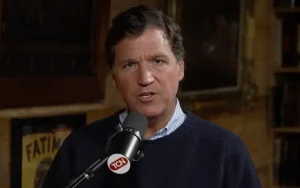
Tucker Carlson has built one of the largest political media platforms in the United States. Since leaving Fox News he has continued broadcasting online to audiences that routinely reach tens of millions of viewers. His interviews and commentary influence debates inside the American right and frequently spill into broader geopolitical discussions. Now Carlson finds himself at the center of a controversy involving Iran, U.S. intelligence agencies and the decades old law designed to regulate foreign influence in American politics.
Carlson recently said that intelligence officials accessed his communications and that the CIA may be preparing a criminal referral accusing him of acting as an unregistered foreign agent because of contacts he had with Iranian officials. Carlson made the claim publicly in a video posted to his platform. At the time of writing no charges have been filed and neither the Department of Justice nor the CIA has publicly confirmed that such an investigation exists. Even without confirmation, Carlson’s claim has drawn attention because his recent work has repeatedly intersected with the messaging of governments openly hostile to the United States and Israel.
The legal framework being discussed is the Foreign Agents Registration Act, commonly known as FARA. Congress passed the law in 1938 as concern grew about Nazi propaganda networks operating inside the United States. The law requires individuals working on behalf of foreign governments or foreign political interests to register with the Department of Justice and disclose their activities. The purpose is transparency. Americans are entitled to know when lobbying, political advocacy or public relations campaigns are being conducted for foreign governments.
For decades the law was rarely enforced, but over the past several years federal prosecutors have revived its use. Some of the most prominent cases involved individuals who secretly worked on behalf of foreign governments while attempting to influence American politics.
Paul Manafort, who served as campaign chairman for Donald Trump in 2016, was convicted in part for failing to register work he performed for a pro Russian political party in Ukraine. Manafort spent years advising Ukrainian political interests tied to former president Viktor Yanukovych and failed to disclose those activities under the law.
Rick Gates, Manafort’s longtime associate, also pleaded guilty to charges connected to undisclosed foreign lobbying tied to Ukrainian political interests.
Michael Flynn, the former U.S. National Security Adviser, admitted that his consulting firm conducted lobbying work connected to Turkish interests while failing to properly register under FARA. Flynn later pleaded guilty to charges related to his statements about those activities.
Another widely watched case involved Bijan Rafiekian, a business partner of Flynn who prosecutors said directed a covert lobbying campaign in the United States connected to the Turkish government.
In each of these cases prosecutors argued that individuals accepted payment or direction from foreign governments while attempting to influence American policy or public opinion without disclosure. Carlson’s situation appears very different from those historical cases.
His recent controversy stems from communications he reportedly had with Iranian officials while pursuing interviews and commentary related to the growing confrontation between Iran, Israel and the United States.
In 2025 Carlson conducted a lengthy interview with Iranian President Masoud Pezeshkian. The interview was widely promoted across Iranian media. Iranian state outlets translated portions into Persian and replayed segments repeatedly in news coverage and commentary programs.
There is no indication that Carlson has any formal relationship with Iranian media organizations. What occurred instead reflects a common practice inside propaganda systems. Governments monitor foreign media closely and amplify statements that support their narrative.
When influential Western commentators criticize American policy or question Western alliances those comments are often rebroadcast by state media in countries such as Iran, Russia or China. The purpose is to demonstrate that criticism of Western governments exists even within Western societies.
The same dynamic appeared after Carlson’s interview with Russian President Vladimir Putin in 2024. Russian state television promoted the interview heavily and replayed segments of Carlson’s commentary during news broadcasts. Russian outlets presented the interview as evidence that Western audiences were questioning their governments’ position on the war in Ukraine.
Researchers who study disinformation say this type of amplification is now a central feature of global information warfare.
Modern propaganda operations no longer rely solely on government spokespeople or official broadcasters. Instead state media organizations monitor social media, independent broadcasters and digital publications across the West. When influential voices deliver commentary that aligns with their geopolitical messaging those statements are translated, rebroadcast and distributed through large online networks.
Analysts studying these campaigns track how narratives move across the internet. They map clusters of social media accounts that share identical messages. They examine timing patterns to identify waves of coordinated posting. They also monitor how stories spread across multiple platforms such as X, YouTube, Telegram and TikTok before eventually appearing in state media broadcasts.
The goal is not necessarily to recruit journalists as agents. The objective is amplification. When criticism of Western governments comes from Western voices it carries a different level of credibility than statements delivered by foreign governments themselves.
Carlson’s prominence illustrates how dramatically the global media landscape has changed. Independent commentators now command audiences comparable to major television networks. A single interview posted online can reach tens of millions of viewers within hours and spread rapidly across borders. That reach means commentary produced for one audience can quickly become part of a much larger international information environment.
For now Carlson’s claim that intelligence officials are examining his communications remains unconfirmed and no legal action has been announced. Whether the controversy fades or develops further will depend on whether any evidence of a formal investigation emerges. What the debate has already revealed, however, is how closely governments monitor the modern media ecosystem. Statements made by influential commentators travel instantly across borders where they can be repurposed by state media outlets seeking to shape the global narrative.
The question surrounding Tucker Carlson may ultimately have a simple answer. Either there is an investigation or there is not. Either the law applies or it does not. What is already clear is something much larger. In the modern information war, powerful voices do not have to work for foreign governments to become useful to them. In a world where a single broadcast can reach tens of millions of viewers in minutes, commentary produced in Washington or New York can be replayed in Moscow, Tehran or Beijing before the show is even finished. That is the new reality of media power, and it is a reality lawmakers never imagined, over 90 years ago, when they wrote the meant to protect the United States from foreign influence.


Discover more from The Montreal Jewish News
Subscribe to get the latest posts sent to your email.