
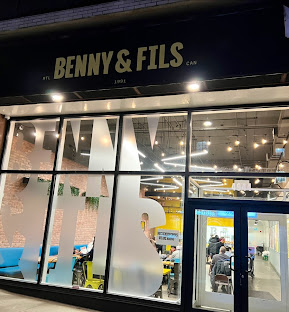
Montreal loves a good kosher fight. We do not always love kashrus, apparently, but we love the fight. Give the community one restaurant, one MK alert, one angry Instagram post, and some baguettes, and suddenly everyone is a dayan, a mashgiach, a food critic, and a public relations expert.
This week, Benny & Fils lost its MK certification.
The MK issued a kosher alert saying that, effective immediately, Benny & Fils, located at 4944 Queen Mary, had its certification revoked because of violations of MK kashrus standards. That is serious. It should be serious. A kosher certificate is not a sticker. It is not a marketing tool. It is not there so people feel better while they eat lunch. It is a religious certification, and if the rules attached to it are not followed, the certifier has every right, and frankly every obligation, to pull it.
Then came the Instagram response from Yaniv Cohen, a partner in Benny & Fils. Cohen called the MK’s action disgusting and said the whole issue was Bridor bread. According to him, the bread is certified kosher by the MK, but the MK does not consider it pas Yisroel for the purposes of the restaurant’s certification. He also released the final notice Benny & Fils received before the certification was removed.
That letter is what makes this much harder for Benny & Fils to sell as some kind of surprise attack.
The letter, which Cohen himself put out, appears to show that the MK had already warned the restaurant about the use of this bread. It was not a mystery. It was not sprung on them at the last minute. It was not some secret rabbinic trap. The MK told them the bread was not approved for use under their certification because it did not meet the pas Yisroel standard required by the agency for the restaurant. The restaurant was told to stop using it. According to the notice, they did not.
So what exactly did Benny & Fils think was going to happen?
This is the part that gets lost when people start yelling online. The question is not whether Bridor bread has some kind of kosher certification. The question is whether Benny & Fils, while operating under MK supervision, followed the standards of the MK. Those are two different things. A product can be kosher in one context and still not be approved for use in a restaurant operating under a stricter standard. That is not a scandal. That is how kashrus works.
People may not like it. Fine. People may think the pas Yisroel standard is too strict. Fine. Benny & Fils may think the MK’s rule is unreasonable. Also fine. But once you accept the MK on your door, you do not get to run your own private kashrus department in the back room. You do not get to decide which rules are important and which rules are annoying. You do not get to benefit from the trust that MK gives you and then turn around and complain when MK expects its standards to be followed.
That is not how any of this works.
The MK is not perfect. No institution is. And yes, in these situations, wording matters. When the public sees “certification revoked” and “violations of kashrut standards,” people naturally start imagining the worst. It would probably help everyone if the specific issue were explained more clearly, especially when the dispute is about pas Yisroel bread and not some dramatic discovery of non-kosher food in the kitchen.
But let’s not pretend the MK created the problem here.
The MK has one job: protect the integrity of its certification. If it tells a restaurant that a product cannot be used under its hashgacha, and the restaurant keeps using it anyway, the MK cannot shrug and move on because the owners are nice or because customers like the schnitzel. The second the MK starts doing that, the certificate becomes meaningless.
And if the certificate becomes meaningless, then the whole system falls apart.
This is where Benny & Fils loses me. Instead of quietly resolving the issue, complying with the standard, or leaving the certification in a straightforward way, Cohen went public and tried to frame the MK as the villain. But the letter he posted does not make Benny & Fils look like a victim. It makes it look like a restaurant that was warned, disagreed with the warning, kept doing what it wanted, and then got angry when there were consequences. That may work on Instagram. It does not work in kashrus.
Kashrus is not run by public sympathy. It is not run by comments, likes, or customers saying, “But I ate there last week and it was delicious.” Nobody is asking if the bread was good. Nobody is asking if the restaurant is popular. Nobody is asking if the owners are upset. The issue is simple: did the restaurant follow the standards of the certification it chose to operate under? If the answer is no, then the MK had to act.
Montreal’s kosher market is already a mess. Prices are high. Options are limited. Families are squeezed. Restaurants are under pressure. Nobody should be happy when a kosher restaurant loses certification. It hurts the business, it hurts the workers, it hurts customers, and it makes an already difficult kosher food scene even smaller. But none of that changes the basics.
A restaurant does not have a right to MK certification. It earns it by following MK standards. The public does not have to like every standard. The owners do not have to agree with every standard. But if the restaurant wants the MK name on the wall, then the MK rules come with it.
This is not complicated. If Benny & Fils wanted to fight the pas Yisroel requirement, they could have done that. If they wanted another certifier, they could have looked for one. If they wanted to tell customers they were using MK-certified Bridor bread without MK restaurant certification, they could have made that decision and lived with the result.
But taking the MK certification, ignoring the MK’s instructions, and then acting outraged when the MK pulled the certificate is not a serious position. It is chutzpah dressed up as victimhood.
The MK may need to communicate more clearly. Fine. That criticism is fair. But the bigger issue here is not the wording of the alert. The bigger issue is a kosher restaurant apparently deciding that it knew better than the agency certifying it.
That cannot be allowed.
Once every restaurant becomes its own rabbi, its own mashgiach, and its own final authority, there is no kashrus system left. There is just branding. And for all the noise, all the Instagram outrage, all the community gossip, and all the predictable screaming, the bottom line is simple;
Benny & Fils did not lose its MK because the MK woke up one morning bored and decided to start a fight. It lost its MK because, according to the notice Cohen himself released, it was told the rules and did not follow them.
That is not persecution, that is accountability.
Howie Silbiger is the host of The Howie Silbiger Show on truetalkradio.com and Political Hitman on Israelnewstalkradio.com. He is the Editor-in-Chief of The Montreal Jewish News.





Leave a Reply