

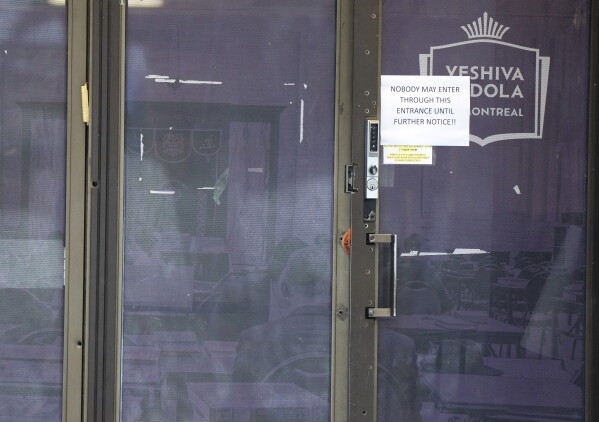
Earlier this week, La Presse published a multi part dossier examining several subsidized Jewish schools in Montreal that had invited Israeli soldiers and Israeli speakers to address students. The articles described appearances by individuals connected to the Israeli military, some of them during periods of intense fighting in Gaza, and raised questions about extracurricular programming in schools that receive partial public funding from the Quebec government. The underlying thrust of the reporting was clear enough: when schools benefit from public subsidy, their activities are open to scrutiny, and programming linked to a foreign military during wartime is, at minimum, controversial.
Within hours, the reaction from the organized Jewish community was not cautious or measured in tone. It was direct, indignant, and unified.
Federation CJA and Centre for Israel and Jewish Affairs issued a joint statement denouncing what they called a “sensationalist dossier” and a “shameful and reckless attack” on Jewish schools. They argued that the reporting mischaracterized cultural and identity based programming as something more ominous and that it landed in a climate already marked by heightened hostility toward Jewish institutions.
The Federation’s statement did not confine itself to technical clarifications. It emphasized that the extracurricular programs referenced were not funded by taxpayer dollars, that the schools meet all provincial standards, and that Jewish day schools operate at significant cost savings compared to the public system. It also framed the issue in much broader terms, describing Jewish schools as central to Jewish continuity and insisting that connecting students with Israelis and Israeli culture is a normal and longstanding component of Jewish education, not an ideological provocation.
The tone of the response reflected more than disagreement with a newspaper’s framing. It reflected a community that feels exposed.
In the past year, Jewish schools in Montreal have been shot at. Synagogues have increased security. Parents have grown accustomed to police presence near institutions that once felt quietly secure. In that context, Federation CJA announced that it would be reinforcing vigilance through its Community Security Network, describing the move as precautionary but acknowledging that the article had altered the security landscape. There was no reference to a specific threat, yet the message was unmistakable: public narratives can have real world consequences.
The controversy quickly moved beyond community institutions and into federal politics.
Anthony Housefather, Member of Parliament for Mount Royal, issued a written statement defending the schools and criticizing the tenor of the coverage. He began by articulating what many Jewish families regard as self evident, namely that there is a fundamental connection between Jewish communities around the world and the State of Israel, and that this connection is reflected in Jewish homes, schools, and camps. He underscored that Jewish Canadians are among the proudest of Canadians and have contributed greatly to the country, adding that their connection to Israel does not diminish that in any way.
Housefather described the articles as disappointing, particularly coming from a respected mainstream publication, and reminded readers that the schools mentioned have existed for more than a century and provide high quality education in the province. He also pointed to federal security infrastructure funding that has benefited the schools and pledged to continue working to strengthen protections for Jewish institutions, referencing the federal government’s Combating Hate Act, currently before committee, as part of that broader effort.
If the institutional responses were swift and disciplined, the public debate was anything but.
On Reddit’s r Quebec forum, the discussion quickly filled with blunt assessments. One commenter wrote that public money should not be associated with what they characterized as military propaganda, regardless of which country is involved. Another argued that religion and politics should not mix in schools that receive government funding and questioned whether similar programming in other communities would be treated differently.
At the same time, other users pushed back just as forcefully. One wrote that Jewish schools teaching about Israel is not propaganda but an expression of cultural identity. Another observed that these institutions have existed for over a century and suggested that the outrage says more about contemporary attitudes toward Israel than about the schools themselves. The exchanges were heated, often sharp, and reflective of a province already divided over questions of secularism, public funding, and minority expression.
At the heart of the matter is a tension that Quebec has lived with for decades. The province subsidizes certain private religious schools provided they meet provincial curricular standards, a model that includes Catholic, Jewish, and other institutions. That arrangement has generally functioned without sustained public controversy. What has changed is the geopolitical backdrop and the heightened sensitivity surrounding Israel and the war in Gaza, which has transformed what might once have been viewed as routine cultural programming into a lightning rod.
The reporting in La Presse placed particular emphasis on the presence of Israeli soldiers as speakers and on activities that were described in military terms. For critics, that emphasis highlights what they see as an uncomfortable intersection between publicly supported education and foreign conflict. For many within the Jewish community, however, the reporting collapses distinctions between cultural connection, national identity, and militarism in a way that feels both inaccurate and unfair.
Federation CJA’s closing declaration that it is a proud Jewish, Zionist community with nothing to apologize for was not an incidental flourish. It was a deliberate statement of identity in response to what it perceives as an attempt to cast that identity as suspect. CIJA indicated that it is reviewing the coverage for potential press standards concerns and continues to engage with the Quebec government regarding school funding and long term viability, signaling that this will not be a brief media cycle but an ongoing conversation.
What remains unsettled is how Quebec as a whole will process the debate. The legal framework governing subsidized private schools has not changed. No funding cuts have been proposed. No formal investigation has been announced. Yet the episode has exposed the fault lines between secular oversight and communal autonomy, between public accountability and minority sensitivity, and between legitimate scrutiny and perceived targeting.
For Jewish parents who send their children to these schools, the connection to Israel is not an abstract political statement but part of how their history, language, and culture are transmitted. For critics who view the issue through the lens of state neutrality, that same connection can appear as political alignment in a charged global conflict. The challenge now lies in whether those two perspectives can be examined without escalating suspicion on one side and defensiveness on the other.


Leave a Reply