
By Leah Rosen (a pen name)
I used to think assimilation was something obvious. It was a Jewish child marrying someone who wasn’t Jewish, a family giving up the holidays, or grandchildren who no longer knew why their grandparents had cared so much about being Jewish. I imagined it happening slowly, over several generations, and mostly in other people’s families, but now I wonder whether it is already happening in mine.
My children attend Jewish schools. They have been surrounded by Jewish teachers, Jewish friends, Jewish holidays and Jewish symbols for most of their lives. They can sing Hatikvah, they know when Yom Ha’atzmaut is coming, they have raised money for Israel and stood at assemblies while Israeli flags were carried into the room. They know that Israel is important, and they know that they are expected to defend it.
I am glad they love Israel, because I want them to love Israel and understand why a Jewish state matters, especially now, when so many people seem comfortable calling for its destruction and pretending that this has nothing to do with their feelings about Jews. What frightens me is how little may be underneath that love.
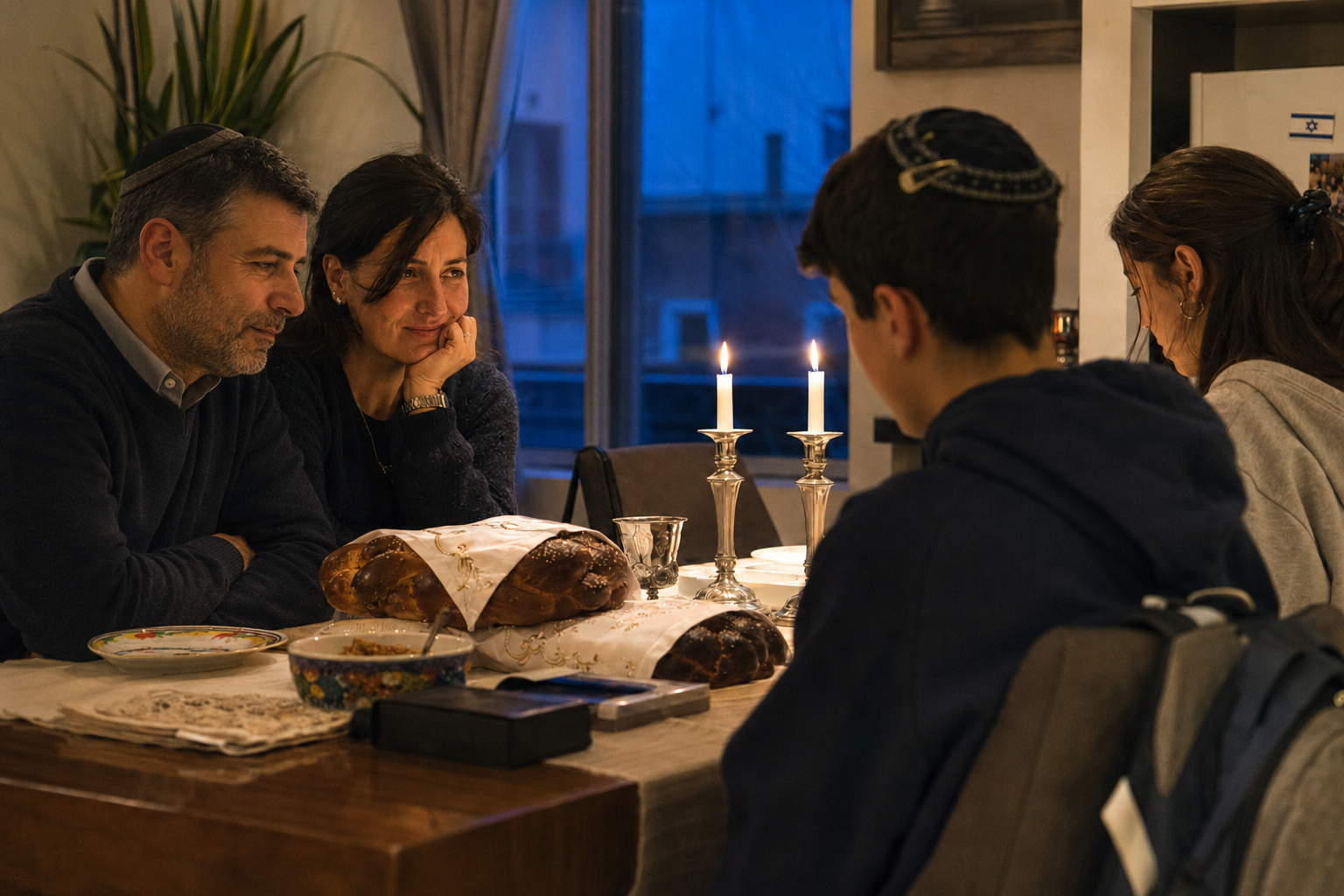
Can they open a siddur and find their place without someone standing beside them? Can they explain what the prayers mean, or why Jews have said them for generations? Can they study Torah, ask questions about it and feel that it belongs to them? Do they know how to speak to G-d when they are frightened, grateful or lost, or has prayer become another school subject to be completed and forgotten? Will they know how to make a Jewish home when I am no longer the one preparing for the holidays, buying the food, lighting the candles and reminding everyone what time dinner starts? I am not sure, and that uncertainty frightens me more than I would like to admit.
Like many Jewish parents, I have spent a great deal of money sending my children to Jewish school. I have paid the tuition, driven the carpools, packed the lunches, found the missing uniform pieces and rearranged my life around a school calendar that does not always resemble the calendar followed by the rest of the city. Somewhere along the way, I allowed myself to believe that all of that guaranteed something, that because they were in Jewish school, they would grow up knowing how to live as Jews.
Deep down, I have always known it does not work that way. A school can teach children about Judaism, but it cannot force them to believe in G-d, make them feel the holiness of Shabbos or create a Jewish home for them. It can give them knowledge, but that knowledge has to be reinforced by the way Judaism is lived and spoken about outside the classroom.
Montreal once had many different ideas about what Jewish education was supposed to accomplish. The Jewish People’s School grew from the Labour Zionist movement. The Peretz School came from a secular Yiddish tradition. Religious schools taught Torah, prayer and Jewish law. Other schools tried to combine Jewish learning with the demands of modern Canadian life. These institutions disagreed with one another, sometimes bitterly, but they were built around substantial ideas of Jewish identity. They were trying to produce a certain kind of Jew, not merely a child who felt warmly about Jewish things.
After the establishment of the State of Israel in 1948, and even more after the Six-Day War in 1967, Israel became the one subject around which nearly every part of the Jewish community could gather. Religious Jews, secular Jews, Yiddish-speaking immigrants, English-speaking professionals and families who rarely entered a synagogue could all stand together for Israel. As Yiddish declined and religious observance weakened, Israel became the common language of Jewish belonging.
It was understandable, and much of it was beautiful. Israel gave Jews pride, security and a sense that Jewish history had not ended in the ashes of Europe. It gave young Jews something living and modern to identify with. It was also easier to teach children a song, raise a flag or celebrate Israeli Independence Day than it was to teach them how to pray, study Torah, understand their obligations to G-d or find personal meaning in thousands of years of Jewish thought. Gradually, Israel came to occupy more and more of the space that had once been filled by Jewish religious knowledge, language and practice.
A 1989 study of 501 Jewish students in Montreal and Toronto observed that Israel appeared to be replacing Jewish ritual as the centre of Jewish identity. A survey two years later found that approximately 90 per cent of respondents considered caring about Israel important to being Jewish, while only about 42 per cent identified themselves as Zionists. Even then, Jewish attachment to Israel was strong, but the words, knowledge and practices that once defined Jewish life were becoming weaker.
More than three decades later, some of our Jewish schools and even the YM-YWHA openly identify themselves as Zionist organizations. I understand why, particularly at a time when Zionism is being treated as a dirty word and Jewish organizations are being pressured to distance themselves from Israel. We should not surrender the word Zionism to people who define it as evil, and we should not teach our children to be ashamed of Israel. At the same time, I cannot help wondering what it says about us when a Jewish institution finds it easier to explain its Zionism than its Judaism.
Judaism and Zionism are connected, but they are not interchangeable. The Jewish attachment to the Land of Israel, Jerusalem and Zion is ancient. It appears throughout our prayers, our holidays and our texts, and it is part of the covenant between the Jewish people and G-d. Modern political Zionism, however, emerged in the nineteenth century, and Jews argued over it from the beginning. Some embraced it, some rejected it and some believed that Jewish national restoration could only happen through religious redemption. There were religious Zionists, secular Zionists, socialist Zionists, anti-Zionist Orthodox Jews, Reform Jews who originally opposed Jewish nationalism and Bundists who believed the Jewish future should be built where Jews already lived.
They disagreed about Zionism, but they were all deeply engaged with the question of what it meant to be Jewish. I worry that many of our children have inherited a position without inheriting the discussion, the knowledge or the faith that once gave that position meaning.
They are taught to defend Israel before they are old enough to understand Jewish history. They learn the slogans used against Israel and the answers they are expected to give, but they may not know enough Torah, Hebrew, prayer or Jewish history to understand the people whose country they are defending. We are preparing them for an argument without giving them a strong enough reason to remain in the room.
Somewhere in all our talk about Jewish identity, Jewish community, Jewish history and Jewish peoplehood, we have also become uncomfortable talking about G-d. We can teach about Israel, the Holocaust, social justice and the importance of standing together, but Judaism cannot survive as a collection of causes and cultural memories. Being Jewish is also a relationship with G-d, a set of obligations and a way of living, even when those obligations are difficult or inconvenient. If our children never hear that, we should not be surprised when they decide that being Jewish is little more than an ethnic label.
Anti-Jewism makes this even more frightening. Jewish schools in Montreal have been shot at. Synagogues and Jewish institutions have been vandalized. Jewish students arrive on university campuses and discover that their identity is treated as a political offence. They are told that the Star of David is threatening, that Zionism is racism and that they must denounce Israel before they will be accepted as one of the good Jews.
If their Jewish identity consists mainly of Israel, the Holocaust and the hatred directed at them, I can understand why some will eventually walk away. That kind of Jewishness is exhausting. It demands that they spend their lives answering accusations, explaining themselves and carrying the weight of a conflict thousands of kilometres away. If we have not given them Shabbos, Torah, prayer, a relationship with G-d, family, memory, community and the simple happiness of living as Jews, then we have given them very little to hold onto when walking away begins to look easier.
I do not want the people who hate my children to become their most influential Jewish educators. I do not want a protester screaming outside their school to teach them more about being Jewish than I have, and I do not want their strongest connection to the Jewish people to come from discovering that someone wants them gone.
The responsibility does not belong only to the schools or communal organizations. It belongs to me, and that may be the most uncomfortable part of all this. I have rushed through holidays because I was tired. I have treated Shabbos like one more obligation during an already crowded week. I have expected a school to build a Jewish foundation that should also have been built in our home. There have been times when I cared more about my children’s grades than whether they understood a prayer, and times when I worried more about the university they would attend than the kind of Jewish family they might one day create. I cannot complain that Jewish education has become shallow while outsourcing all of my children’s Judaism to their teachers.
I am not asking our schools to teach less about Israel. I want them to teach more Judaism. I want Israel taught as part of the long Jewish story, not as a political subject that begins in 1948. I want children to understand that Zion is in our prayers because generations of Jews longed for it long before Theodor Herzl convened the First Zionist Congress. I want them to learn Hebrew as more than a collection of sounds, Torah as more than a subject on a timetable and prayer as more than something performed at an assembly. Most of all, I want them to understand that Judaism is not merely something they belong to, but something they can believe in and live.
I know they will make their own choices. They may not observe the way I do, believe what I believe or build the kind of home I imagine for them. Children grow up, and mothers eventually have to accept that we cannot decide everything for them. What I cannot accept is allowing them to reach adulthood with so little Jewish knowledge that they do not even understand what they are choosing to leave behind.
One day, I will not be there to organize the Seder, light the candles, make the phone calls or remind them that a holiday is coming. I want them to be able to enter a synagogue anywhere in the world and recognize the words being said. I want them to study Torah and feel that it belongs to them, not to somebody more religious, more educated or more Jewish. I want them to know that they can turn to G-d in a moment of fear, gratitude or uncertainty, and I want them to know how to bring Judaism into their own homes without waiting for me to do it.
I want my children to stand up for Israel, recognize Jew hatred and refuse to hide from it, but I also want them to inherit something more than a flag to defend and a list of accusations to answer. I want them to inherit a Judaism that is strong enough to question, meaningful enough to practise and precious enough to pass on to their own children.



Leave a Reply