
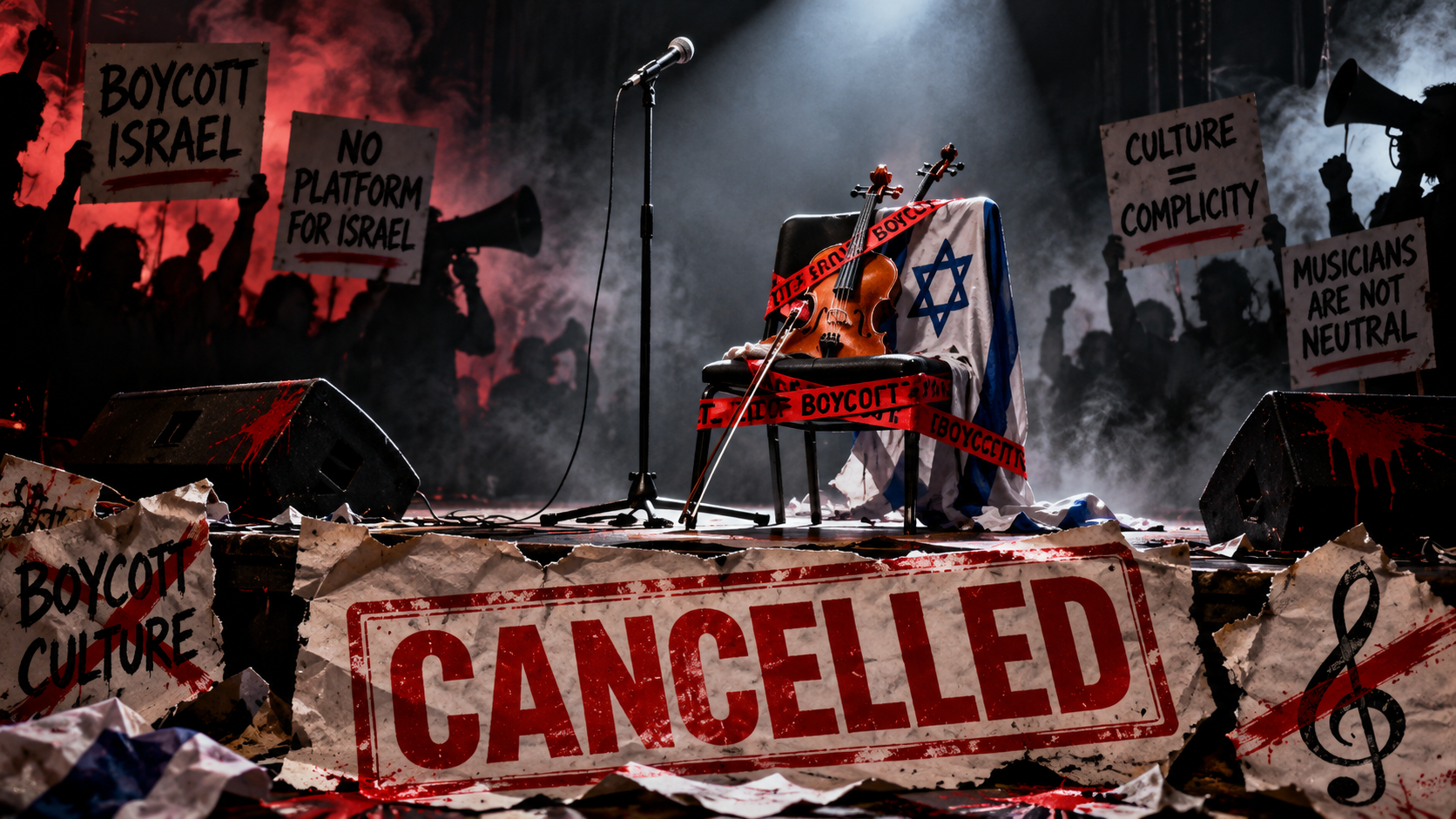
More than 120 Montreal musicians and cultural organizations have joined the international boycott of Israel, adding their names to a campaign that has somehow convinced artists that refusing to play music for Israelis is an important contribution to world peace. Among the signatories are Patrick Watson, Godspeed You! Black Emperor, Safia Nolin, several record labels and a collection of concert venues, some of which receive government funding. They have pledged to avoid Israeli cultural institutions, refuse performances in Israel and withdraw from projects that might be seen as normalizing the country. It is quite an impressive undertaking, particularly for musicians whose biggest sacrifice may be turning down a concert invitation they never received.
The boycott is part of the larger Boycott, Divestment and Sanctions movement, which has spent the past two decades trying to isolate Israel economically, culturally and academically. Its supporters portray it as a peaceful effort to change Israeli policy, although the movement’s demands go considerably further than that. BDS wants economic pressure, international sanctions, the withdrawal of institutional cooperation and the return of Palestinian refugees and their descendants to Israel. Taken together, those demands could bring about something the movement’s more enthusiastic supporters have wanted for generations, the end of Israel as a Jewish state.
The idea is hardly original. The Palestine Liberation Organization was established in 1964 with the objective of eliminating Israel, three years before Israel captured Judea and Samaria and Gaza in the Six-Day War. The PLO’s original charter rejected Israel’s existence, and its campaign relied on armed struggle. BDS arrived in 2005 with a more socially acceptable approach, replacing the gun with financial pressure, international isolation and a seemingly endless supply of petitions. The organizations are different, as are their methods, but the desired elimination of Israel’s Jewish national character is difficult to ignore. BDS co-founder Omar Barghouti was quite open about the implications in a 2020 interview, describing how implementing the movement’s refugee demands would leave Palestinians a majority in what is now Israel, with no Zionist state remaining.
And now we have musicians joining the campaign, apparently believing they are helping to deliver the final blow by keeping Israeli artists off international stages.
The cultural boycott has become ridiculous because of the rules its organizers have invented. The Palestinian Campaign for the Academic and Cultural Boycott of Israel, which oversees the cultural component of BDS, has published guidelines explaining which artists, performances and cultural projects should be excluded. Israeli cultural institutions are presumed complicit in government policies unless they prove otherwise, and even joint Israeli and Palestinian projects promoting coexistence can be rejected unless they satisfy the movement’s political conditions.
In other words, an Israeli musician and a Palestinian musician can get together to perform, but if the purpose is simply to make music and encourage friendship, the project may be considered unacceptable. The movement prefers what it calls co-resistance to coexistence. Apparently, two people putting aside their differences and working together are not helping the cause unless they first agree to the political demands of the people organizing the boycott. It takes a remarkable degree of ideological arrogance to turn cooperation between Israelis and Palestinians into something that requires political permission.
Then there was Eurovision. Five countries, Spain, Ireland, Iceland, Slovenia and the Netherlands, refused to participate in this year’s contest because Israel was allowed to compete. There were angry statements, declarations of solidarity and the usual applause from activists congratulating one another for taking a stand. Israel performed anyway and finished second. The countries that boycotted the competition succeeded in excluding their own performers while giving the Israeli entry one less group of competitors to worry about. That probably wasn’t the intended result, but then again, nobody has ever accused this movement of thinking through every consequence of its decisions.
Unfortunately, the consequences for Israeli musicians are considerably less amusing. As Montreal Jewish News reported Wednesday, organizers of Israel’s annual Music Showcase Festival expect only about 30 international industry representatives at this year’s event, compared with 60 last year. The Israeli jazz trio Shalosh has seen its international performances drop from approximately 60 concerts annually to 30. Promoters are increasingly reluctant to work with Israeli performers, and booking agents are finding it more difficult to arrange international appearances. These musicians are not making Israeli foreign policy, but their livelihoods have become convenient targets for people who want to punish Israel without having to deal with anyone actually responsible for government decisions.
The economic campaign is considerably more ambitious. Israel has become a major player in technology, medicine, communications, agriculture and scientific research, with products and innovations used internationally. Removing Israeli participation from those industries would be substantially more difficult than cancelling a film screening or refusing to book a singer. It might require boycott supporters to make sacrifices of their own, which is considerably less appealing than signing an open letter and receiving applause from their colleagues.
The cultural world has also developed a rather selective understanding of artistic freedom. Performers regularly insist that music transcends borders and that art should bring people together, yet many of the same people are perfectly comfortable demanding that Israeli cultural institutions be excluded from international events. Their objection is not necessarily to anything a particular artist has said or done, but to the institutions associated with that person’s country. The movement describes this as an institutional rather than an individual boycott, a distinction that offers little consolation to a musician whose concert has just been cancelled.
There is nothing wrong with an artist choosing not to perform somewhere. Nobody is obliged to accept a concert booking, and performers are entitled to express their political opinions. But there is a considerable difference between making a personal decision and joining an organized campaign designed to isolate an entire country’s cultural institutions. The fact that the latter has become fashionable in artistic circles does not make it any less objectionable.
The more troubling development is the willingness of cultural organizations to participate in a campaign that actively discourages ordinary relationships between Israelis and Palestinians. The people behind BDS have developed an extraordinary system in which international cooperation is acceptable when it advances their political objectives, while reconciliation without those conditions can be dismissed as normalization. That is a peculiar way to encourage peace, particularly from people who claim that cultural exchange and mutual understanding are among the great virtues of the arts.
Meanwhile, in Montreal, musicians and cultural administrators can enjoy the satisfaction of joining an international political movement without ever having to explain how refusing to work with an Israeli artist will improve the life of a single Palestinian. They can publish their declarations, congratulate themselves and return to their performances, while Israeli musicians struggle to find venues willing to book them.
The original PLO tried to destroy Israel through armed struggle. BDS has adopted economic and cultural isolation in pursuit of an outcome that would dismantle the Jewish state. It has enlisted universities, corporations, unions and now a growing collection of artists in that campaign.
The musicians who have joined BDS may genuinely believe they are standing up for human rights. What they have actually signed onto is a movement that can treat friendship between Israelis and Palestinians as a political offence, blacklists cultural institutions for their national connections and considers the cancellation of a jazz concert a meaningful victory.
That’s quite a legacy for people who claim to believe that music brings the world together.





Leave a Reply