


By.Howie Silbiger
Belgium has not banned brit milah. It has found another way to make performing one potentially criminal.
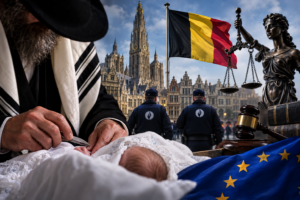
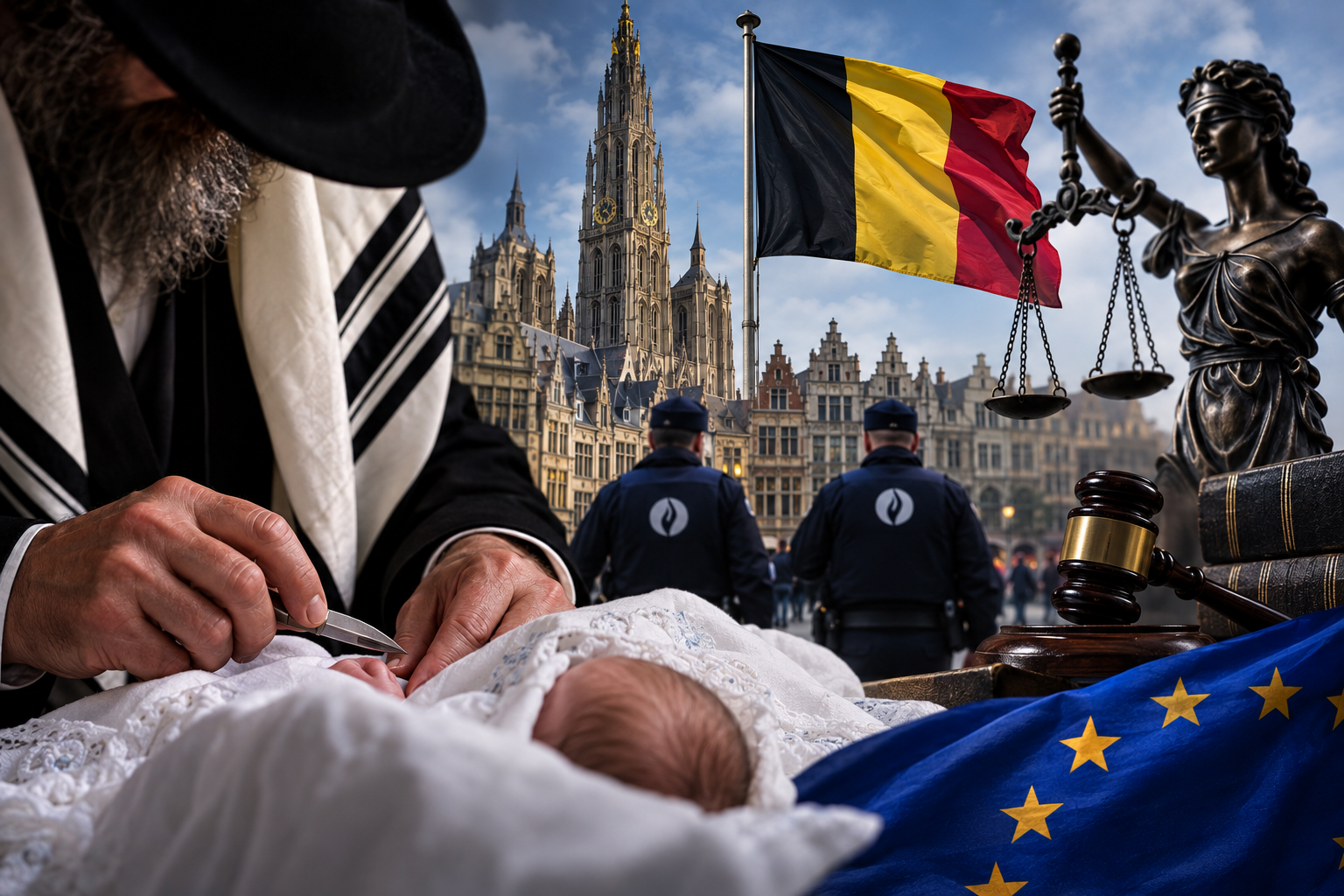
Two Jewish mohalim in Antwerp are facing the possibility of a criminal trial after prosecutors decided that performing a traditional Jewish circumcision without being a licensed physician could constitute the illegal practice of medicine and intentional bodily harm against a minor. What began several years ago as complaints about the controversial practice of metzitzah b’peh has turned into something much larger, with Belgian authorities now questioning whether a traditional mohel who is not also a doctor can legally perform a brit milah at all.
The case began in 2023 when Moshe Aryeh Friedman, a controversial figure within Antwerp’s Jewish community, filed complaints against six mohalim, claiming they were performing metzitzah b’peh, in which blood is drawn from the circumcision wound by mouth. The investigation continued, but eventually moved well beyond the original allegations and into the legality of circumcision itself when performed by someone who does not hold a Belgian medical licence.
In May 2025, Belgian police raided the homes of Antwerp mohalim, including Rabbi Aharon Eckstein and Rabbi Moshe David Landau, seizing circumcision instruments and seeking information about babies who had undergone brit milah. Eckstein said police arrived at his home at approximately five in the morning and took his circumcision kit.
By May of this year, Antwerp prosecutors announced that they believed they had enough evidence to send two mohalim to correctional court. The proposed charges were not minor. Prosecutors were seeking to pursue the men for unlawful practice of medicine as well as intentional bodily harm with premeditation against minors.
The case reportedly involves at least 98 babies circumcised over a period of a little more than a year.
There is, however, a rather large hole in the original reason authorities became involved. Belgian reporting following a June hearing indicated that investigators had found no evidence of oral suction in the case being considered by the court. The allegation that helped start the investigation may have disappeared, but the investigation itself did not.
Instead, Belgian authorities were left with a much broader question, and one that could affect Jewish communities well beyond Antwerp.
Belgium considers circumcision a medical procedure. Under the interpretation being pursued by prosecutors, a person performing one without the required medical qualifications can therefore be accused of illegally practising medicine. A traditional mohel may have extensive training and may have performed hundreds or thousands of circumcisions, but unless he possesses the medical qualifications recognized by Belgium, prosecutors can argue that he has no legal authority to perform the procedure.
Nobody needs to pass a law banning brit milah if the person traditionally responsible for performing it can be prosecuted for doing his job.
The case has become so contentious that it has managed to create a diplomatic fight between Belgium and the United States.
US Ambassador to Belgium Bill White publicly demanded that Belgian authorities end the prosecution, describing the investigation as unacceptable harassment and calling for a legal exemption protecting mohalim. Belgium responded by summoning the American ambassador and reminding him that its judiciary is independent.
White was not particularly impressed.
“Drop the damn case,” he later told The Brussels Times.
When prosecutors subsequently announced their intention to bring the two mohalim before a criminal court, White called the case a “shameful stain on Belgium.” Israeli Foreign Minister Gideon Sa’ar also entered the dispute, while Belgian officials rejected accusations that the country was engaging in anti Jewish persecution.
Belgian Prime Minister Bart De Wever defended his country against accusations of anti Jewish behaviour, while at the same time acknowledging that circumcision is fundamental to Jewish and Muslim religious life and that some accommodation between Belgian law and religious practice has to be found.
The case was supposed to move forward on June 18, but it didn’t.
At the hearing, Friedman, whose complaints had helped launch the investigation, requested additional investigative measures and further questioning. The defence also sought additional questioning. The chamber therefore postponed its decision on whether the two mohalim should actually be sent to trial.
As of now, no trial has taken place and neither mohel has been convicted of anything.
While Belgium works out whether a mohel can legally be a mohel, European Jewish organizations have apparently decided that waiting around for governments to figure out Jewish religious practice may not be the best strategy.
Earlier this month, the European Jewish Association and Rabbinical Centre of Europe announced the creation in Brussels of the Centre of Excellence for Religious Male Circumcision, known as CERM, a new European training and certification program designed to provide already qualified mohalim with extensive medical and safety training.
The program includes newborn assessment, infection prevention, bleeding and wound care, recognition of complications, emergency procedures, infant basic life support, medical referrals and aftercare. Medical professionals, including pediatricians and urologists, are involved in its standards and oversight.
It is an attempt to answer the argument being made in Belgium with something more substantial than a press release. If European governments insist that circumcision requires medical standards, Jewish organizations intend to demonstrate that properly trained mohalim can meet rigorous medical standards without turning a brit milah into a hospital procedure performed by someone with little connection to the religious obligation involved.
The idea has already received support from senior European officials. EU Health Commissioner Olivér Várhelyi described the initiative as a constructive model capable of protecting religious practice while meeting modern health and safety standards.
CERM is also careful not to pretend that a certificate magically changes national law. Its own standards acknowledge that certification does not give a mohel authorization to practise medicine and does not override the laws of the country in which he is working.
That leaves the central problem exactly where it was.
Belgium can recognize that Jews have been performing brit milah for thousands of years. It can acknowledge that circumcision is fundamental to Jewish religious life. It can insist that it has absolutely no intention of banning the practice. It can even say that the entire dispute is about medical regulation rather than religion.
But if a Jewish family can have a brit milah only when the person holding the knife has the medical licence demanded by the state, while the traditional mohel risks being prosecuted for bodily harm and illegally practising medicine, the wording becomes rather academic.
European Jews have been down a similar road before. Belgium has already restricted shechita through laws requiring animals to be stunned before slaughter, legislation that Jewish communities argued made traditional kosher slaughter impossible. Those restrictions survived challenges in European courts.
Now the argument has moved from the kosher slaughterhouse to the brit milah.
There is one considerable irony in the Belgian case. The government did not begin this fight on its own. The original complaints came from inside Antwerp’s Jewish community, and Belgian officials have repeatedly pointed that out when accused of targeting Jews.
It may have started as an internal Jewish complaint about the way some circumcisions were allegedly being performed. Three years later, European Jewish organizations are building an international medical certification system, an American ambassador is telling Belgium to “drop the damn case,” Israeli officials are weighing in, and two mohalim are waiting to find out whether performing one of Judaism’s oldest commandments will put them in a criminal courtroom.
Quite a journey for an allegation investigators apparently could not prove.


Discover more from The Montreal Jewish News
Subscribe to get the latest posts sent to your email.