



By Howie Silbiger
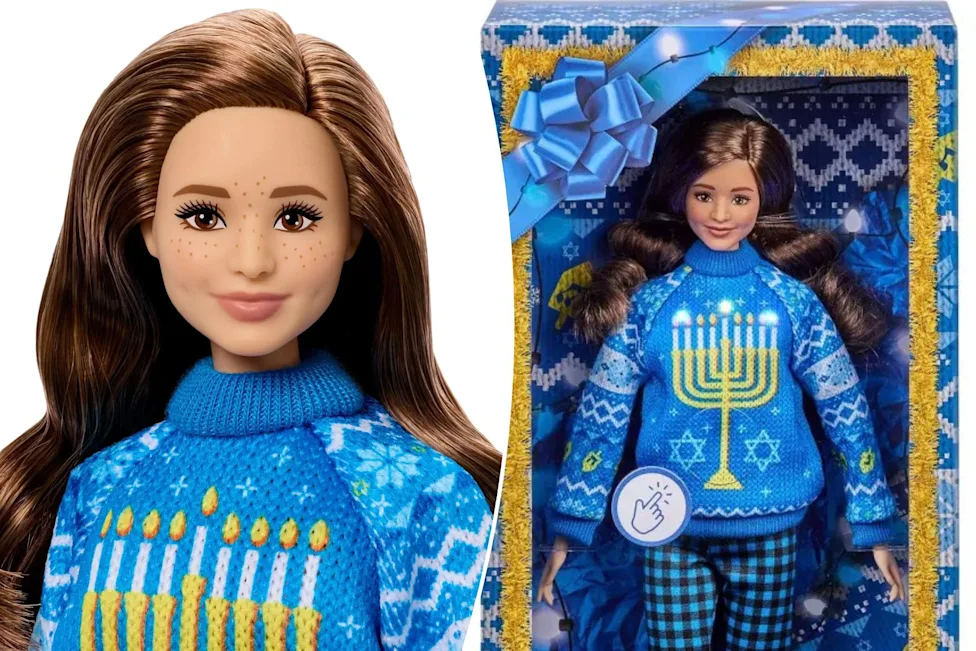
Mattel has released its first official Chanukah Barbie, and almost immediately people started arguing about her nose. The doll is part of the company’s 2026 Holiday Sweater collection, with two Barbies dressed for Christmas and a third wearing blue pants and a blue sweater covered with dreidels, Jewish stars and a Chanukah menorah that actually lights up. She has brown hair, a slightly darker complexion and a nose that appears a little more prominent than those on the Christmas dolls beside her, which was apparently enough to turn what should have been a fairly simple holiday toy story into another argument over Jews and how we are supposed to look.
Some people saw a Jewish doll that looked a little more like actual Jewish women, while others saw an old stereotype and accused Mattel of deliberately giving the Jewish Barbie a larger, more recognizably Jewish nose. Collectors have pointed out that Mattel appears to be using its existing Violet, or Dimples, face mold, which has been around since 2018 and has appeared on other dolls that had absolutely nothing to do with Jews or Chanukah, so the idea that Mattel designed a special Jewish nose does not hold up particularly well. There is a long and ugly history behind exaggerated Jewish features in anti Jewish propaganda, but in this case the much more interesting story is not Barbie’s nose, it is that after 67 years Barbie has finally become openly Jewish.
Barbie was created by a Jewish woman whose own life was shaped by the pressure to assimilate into America. Ruth Handler was born Ruth Moskowitz in Denver in 1916, the daughter of Polish Jewish immigrants, and grew up at a time when Jews were finding greater opportunity in the United States while still understanding that fitting in could make life considerably easier. She met Izzy Handler at a Jewish youth dance, and Izzy eventually became Elliot, a change Ruth encouraged in part because a more American sounding name made things easier.
There was nothing unusual about that story. Jewish families across North America shortened or changed their names, lost their accents, left immigrant neighbourhoods and moved into suburbs their parents could never have imagined living in. Their children went to universities, entered professions that had once excluded Jews and built businesses that became part of mainstream American and Canadian life. They were not necessarily giving up Judaism, but they were learning how to make themselves fit more comfortably into the countries they had chosen to call home.
Then Ruth Moskowitz Handler created Barbie, one of the most recognizable symbols of postwar American culture. Barbie was blonde, fashionable and completely at home in the America around her, with the clothes, the car, the dream house and eventually Ken, while there was nothing about her that suggested she had come from the imagination of the Jewish daughter of Polish immigrants. Millions of children grew up with Barbie without ever knowing that the woman who created her was Jewish, and in many ways that made Barbie an almost perfect symbol of the assimilation Ruth Handler’s generation had worked so hard to achieve.
The idea was fairly simple. Become American enough or Canadian enough, become educated and successful, leave the old neighbourhood behind and eventually being Jewish becomes just another detail in the family history. Change Izzy to Elliot, leave St. Urbain Street, stop speaking Yiddish, send the children to university, build a successful business and live the same life as everybody around you. Maybe you keep kosher and maybe you do not, maybe you go to synagogue every week or only on the High Holidays, but either way you have become part of the country and eventually nobody should particularly care how your grandparents prayed.
Unfortunately, Jews have learned repeatedly that assimilation and acceptance are not quite the same thing, because no matter how completely you blend into the society around you, somebody else still gets to decide whether your Jewishness matters to them. You can be a Hasidic Jew walking through Outremont in a shtreimel or a completely secular Jewish professional living in Westmount, you can keep every mitzvah or none of them, and you can spend Shabbos in synagogue or Saturday afternoon at Costco. Inside the Jewish community those differences can seem enormous and we can spend endless amounts of time arguing about them, but to somebody who hates Jews, all of those distinctions tend to disappear very quickly because you are still a Jew, no matter what kind of Jew you are.
Montreal has provided enough examples of that over the past few years. Hasidic Jews have been harassed and attacked in Outremont and Mile End, Jewish schools have been shot at and synagogues have been vandalized and targeted. Temple Emanu El Beth Sholom in Westmount could hardly be more different culturally from a Hasidic shtiebel in Outremont, but somebody looking for a Jewish target is not particularly interested in whether the Jews inside are Orthodox, Conservative or Reform, how often they attend synagogue or what they had for lunch.
Against that background, I have trouble getting terribly worked up over whether Chanukah Barbie’s nose is a little too large. Mattel did not have to make this doll, there was no massive public campaign demanding one and nobody would have thought twice if the Holiday Sweater collection had consisted entirely of Christmas Barbies. The company could also have taken the easy corporate route and produced a blue winter sweater covered with snowflakes, avoiding anything overtly Jewish while still leaving enough hints for Jewish customers to understand what it was supposed to represent.
Instead, Mattel put a menorah on Barbie and surrounded it with unmistakably Jewish symbols, at a time when being visibly Jewish has become considerably more complicated than it was only a few years ago. Jewish institutions require security, schools have guards, synagogues have police outside and the sight of a Star of David or a menorah can somehow become part of a political argument that has nothing to do with the person wearing or displaying it. A major international toy company decided anyway that one of the most recognizable dolls on earth could stand on a store shelf looking unmistakably Jewish, and I find that considerably more significant than whether somebody thinks her nose is a few millimetres too prominent.
There is also a fitting Montreal connection, since Les Cours Mont Royal is home to Barbie Expo, which bills itself as the largest permanent Barbie exhibition in the world and has more than a thousand dolls on display. It would be appropriate for Chanukah Barbie to eventually join them, particularly in a city where Jews have spent the past few years receiving some very unpleasant reminders that fitting in and being accepted are not necessarily the same thing.
Ruth Handler’s generation spent enormous energy proving that Jews could become part of North American life, and they succeeded beyond anything their immigrant parents could have imagined. Ruth Moskowitz Handler herself created one of the most American cultural icons of the twentieth century, a doll that became so completely part of the mainstream that the Jewish story behind her was largely forgotten.
Sixty seven years later, Barbie can finally be openly Jewish too, with the dream house, the clothes, the boots, the menorah and even a nose that looks a little different from the one on Christmas Barbie.
Perhaps that is the real difference between assimilation and acceptance. Assimilation asks how much of yourself you are willing to change in order to belong. Acceptance is when you no longer have to.


Discover more from Montreal Jewish News
Subscribe to get the latest posts sent to your email.