
Annie is coming back to Broadway in 2027, fifty years after it first opened there, which will undoubtedly mean another generation of children singing “Tomorrow,” another round of Daddy Warbucks bald caps and probably another fifty years of people thinking that Annie is basically a cute musical about an orphan who gets adopted by a billionaire.
It is actually a very political musical, and when you dig into where it came from, what its creators did to the original story and the political climate in which they wrote it, it becomes something considerably more interesting. It also has a strange relevance to Jewish politics today, particularly at a time when Jews in both Canada and the United States are trying to figure out exactly who their friends are, which institutions still work for them and whether decades of political access have actually bought the community very much when it has needed that access most.
The Annie most of us know was not the Annie Harold Gray created in 1924. Gray’s Little Orphan Annie comic strip was enormously popular, but it was also unabashedly political. Gray was conservative, deeply suspicious of government and particularly hostile to Franklin Roosevelt and the New Deal. The Library of Congress describes conservative politics as permeating his stories, and Daddy Warbucks represented much of Gray’s worldview. Warbucks was enormously wealthy, independent, powerful and generally convinced that private individuals could accomplish things government either could not or should not be doing in the first place.
The Broadway creators took that story and pretty much hijacked it politically. Thomas Meehan, who wrote the book for the musical, was quite open about what they had done. In a 1977 interview with The Washington Post, he said that Warbucks had presented a problem for the creators, so they changed his politics from a “right wing Republican” into a “left wing Democrat.” Gray’s Warbucks hated Roosevelt. The Broadway Warbucks finds himself working with Roosevelt, while Annie wanders into the White House and helps provide a little optimism to a president and cabinet trying to drag the United States out of the Depression.
This was not some accidental byproduct of adapting an old comic strip. Meehan, Martin Charnin and Charles Strouse began working on Annie in 1972, when Richard Nixon was president, and decades later Meehan and Charnin were still quite happy to explain their thinking. They disliked Nixon and remembered Roosevelt very differently. Meehan recalled that the three of them had talked about what it was like to have a president who they believed cared about ordinary people, and he said plainly that the idea went into the show.
So, while Annie is set during the Depression, it is really a piece of political theatre from the Nixon years, written by people looking backward at Roosevelt and imagining a government that was capable of caring about the people it governed. They took a character created by a man who distrusted government and put her into a musical in which government, business and individuals eventually have to work together. They even took Gray’s capitalist hero and made him politically acceptable to themselves in the process.
That makes Annie herself much more interesting. She has absolutely nothing. She has no family, no money, no political influence and no constituency. There is no reason for anyone important to care about her. She cannot write a cheque to a political campaign, she cannot deliver votes, she cannot get anyone elected and she is not the president of an organization that can issue a press release. She is an eleven year old orphan living in an institution run by a drunk who treats the children horribly. In political terms, Annie is useless. Yet, somehow, everybody in the story eventually has to deal with her.
Warbucks can give her things. He can put her in a mansion, buy her clothes, feed her and use his money and connections to search for her parents, but even Warbucks eventually runs into problems his money cannot immediately solve. Roosevelt has the resources of the United States government behind him, but the federal government cannot give Annie a family. The police can arrest people, the orphanage can house children and the politicians can sit around a table discussing how to save the country, but none of those things by themselves solve Annie’s problem. Eventually, people have to decide that they care enough about her to actually do something.
There is a Jewish element to all of this that is also difficult to ignore. Charles Strouse, the composer of Annie, was Jewish, and the musical came out of a Broadway tradition built to an extraordinary extent by Jewish composers, lyricists, writers and producers. Broadway was one of the places where generations of American Jews wrote themselves into the American story. They created an America onstage in which immigrants could become Americans, outsiders could belong and people who began with very little could somehow find a place for themselves.
For a very long time, that also described a large part of Jewish political thinking in North America. Jews did not withdraw from the political system. We threw ourselves into it. Jews became lawyers, judges, doctors, professors, journalists, business owners, politicians and political donors. Jewish organizations became very good at building relationships with governments, political parties, police departments, universities and other institutions. We sat on boards, raised money, attended dinners, lobbied ministers and members of Congress, met with premiers and presidents and generally operated under the assumption that being fully involved in democratic society was not only good citizenship, but also one of the ways Jewish security was protected.
It worked well enough that it became almost automatic. Something happened to Jews, the organizations issued statements, meetings were arranged, politicians expressed their concern and everyone went home reassured that the system had responded.
Then October 7 happened.
Jewish politics did not suddenly flip from left to right, regardless of what people on either side would like to believe, in fact, a March 2026 poll by the Jewish Electorate Institute found that 69 percent of American Jewish registered voters still identified as Democrats and 24 percent as Republicans. At the same time, the survey found that Democratic Jewish voters had more uncertainty about what their own party stood for, particularly on Israel, while Republican Jews overwhelmingly understood what their party stood for and Republicans held an advantage when respondents were asked which party they associated with being pro Israel. American Jews remained politically where they largely had been, but some of the comfort with that political home was clearly less certain.
The more significant change may not be where Jews vote at all. It may be how much faith Jews still have in the institutions around them. The American Jewish Committee’s 2025 survey found that 93 percent of American Jews considered anti Jewish hatred a problem in the United States, 78 percent said the October 7 attacks and the war that followed had made them feel less safe as Jews in America, and 66 percent believed Jews were less secure than they had been only a year earlier. Those are not the numbers of a community feeling particularly comfortable.
Canada is hardly providing a more reassuring picture. Statistics Canada recorded 788 police reported hate crimes targeting Jews in 2025. The number was down from 943 in 2024 and 959 in 2023, but Jews still represented 788 of the 1,115 police reported hate crimes motivated by religion in Canada that year. Jews make up a tiny percentage of the Canadian population and still accounted for more than seventy percent of those religiously motivated hate crime reports.
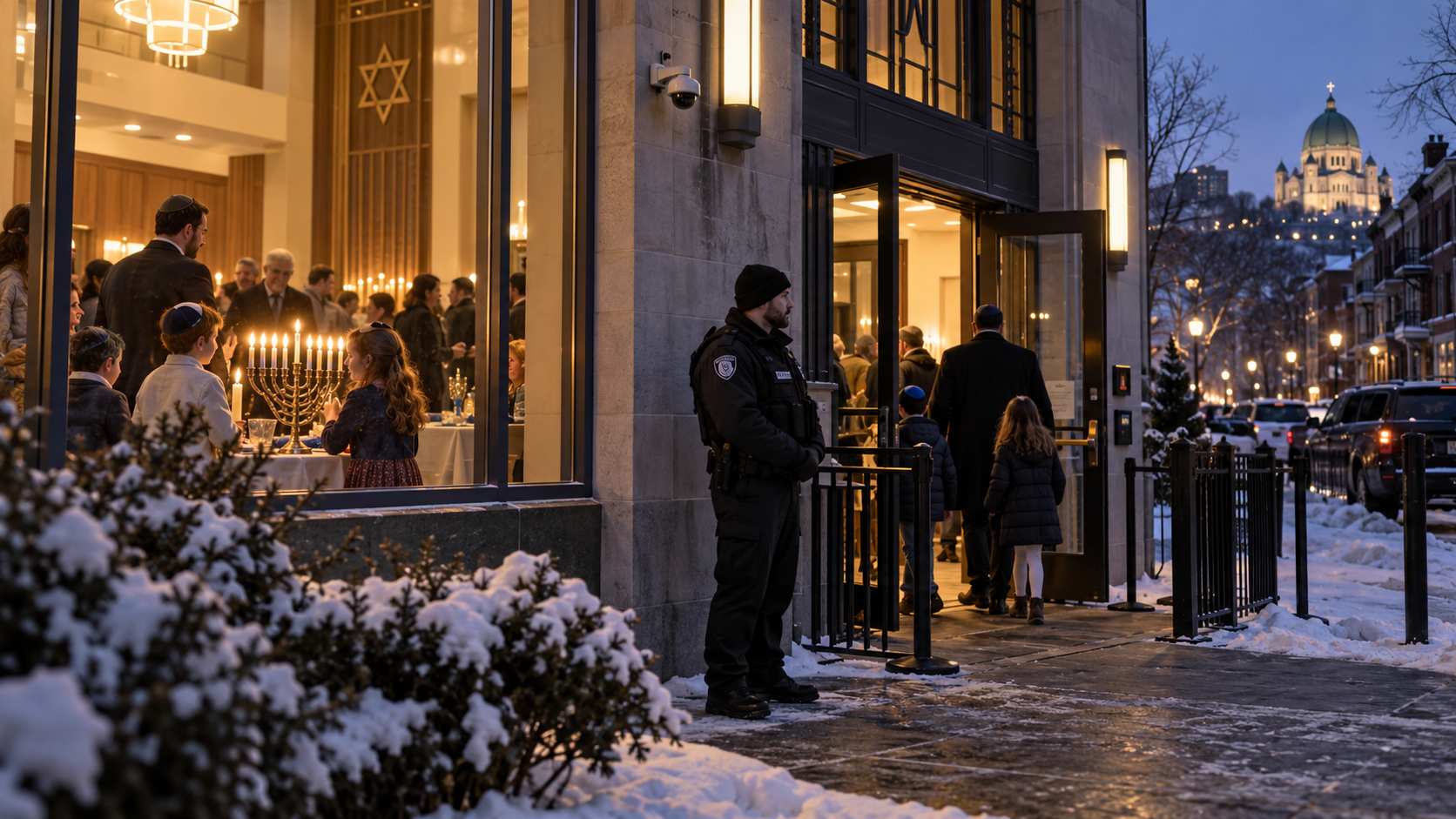
Meanwhile, Jewish schools have security guards. Synagogues install cameras, barriers and reinforced entrances. Jewish organizations send out security notices. Jewish students on campuses have had to think about whether openly identifying themselves as Jewish or supporting Israel is going to make them a target. Jewish institutions that spent decades trying to become open and welcoming buildings increasingly look at security as one of their basic operating expenses.
All of this is happening while Jews arguably have more political access than at almost any point in our history in North America. That contradiction is where Annie starts becoming very uncomfortable.
Daddy Warbucks has access. He has money. He knows important people, he can get into the White House, he can pick up a telephone and reach people ordinary Americans could never hope to reach. In modern Jewish communal terms, Warbucks would have a table at every dinner, photographs with half the cabinet and probably his name on the side of the building. but access is not the same thing as protection.
Jewish organizations in Canada and the United States have become very good at access. Politicians show up at Jewish events. They light Chanukah candles, attend Holocaust commemorations, release statements condemning attacks and tell Jewish audiences how seriously they take anti Jewish hatred. Jewish leaders meet with them, shake their hands, take the pictures and issue their own statements thanking them for the meeting.
Then Jews go back to synagogues surrounded by security. That does not mean the meetings are useless or that the political relationships should not exist. It means we may have confused being invited into the room with having power inside it.
For generations, Jewish communal politics was built around the belief that if we participated fully enough, cultivated the right relationships, supported the institutions around us and made ourselves indispensable members of society, those same institutions would be there when we needed them. What the last few years have done is force Jews to reconsider how automatic that protection really is.
It has also left Jews in a strange political position. The traditional Jewish left remains uncomfortable with parts of the political right. Jewish conservatives look at parts of the left and see movements and organizations where hostility toward Israel has become increasingly difficult to separate from hostility toward Jews. Neither side owns the Jewish community, and neither side is entitled to it. Jews are still arguing among themselves because that is what Jews do, but underneath those arguments sits something that did not feel nearly as urgent a decade ago.
There is a growing sense of political orphanhood. Not because Jews have nowhere to vote, but because having somewhere to vote and having somewhere that feels like home are not necessarily the same thing.
That brings us back to Annie. Harold Gray’s answer was largely the individual. Do not expect government to save you. Work, survive, rely on yourself and on people strong enough to help you.
Broadway rejected that and brought Roosevelt directly into the story, but even Broadway never really made government the answer. Warbucks cannot do it alone, Roosevelt cannot do it alone, money does not solve everything and neither does the government. Annie survives because eventually enough people decide that she is their problem and that may be the part of the musical worth thinking about fifty years later.
Jews have spent generations making ourselves part of the political system and we should not stop doing that. We should also probably stop assuming that a photograph with a politician, a statement condemning hate or another meeting with community leaders means that somebody else has taken responsibility for Jewish security. Nobody was coming to save Annie until people decided to save Annie.
“Tomorrow” works beautifully in a theatre because everyone in the audience knows how the story ends. Annie will be safe, Warbucks will be there, the villains will be dealt with, and the curtain will come down with everyone smiling. Jewish history has never offered that kind of script. It has been particularly unforgiving to Jews who confused reassurance with protection, access with power or public sympathy with any guarantee that somebody would actually act when acting became difficult.
There is nothing wrong with believing in tomorrow. Jews have survived on hope for a very long time. But hope did not protect Jewish communities, build institutions, defend synagogues or force governments to take Jewish security seriously when things went south. People did that, communities did that, governments did it when they were strongly pushed to do it, and more often than not, they did not do it at all.
“Tomorrow” is a wonderful song, but it is a terrible Jewish security policy.




Leave a Reply