
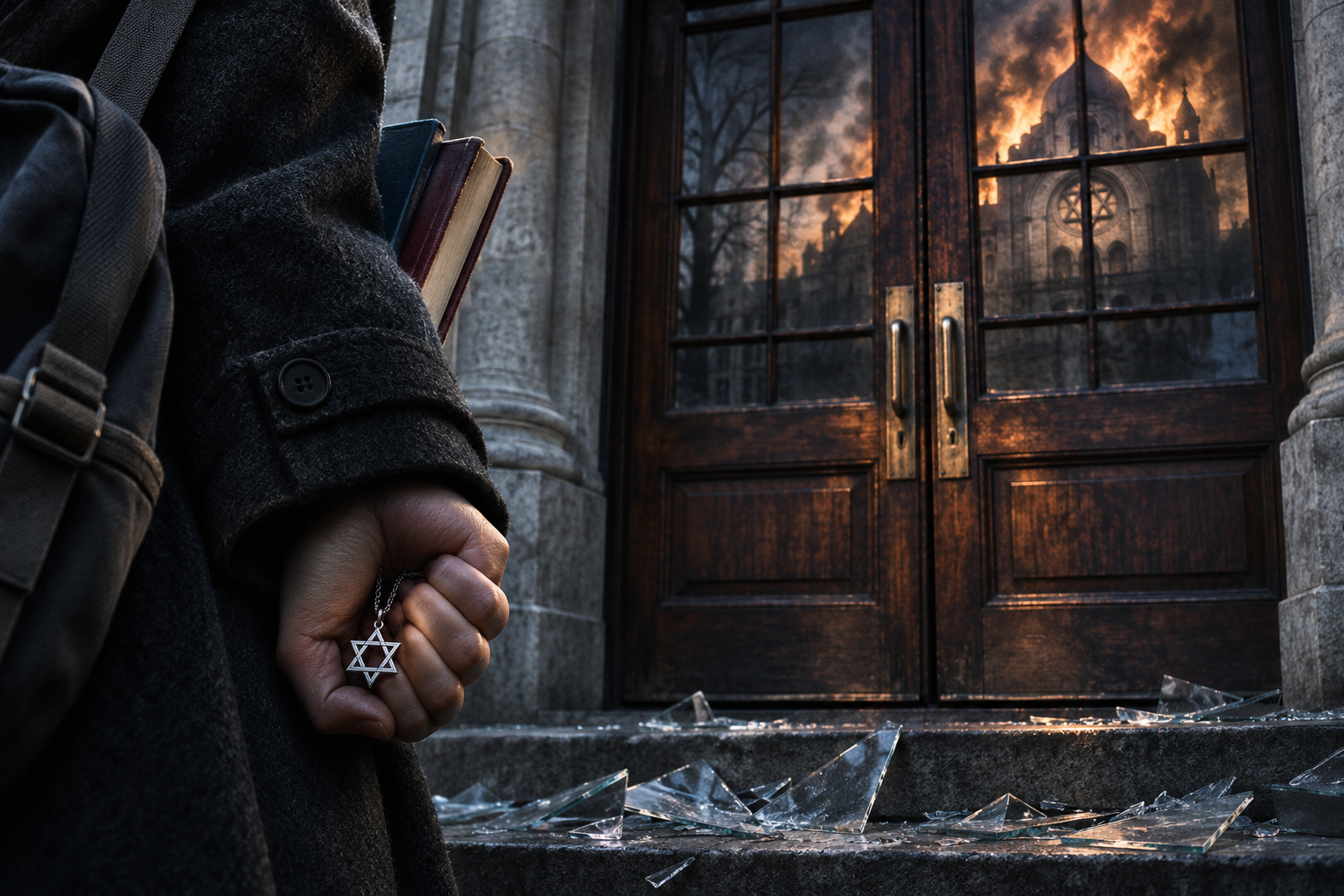
On November 9, Jews will mark 88 years since Kristallnacht, the night the Nazis burned synagogues, destroyed Jewish businesses and dragged Jewish men into concentration camps. Here in Montreal, the anniversary carries an additional significance. On November 9, 2023, bullet damage was discovered at Yeshiva Gedola and Talmud Torah Elementary, and three days later Yeshiva Gedola was shot at again. There is something particularly sickening about Jewish schools being attacked on the anniversary of a pogrom that we have spent decades teaching people to remember. But concentrating entirely on the bullets and broken windows allows us to avoid examining the treatment of Jews long before someone picks up a gun.
In September 1933, Dr. Susanne Engelmann, the principal of a large girls’ high school in Berlin, received a letter dismissing her from public school teaching under the Nazi civil service law. The United States Holocaust Memorial Museum preserves the document, a piece of administrative correspondence recording the removal of a Jewish educator from her profession. There were still five years to go before Kristallnacht. By then, the German government was already deciding that being Jewish disqualified someone from a job she had been qualified to hold before the Nazis came to power.
The persecution developed through laws, regulations and decisions carried out by institutions. In April 1933, the government began removing Jews from the civil service and restricting their access to universities and the medical and legal professions. Further restrictions followed, progressively limiting their ability to work, study and support themselves. By the time more than 1,400 synagogues were destroyed during Kristallnacht, Jews had already spent years being stripped of their place in German society. Remembering the destruction without examining how Jewish exclusion became acceptable leaves an enormous part of the history untaught.
I find that omission particularly disturbing when reading what Jewish students are reporting about Canadian universities. A government commissioned study published in August found that 57 per cent of Jewish respondents avoided wearing or displaying Jewish symbols because of safety concerns, while 72 per cent limited what they said in class about being Jewish. These are students trying to get an education who have concluded that drawing less attention to their Jewish identity will make their lives easier or safer. Anyone running a university where students feel compelled to make that calculation should have considerably more to offer than a statement about how much the institution values diversity.
A student wearing a Star of David has not volunteered to defend an Israeli cabinet decision. A student wearing a kippah has not invited his classmates to interrogate him about Gaza. Jews have families in Israel, religious connections to Israel and a history that cannot be taught honestly by pretending Israel is some embarrassing attachment we acquired recently. Nobody has to agree with a Jewish student’s politics, but the expectation that a Jew must explain or renounce those connections before being accepted is outrageous. An institution that allows this pressure to continue is leaving Jewish students to negotiate the terms of their own participation in university life.
The findings about complaints are equally damning. Only a third of respondents reported the incident they described, and 63 per cent of those who reported were dissatisfied with its handling. Among those who did not report, 52 per cent thought reporting would not help. These percentages describe the survey participants, rather than every Jewish student in Canada, but the institutions concerned still have an obligation to address what those participants reported. A student who expects nothing from the complaints process has already lost confidence in the people responsible for protecting him. Telling him to submit another form does very little to repair that.
We have also developed a ludicrious standard for discussing this problem, where any reference to the history of Jewish persecution produces an argument over whether the present situation is identical to Nazi Germany. Historical knowledge is supposed to help people recognize and confront persecution before it reaches its worst possible expression. It should not require Jews to prove that they are about to be deported before their concerns about exclusion and intimidation are taken seriously. I have no interest in waiting for conditions to deteriorate enough to satisfy someone else’s requirements for an appropriate historical comparison.
Jewish students are also being asked to absorb the consequences of institutional hesitation. Keeping quiet may spare a student an argument, concealing a Jewish symbol may spare him unwanted attention, and abandoning a complaint may spare him weeks of frustration. Each accommodation makes life easier for the university because the problem becomes less visible. Administrators can carry on discussing inclusion while the students paying for their education learn which parts of themselves are better kept out of sight.
This November, universities participating in Holocaust remembrance should be expected to account for their handling of complaints from Jewish students. That includes whether complaints were investigated, whether established rules were enforced and whether students received an answer beyond an acknowledgement that their concerns had been received. The survey found that 70 per cent of Jewish respondents believed their university did not take Jew hatred seriously. Those institutions have students on their campuses now who do not trust them, and a remembrance ceremony does not constitute a response to their complaints.







Leave a Reply