
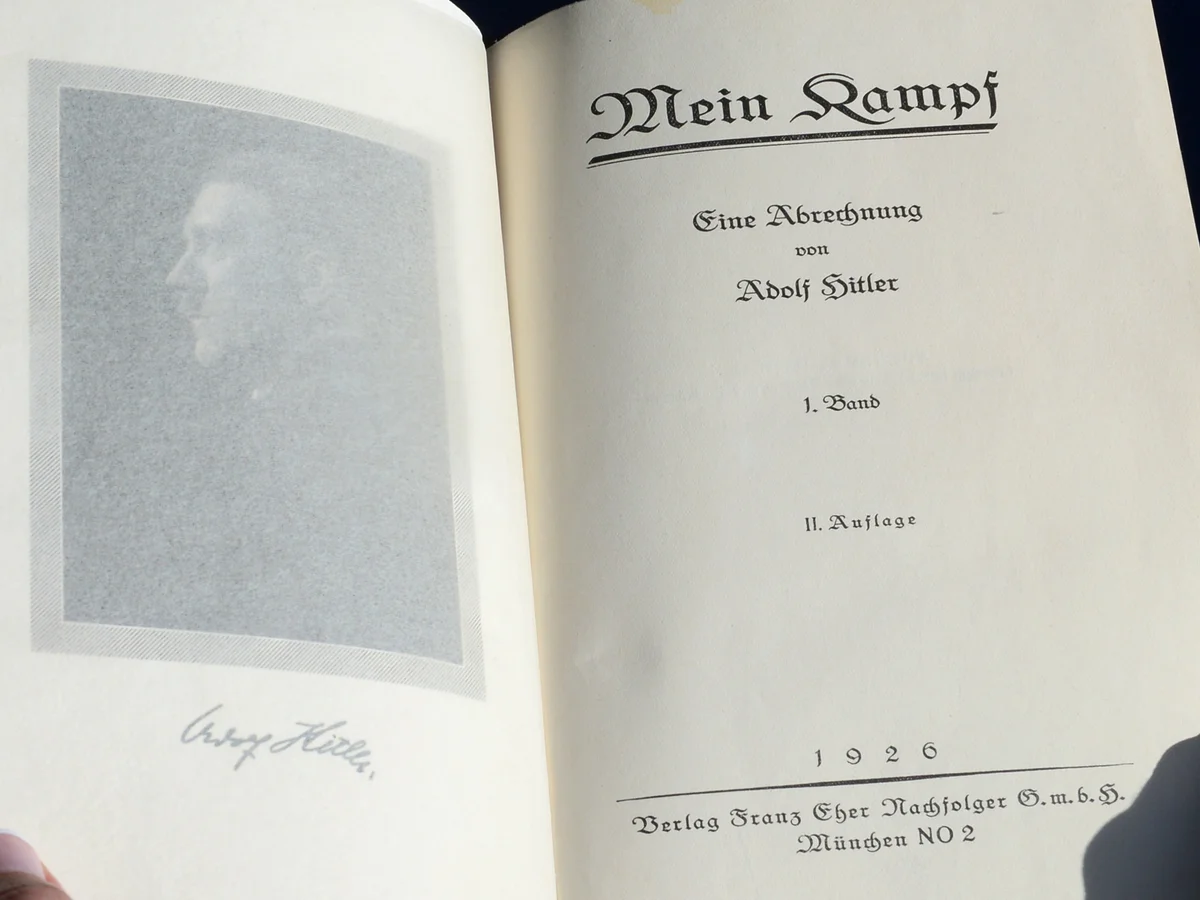
In 2010, an Ontario businessman named Bob Gale paid $6,345 for a copy of Adolf Hitler’s Mein Kampf, personally signed by the Nazi dictator. In 2018, the book was authenticated and appraised at $16,000. In March 2026, when the public learned that Gale owned it, the controversy became so intense that he resigned as chairman of Niagara Region. Now, eight months later, the book has been donated to a Jewish organization that intends to put it on display in a museum.
Apparently, a signed copy of Hitler’s manifesto is an intolerable object when it sits in a private collection, but becomes a valuable educational resource when it moves into a Jewish museum.
The book hasn’t changed. Neither has Hitler’s signature. What has changed is the identity of the person holding it and the purpose for which it will be used.
Gale was appointed regional chair in December 2025. Less than three months later, two Niagara anti-racism organizations publicly condemned his ownership of the book, demanding an explanation and an apology. The resulting controversy contributed to his resignation on March 11. Gale maintained that he was a collector of historical documents, including letters connected to George Washington, Winston Churchill and the American abolitionist John Brown. He also suggested that his political opponents were using the controversy to derail his attempts to reform regional government.
Whether Gale was an effective regional chairman is a separate issue. His proposed restructuring of municipal government had already made him unpopular with some local politicians, and there were legitimate political disagreements over his administration. But the revelation that he owned an unpleasant historical artifact quickly became grounds for questioning his character.
I would be considerably more interested in learning what Gale believed about Hitler than in knowing that he owned something Hitler signed. An autograph is evidence of an object’s provenance, not evidence that its owner agrees with the person who signed it. Museums, universities, historians and private collectors possess objects associated with some of the most depraved people in history. Those objects survive because destroying the evidence of history does nothing to change what happened.
In fact, this particular copy has an interesting history of its own. According to documentation reported by CityNews, the book contains an inscription identifying it as a gift to Max Sauerteig, described as a socially prominent Nazi Party member. That makes it more than an ordinary copy of a notorious political manifesto. It is an artifact connected to the people who circulated and embraced Hitler’s ideology.
The book itself is hardly a mystery. Hitler began writing Mein Kampf while imprisoned following his failed 1923 coup attempt. The first volume appeared in 1925, and its pages laid out much of the racial hatred and expansionist ambitions that would eventually define Nazi Germany. According to the United States Holocaust Memorial Museum, more than 12 million copies were printed by the end of 1944. It was distributed throughout Germany, including special editions intended for newly married couples.
The Nazis wanted Germans to read it. Today, some people seem to think the safest approach is to make sure nobody ever sees it. That is precisely the wrong lesson to take from the Holocaust.
The people who perpetrated the Holocaust did not conceal their hatred until the trains started moving. They published it, repeated it, taught it and eventually turned it into government policy. Hitler’s writings are important historical evidence because they demonstrate how openly the Nazis described their intentions while much of the world failed to appreciate the consequences.
Jewish Niagara, which operates a community centre in Niagara Falls, has accepted Gale’s donation and plans to display the book in a future museum. The organization’s Perla Zaltzman explained that difficult historical artifacts can serve an educational purpose when presented with appropriate context. She is absolutely correct.
Saleh Waziruddin of the Niagara Region Anti-Racism Association disagrees. He told local media that the book should not be publicly displayed because of its connection to the Holocaust, and questioned why someone genuinely interested in history would have kept it privately for so many years.
The suggestion that possessing an object associated with evil somehow contaminates its owner ignores much of what historical preservation actually involves. A museum can display a Nazi uniform without celebrating the SS. A historian can collect Nazi propaganda without endorsing its message. A collector can own a signed copy of Mein Kampf without believing a word of it.
There are legitimate questions about how such objects are acquired, how they are displayed, whether they were stolen, and whether their sale enriches people glorifying Nazi ideology. Those questions deserve answers. But ownership alone does not establish admiration.
There is also an uncomfortable inconsistency in the public reaction. We have reached a point where photographs of Hitler, Nazi documents and artifacts associated with the Holocaust are considered essential teaching materials, provided they are displayed by institutions we approve of. Put the same objects in a private collection and some people immediately assume the worst.
History is not made less disturbing by placing it behind museum glass. The swastika on a Nazi banner is the same swastika whether the banner is in a collector’s basement or a Holocaust museum. What matters is why the object is there, what is being done with it and whether the person possessing it is preserving history or celebrating its perpetrators.
I have no particular interest in defending Bob Gale’s political career. I do, however, have a serious problem with the idea that the mere possession of an authenticated historical document should be sufficient to condemn someone without examining his intentions or conduct.
The irony is that Gale has now done exactly what his critics say he should have done. He has placed the book in the hands of a Jewish organization, which intends to use it to educate the public. The same object that helped end his public career will eventually sit in a museum teaching people about the dangers of Nazi ideology.
Perhaps visitors to that museum will learn something about Hitler, about the people who supported him and about the consequences of allowing murderous ideas to become respectable political thought. That would be a worthwhile outcome.
It would also be worthwhile for those demanding that disturbing historical objects disappear from public view to remember that the Holocaust was perpetrated by people, not by books sitting on shelves.
A signed copy of Mein Kampf cannot murder anyone. The danger comes from people who believe what is written inside it, and we should be far more concerned about identifying those people than condemning someone for preserving a copy of the evidence.







Leave a Reply