
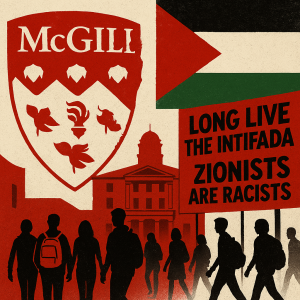
McGill University students voted overwhelmingly Monday night in favour of a motion calling on the Students’ Society of McGill University to push the university to end its exchange program with the Hebrew University of Jerusalem.
Solidarity for Palestinian Human Rights McGill, which supported the boycott campaign, announced the result on Instagram shortly after the September 28 SSMU General Assembly, claiming more than 96 percent of the votes cast were in favour.
The group celebrated the vote with a graphic declaring “VICTORY” and, underneath its description of the result, the words “LONG LIVE THE STUDENT INTIFADA,” followed by Palestinian flag and flaming heart emojis. The words were posted by SPHR McGill and were not part of the motion passed by students.
SSMU had not published an official numerical breakdown of Monday night’s vote as of Tuesday morning, so the 96 percent figure being circulated comes from SPHR McGill.
The motion calls for McGill’s exchange agreement with Hebrew University to be “neither renewed nor reinstated” and instructs the SSMU President and Vice President University Affairs to bring a corresponding motion before the McGill Senate no later than its January 13, 2027 meeting.
The vote does not cancel McGill’s agreement with Hebrew University. SSMU can adopt positions and instruct its representatives to lobby the university, but it cannot terminate a McGill academic agreement. The motion also provides for an online ratification vote by the wider SSMU membership following approval at the General Assembly.
The campaign to target Hebrew University had been underway before Monday’s meeting. Earlier this month, The McGill Daily reported that McGill student Sumayya Kheireddine was collecting the 500 signatures needed to bring the proposal before the General Assembly. Kheireddine said she had spent months filing Access to Information requests seeking information about McGill’s relationship with the Israeli university.
The exchange agreement allows McGill students to study at Hebrew University and Hebrew University students to attend McGill. The program is currently inactive for outgoing McGill students because university travel rules prohibit participation in programs in countries covered by certain Government of Canada travel advisories.
Organizers accuse Hebrew University of being closely connected to the Israel Defense Forces and have pointed to military academic programs at the university as justification for the boycott. They have also raised objections concerning Hebrew University’s Mount Scopus campus and its location in Jerusalem.
Hebrew University has rejected the international campaign to boycott Israeli universities. In April, the university established an Initiative for Academic Freedom and Dialogue to respond to the growing number of academic boycotts directed against Israeli institutions.
“Since October 7, 2023, we have observed with concern an increase in calls for boycotting Israeli academic institutions, including our own,” the university said in announcing the initiative. Hebrew University said targeting Israeli academia damages scientific cooperation and academic freedom and described academic boycotts as “morally misguided and practically counter productive,” regardless of criticism directed at the Israeli government.
This is not the first campaign at McGill aimed at ending academic relationships with Israel or Hebrew University.
In 2025, SPHR McGill launched an email campaign against a McGill summer exchange program with Hebrew University. According to The Link, the campaign sought to stop Israeli students and IDF soldiers from coming to McGill and accused the university of quietly restarting its POLI 339 summer course in Israel.
The McGill Association of University Teachers followed in October 2025, voting to endorse an academic and cultural boycott of Israel and calling on the McGill administration to implement a boycott of Israeli academic institutions. The MAUT resolution specifically stated that the boycott was intended to apply to institutional partnerships and agreements rather than individual Israeli academics.
McGill did not adopt the boycott and has repeatedly maintained that it will not sever academic relationships with Israeli universities because of political pressure. In December 2024, after several university buildings were vandalized during protests demanding divestment and sanctions against Israel, McGill President Deep Saini said the university’s rejection of BDS remained “clear and firm.”
The “student intifada” language used by SPHR McGill following Monday’s vote has also appeared repeatedly during demonstrations involving McGill students.
On October 7, 2024, the first anniversary of the Hamas attack on Israel, protesters gathered in Montreal carrying signs reading “The student intifada lives on!” while calling for McGill and Concordia to divest from companies connected to Israel and boycott Israeli academic institutions. SPHR McGill and SPHR Concordia promoted that demonstration and described October 7 as the anniversary of the “historic breach of the colonial border wall” and “a year of Palestine’s historic resistance.”
The Hebrew University vote comes as the fight over Israel continues to occupy McGill student politics. McGill law students voted earlier this year on a separate referendum concerning an academic and cultural boycott of Israel, a decision that was subsequently challenged through university procedures and the courts. SSMU’s own published election records continue to list the law school boycott referendum among its 2026 results.
Monday’s motion now moves into the next stage of the SSMU process. If ratified by the wider undergraduate membership, SSMU representatives will be required to take the demand to McGill’s Senate and ask the university to end the Hebrew University exchange.
McGill has not ended the exchange agreement.




Leave a Reply