
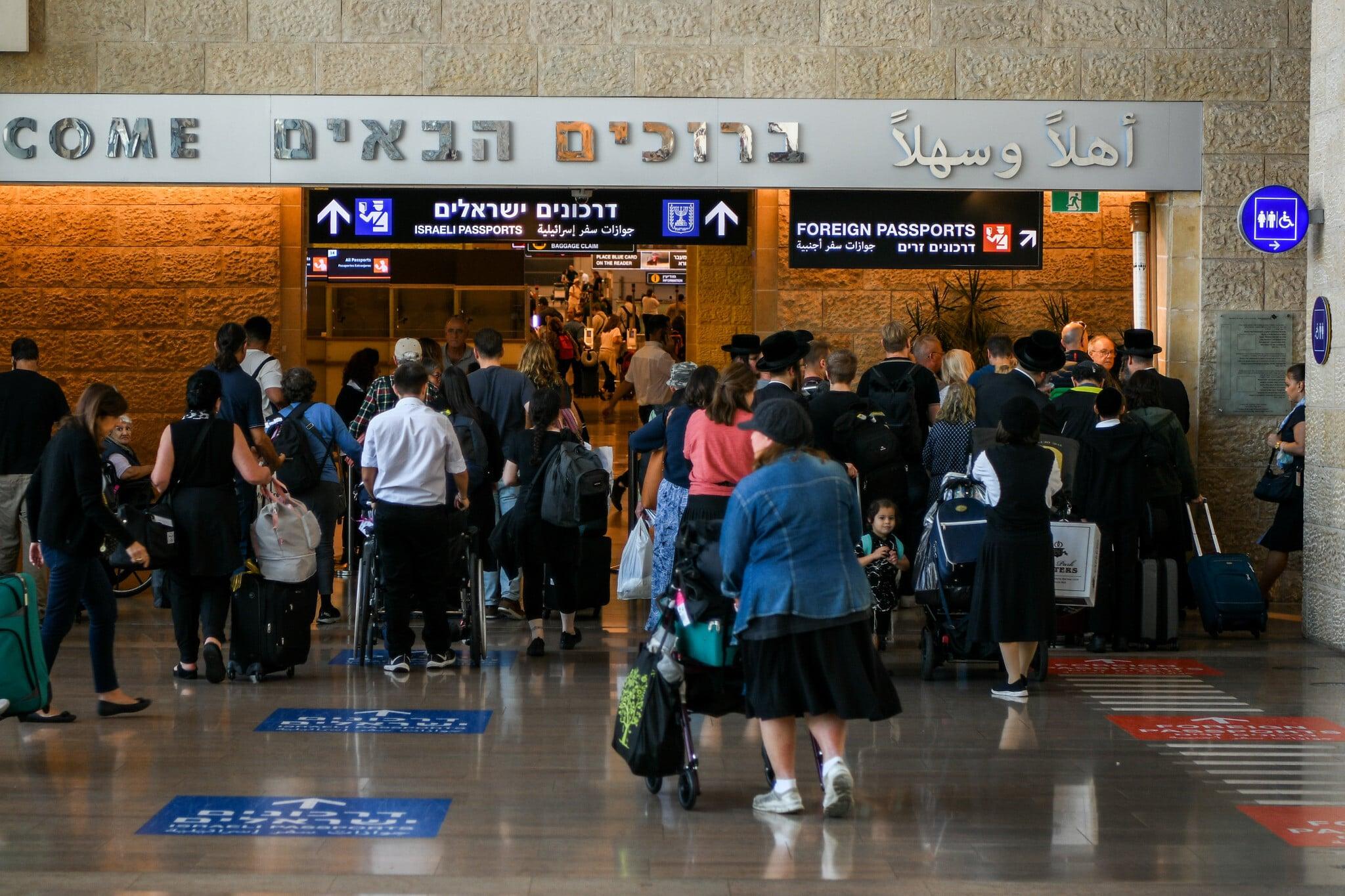
Israel has started reading past the line on an aliyah application that says the applicant is Jewish. Two young Jews who had already been approved by the Jewish Agency have now had their applications frozen by the Population and Immigration Authority, and both had been involved in pro Palestinian activism in Judea and Samaria. Neither application has been finally rejected, but both are being reviewed and communications reported by Haaretz indicate that their activism is part of the reason.
Lawrence Shenkin is a 23 year old British Jew who came to Israel at 18 to study in yeshiva and lived there for about five years. During that time he became active with Bnei Avraham, participating in what pro Palestinian groups describe as protective presence, accompanying Palestinians in Judea and Samaria. His electronic travel authorization was cancelled in January, he later returned to Britain for Pesach and found himself unable to get back into Israel, so he restarted the aliyah process from London. The Jewish Agency approved him in July and in August the Population and Immigration Authority informed him that the approval was under review and temporarily cancelled.
The second applicant is a 27 year old American Jewish woman who had also participated in protective presence activity. She too received approval from the Jewish Agency and then learned that the Population and Immigration Authority had frozen the file. Communications from the authority indicated that her Palestinian rights activism was involved in the decision, although neither applicant has been publicly accused of violence or criminal activity. Bnei Avraham has called the move a dangerous precedent and argues that the Law of Return cannot depend on the political position of the Jew applying.
They are not the first foreign Jews to discover that Israeli authorities have been paying attention to what activists are doing in Judea and Samaria. In August, the Forward interviewed seven American Jews whose electronic travel authorizations had been revoked after they participated in protective presence programs. One of them, New York actor Sam Sherman, was seven weeks into a three month placement in Masafer Yatta when the cancellation arrived, while another woman discovered that she could no longer enter after leaving Israel for a short trip. None of the seven interviewed by the Forward had been arrested or criminally charged.
The scrutiny is considerably larger than those seven cases. Israel National News reported in August that a special police desk operating in the Judea and Samaria District had helped deport 47 foreign activists and, since the beginning of 2026, had helped prevent another 130 from entering Israel. According to the report, the unit collects information on foreign activists suspected of interfering with security forces, acting against Jewish communities or engaging in anti Israel activity, and passes that information to the Interior Ministry and the Population and Immigration Authority.
A few months earlier, Tyler Oliveira discovered that Israeli officials were also willing to look at what someone had been doing thousands of kilometres away. Oliveira is an American YouTuber with millions of followers who produced videos about Orthodox and Hasidic communities in Kiryas Joel and Lakewood, focusing heavily on claims of welfare fraud, political influence and corruption. Jewish leaders accused him of pushing anti Jewish stereotypes and misrepresenting the communities, while Oliveira maintained that he was investigating government dependency and fraud.
In April, Oliveira publicly wondered whether Israel would let him into the country. He received his answer on May 11 when he arrived at Ben Gurion Airport and was refused entry. Diaspora Affairs Minister Amichai Chikli confirmed that he had intervened in the case and accused Oliveira of coming to Israel to spread hatred, while the Diaspora Affairs Ministry said his online activity went beyond legitimate expression. Israeli authorities looked at the material already attached to his name and made their decision before allowing him through the border.
The Entry into Israel Law already prohibited visas and residence permits for certain foreign nationals involved in boycott activity. In February 2025, the Knesset expanded those provisions to include people who deny the Holocaust, deny the October 7 massacre or publicly support international prosecution of Israeli citizens for actions carried out in their roles in Israel’s security services. The amendment passed its final readings with 12 members voting in favour and none opposed or abstaining.
The Law of Return is different. It begins with the famous promise that every Jew has the right to come to Israel as an oleh, but the law also contains exceptions. An oleh visa can be refused if the Interior Minister is satisfied that the applicant is engaged in activity directed against the Jewish people, is likely to endanger public health or the security of the state, or has a criminal past likely to endanger public welfare. The criminal provision was added in 1954, four years after the original law was passed.
Israel has used those provisions before, and one of the most famous cases involved a Jew who had actually done quite a bit for Israel before the government eventually showed him the door. Meyer Lansky was unquestionably Jewish, but his relationship with Israel went well beyond religious identity.
During the crucial years of 1947 and 1948, Lansky pressured Jewish and Italian underworld figures to raise money for Israel and used his connections on the New York waterfront to help expedite arms shipments barred by the American embargo. JTA later described his role as well documented and noted that, according to one version of events, Lansky’s connections were also used to sabotage ships carrying weapons to Arab countries. Whatever else Meyer Lansky was, when Jews in Palestine were trying to arm themselves for the war that would accompany the creation of Israel, he helped.
None of that guaranteed him a home there twenty years later. Lansky came to Israel in 1970 and eventually tried to remain under the Law of Return while American authorities were pursuing him and his reputation as one of the most important figures in American organized crime had followed him across the Atlantic. The Interior Ministry refused him immigrant status and Lansky challenged the decision. In September 1972, a five member Supreme Court panel unanimously upheld the government’s order to expel him, ruling that the ministry had sufficient grounds to conclude that Lansky had a criminal past likely to endanger public welfare.
Lansky’s case bears very little resemblance to two young Jews accompanying Palestinians in Judea and Samaria, but his history shows that Israeli authorities have never treated Jewish identity as the last page of an immigration file. A man who raised money for Israel, helped move weapons to Jewish forces during the War of Independence and had very real ties to the country was still judged on everything else the government knew about him. The Supreme Court did not erase what Lansky had done for Israel, it simply did not treat those contributions as cancelling the rest of his record.
Shenkin and the unnamed American woman have not been rejected. The Population and Immigration Authority says both applications remain under review and that decisions have not yet been made. If Israel refuses either applicant, the government will eventually have to explain what in those files caused it to reverse approvals that had already been granted.





Leave a Reply