
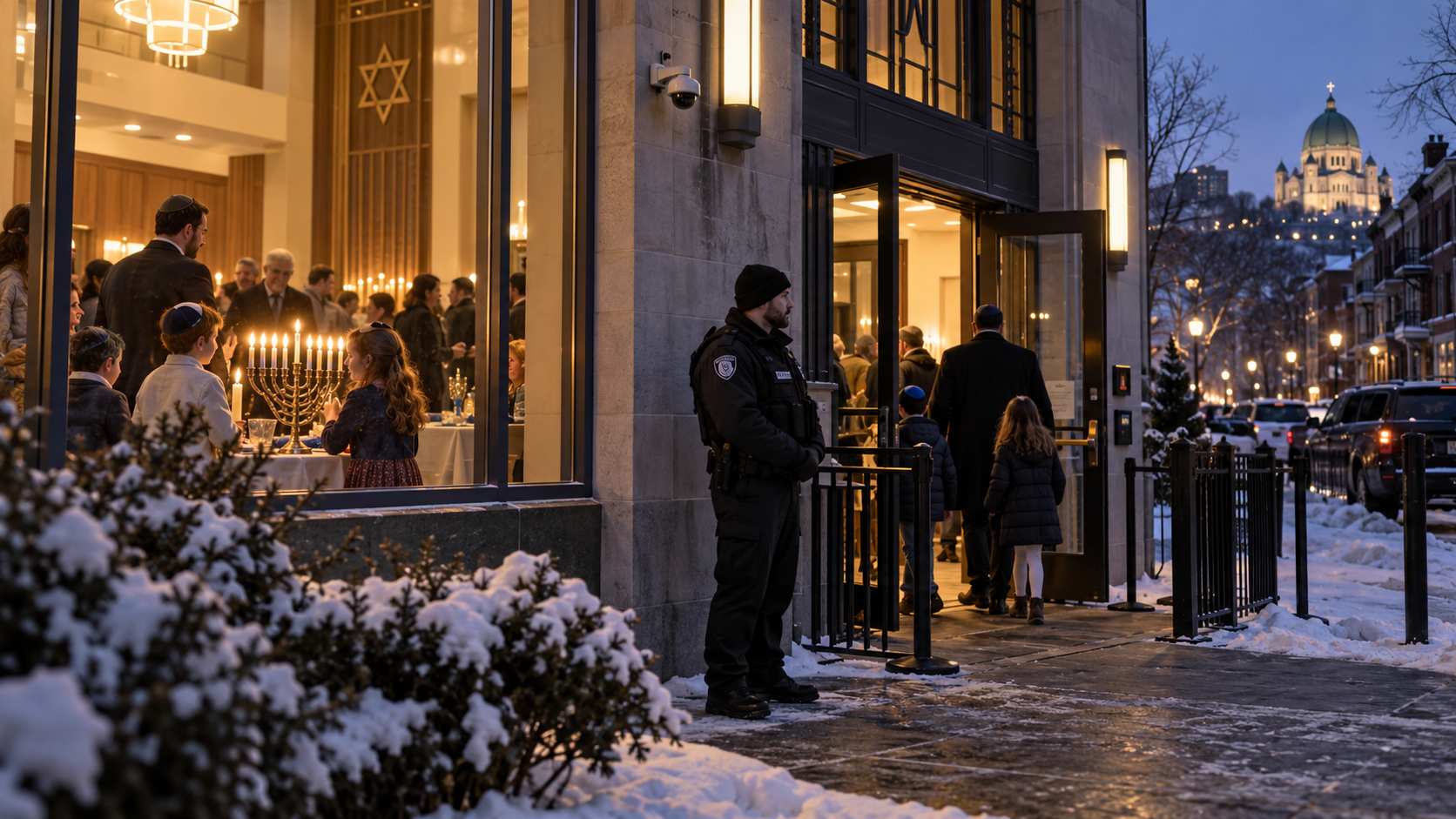
There is something profoundly disturbing about having to hire a security guard for a Chanukah celebration. Or a Purim party. Or simply to attend synagogue on a Saturday morning. Yet in Montreal, we have reached a point where these arrangements are so commonplace that most of us barely give them a second thought. We arrive at our community events, pass the security personnel, perhaps have our bags checked, and continue with whatever activity brought us there in the first place. We have become accustomed to the idea that gathering publicly as Jews involves a certain amount of personal risk, and I find it infuriating that we have allowed this to become an accepted part of Jewish life in Canada.
In March 2024, the federal government announced $293,083 in security funding for nine Jewish community projects in Montreal. Congregation Shomrim Laboker received funding to hire security guards for Shabbos services, Chanukah and Purim celebrations. Baron de Hirsch cemetery received money for security personnel and protective improvements, while Académie Yéchiva Yavné received $107,779 for security guards, surveillance equipment, a public address system and 50 classroom door barricades. Other recipients included JPPS Bialik, the MADA Community Centre and Federation CJA. These were not facilities housing dangerous criminals, military installations or government buildings containing classified information. They were Jewish institutions going about the ordinary business of serving their communities.
I find the cemetery example particularly offensive. Visiting the grave of a parent, grandparent or other loved one is among the most personal things someone can do. It is supposed to be a quiet moment of reflection and remembrance, yet apparently even our cemeteries require protection from people who might decide that attacking Jews extends to those visiting the dead. The federal government allocated $31,646 to Baron de Hirsch for a security guard, protective window film, a public address system and security training. Think about that for a moment. We are spending public money to ensure that people can visit a Jewish cemetery without being threatened or attacked. The fact that such an expenditure can be announced in a government press release without provoking widespread public outrage is almost as troubling as the need for it in the first place.
The situation in our schools is no less outrageous. Fifty classroom door barricades were included in the funding approved for Yéchiva Yavné. These are classrooms where children are supposed to learn mathematics, English, French and Jewish studies, where teachers should be concerned with lesson plans, report cards and helping students who are struggling academically. Instead, money must be spent on equipment intended to secure classroom doors in an emergency. I wonder how many parents outside the Jewish community have ever considered the possibility that their children’s schools might need additional security simply because of their religion. For Jewish parents, these considerations have become part of the school experience, and the children are growing up in an environment where security precautions are as familiar as the playground and the lunchroom.
I have no objection to the funding itself. The government has a responsibility to protect its citizens, and given the threats facing Jewish institutions, refusing to provide security assistance would be irresponsible. What angers me is that we appear to have accepted the need for these expenditures without giving nearly enough attention to the disgraceful circumstances that make them necessary. Our politicians announce security programs, community organizations apply for funding, contractors install equipment and guards are hired. Everyone congratulates everyone else for taking the appropriate steps, and another Jewish institution becomes a little more secure. Meanwhile, nobody seems particularly embarrassed that Canadian citizens require these extraordinary measures simply to practise their religion.
There is also an enormous financial burden that does not disappear when the government provides a grant. Security personnel must be paid, equipment requires maintenance, cameras need replacing and buildings must be modified. Money that could have gone toward scholarships, helping struggling families, expanding educational programs or supporting elderly community members is instead diverted toward protecting the people who use those services. For organizations already struggling with rising operating costs and fundraising pressures, security has become another expense that cannot be avoided. We are effectively being forced to pay an additional price for being Jewish, and the bill keeps growing.
Beyond the financial considerations, I am particularly bothered by how profoundly this situation has changed the ordinary experience of participating in Jewish life. We have become familiar with security procedures that would have seemed excessive not so many years ago. People register for events in advance, doors remain locked, guests must be identified and security personnel monitor activities that should require no more protection than a church gathering, a neighbourhood festival or a community dinner. There are occasions when the security arrangements themselves become a significant part of organizing the event. Instead of concentrating exclusively on the celebration, the program or the people attending, organizers must devote time and resources to ensuring that nobody gets hurt.
It is not only the large institutions that bear this burden. Consider the smaller synagogues operating on limited budgets, where volunteers already struggle to maintain the building, organize services and keep their congregations functioning. Consider community organizations planning events for children and families, where every additional expense means something else must be reduced or eliminated. These organizations exist to provide opportunities for Jewish people to gather, celebrate and maintain their traditions. They were never intended to operate as fortified facilities, yet increasingly they are expected to behave like them.
What I find particularly offensive is the expectation that Jews should simply adjust to this reality. We are advised to remain vigilant, report suspicious activity, avoid unnecessary risks and take additional precautions when participating in public events. All perfectly reasonable advice under the circumstances, but I am getting rather tired of being told how Jews can better protect themselves from people who hate them. We have become remarkably efficient at modifying our own behaviour, protecting our buildings and preparing for potential attacks. The people creating the threats, meanwhile, have succeeded in imposing restrictions on our lives without necessarily having to do anything beyond making us believe that an attack is possible.
And there is a personal cost to all of this that cannot be calculated in dollars. There are people who think twice about attending a public Jewish event, parents who worry about their children and individuals who have become more cautious about displaying their Jewish identity. I am not suggesting that every Jew in Montreal lives in fear, because that would be ridiculous. Most of us continue with our daily activities, attend synagogue, send our children to school and participate in community life. But there is a difference between living normally and having to make a conscious decision to disregard the potential danger associated with doing perfectly normal things.
The saddest part may be what we are teaching the next generation. Today’s Jewish children are growing up in a Montreal where security guards are part of the scenery, where certain buildings have controlled access and where adults routinely discuss threats directed at Jewish institutions. For many of these children, this is simply the way things have always been. They have no memory of a time when security precautions were less intrusive, and they may have difficulty imagining that there should be anything unusual about the arrangements surrounding their schools and places of worship. I find that particularly difficult to accept. We are raising children in a country that prides itself on religious freedom and multiculturalism, while simultaneously teaching them that practising their own religion requires extraordinary protection.
We are also doing a remarkable job of hiding the severity of this situation from ourselves. Every successful Jewish event held without incident is treated as evidence that our security arrangements are working, and perhaps they are. But we have developed a rather peculiar definition of success when a religious celebration is considered successful partly because nobody attempted to attack it. We have lowered our expectations of what it means to live safely in this city, and I am not convinced that we even recognize how far those expectations have fallen.
Montreal has a long and rich Jewish history. Generations of Jewish families have established themselves here, built businesses, created institutions and contributed enormously to the city’s development. Jewish hospitals, charitable organizations, schools and cultural institutions have served Montrealers from every background, and the Jewish community has never asked for anything beyond the rights and protections that every Canadian citizen is supposed to enjoy. Yet here we are, in 2026, investing substantial amounts of money in security measures that are necessary precisely because those rights and protections cannot be taken for granted.
I am grateful to the police officers, security personnel and community volunteers who work to protect Jewish Montrealers, and I have nothing but respect for the difficult work they do. But their dedication should not become an excuse for the rest of society to avoid confronting the situation that has made their presence so necessary. We should be absolutely furious that Jewish cemeteries require security guards, that classroom barricades are being installed in Jewish schools and that celebrating Chanukah or attending Shabbos services can require additional protection. Instead, these arrangements have become routine, their costs have become accepted and the announcements of additional security funding are treated as positive developments.
There is something terribly wrong with a society in which a government can announce that it is helping citizens protect themselves from religious hatred, while the citizens being protected are expected to express gratitude rather than outrage at the conditions that have made such protection necessary.
I refuse to accept that this is simply the price of being Jewish in Montreal. We should not have to turn our synagogues into secure compounds, our classrooms into emergency shelters or our cemeteries into guarded properties. Those responsible for spreading hatred and threatening Jewish institutions should be the ones facing restrictions on their activities, not the people trying to attend a religious service or visit a loved one’s grave.
We have become very good at protecting ourselves. Unfortunately, the people who have made all this protection necessary seem to have become equally comfortable with the arrangement. They threaten, we spend money, and everyone else gets to carry on as though this were a perfectly reasonable way for a community to live.
It isn’t. And I am getting very tired of pretending otherwise.




Leave a Reply