
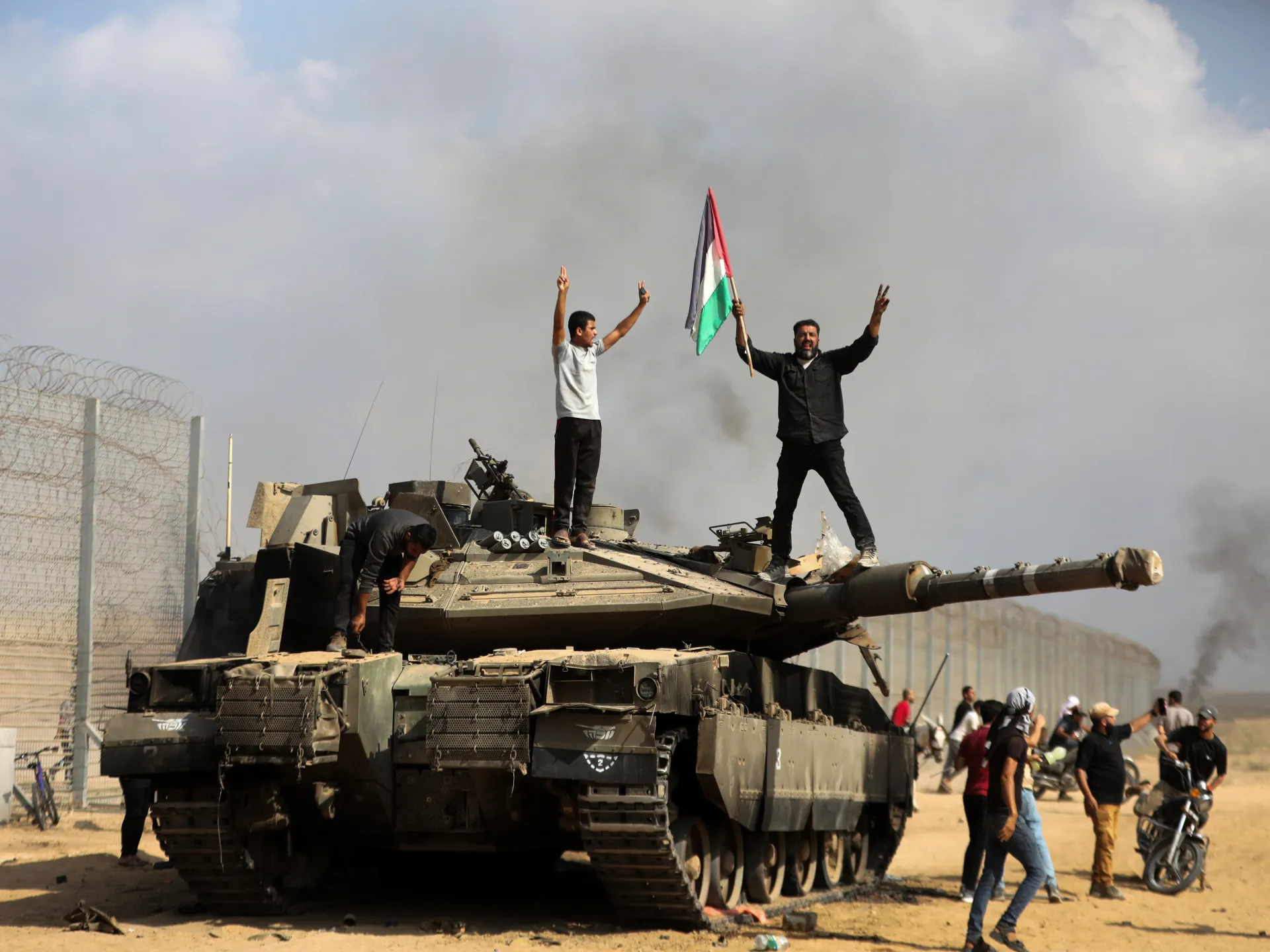
Today the Prime Minister of Canada called what Hamas did on October 7th “the worst attack against Jewish people since the Holocaust,” and on the very same day CTV News ran a Canadian Press story marking the anniversary under the headline “Anniversary of Gaza war marks 3 years of pain for Canadians with ties to Middle East.” Read the headline carefully. Three years after Hamas terrorists crossed into Israel and murdered approximately 1,200 people, most of them civilians, slaughtered hundreds of young people at a music festival and dragged another 251 people into Gaza, the anniversary has somehow become the anniversary of the Gaza war. Even more disturbing is that once you get past the opening paragraphs, the pain presented in the story belongs almost entirely to people who suffered as a result of Israel’s response.
The Canadian Press story is built around three Canadians: an Edmonton mother whose husband is stuck in Gaza, Sylvie Labrecque, whose son, an aid worker, was killed in an Israeli airstrike, and the brother of a Windsor man killed in southern Lebanon in what his family says was an unprovoked Israeli drone strike. Hamas and the October 7th massacre are mentioned briefly near the beginning and then largely disappear. The Canadian Press states that the war “has killed more than 75,000 people in the Gaza Strip” and that Israel is “violently occupying southern Lebanon and allowing settlers to attack Palestinians in the West Bank.” There is no attribution attached to those statements, they are simply presented as fact. Israel, meanwhile, “insists” that it is defending itself and attempting to avoid civilian casualties, and even that one sentence ends with Labrecque saying the claim “strains credibility.” Nobody who lost a family member on October 7th is quoted. The words Jewish and antisemitism do not appear anywhere in the story. On the third anniversary of the largest massacre of Jews since the Holocaust, I find that disgusting.
October 7th, 2023 fell on both Shabbos and Simchas Torah, the day Jews finish reading the Torah and immediately begin reading it again. Hamas launched its attack at 6:29 in the morning and by the time the killing was over approximately 1,200 people were dead and 251 had been taken into Gaza as hostages. Four days later I wrote that there was a time when I believed evil existed but was somehow restrained by basic humanity, and after seeing what happened that Saturday morning I no longer believed it. Three years have passed and unfortunately nothing I have seen since has given me much reason to change my mind.
The terrorists murdered 364 people at the Nova music festival and went through communities including Be’eri, Kfar Aza and Nir Oz, murdering people inside their homes and, in some cases, wiping out entire families. Human Rights Watch reported that houses were deliberately set on fire, burning and suffocating people inside, while a United Nations team later found reasonable grounds to believe that rape and gang rape took place during the attacks and that in most of the cases it examined the women were raped before being murdered. Thirty nine of the 251 hostages were children.
Kfir Bibas was only nine months old when he was kidnapped from his home in Nir Oz along with his mother Shiri and his brother Ariel. He was the youngest hostage taken into Gaza and in February 2025 Hamas turned the return of his body into a public ceremony in Khan Younis in front of hundreds of people. The last hostage to come home was Ran Gvili, a 24 year old police officer who was killed fighting the terrorists on October 7th. His body remained in Gaza for more than two years before finally being returned to Israel in January of this year. These were babies, soldiers, grandparents and young people who went to a music festival. Some eventually came home alive and many did not.
One of the people murdered at Nova was from Montreal. Alexandre Look was 33 years old and visiting Israel when the attack happened. His mother Raquel later told CTV Montreal that according to a first responder Alexandre was found lying over two people he had been trying to protect at the entrance to a shelter and had taken most of the bullets and grenades. Prime Minister Carney mentioned Alexandre in his statement today, and Côte Saint Luc dedicated Alexandre Look Place in his memory in 2024.
What happened immediately after October 7th disturbed me almost as much as the speed with which the massacre itself disappeared from the discussion. Before many of the dead had even been identified, Samidoun was distributing pastries on a street in Berlin to celebrate the attack. Germany dissolved the organization’s German branch less than a month later. At Harvard, on the same Saturday as the massacre, the Palestine Solidarity Committee and more than thirty other student organizations released a statement holding “the Israeli regime entirely responsible for all unfolding violence.” Israel had not yet buried its dead and people thousands of kilometres away had already managed to decide that the people who were murdered were responsible for their own murders.
Three years later, we are watching the same thing happen again on the anniversary itself, except this time we do not have to speculate about what some of these demonstrations represent because the protesters are telling us themselves. In London, approximately 250 pro Palestinian protesters marched through the city despite the Metropolitan Police publicly asking them to choose another day because of the distress an October 7 demonstration would cause the Jewish community. Protesters chanted “We will honour our martyrs,” “From the river to the sea” and “End the Zionist occupation.” Earlier in the day another group demonstrated outside the London headquarters of the Board of Deputies of British Jews, the representative body of British Jewry, carrying signs accusing it of being a “shield for Israel’s crimes.” Five people were arrested there on suspicion of inciting racial hatred over alleged chants calling for intifada, and by the end of the day police said eleven people had been arrested at demonstrations across London.
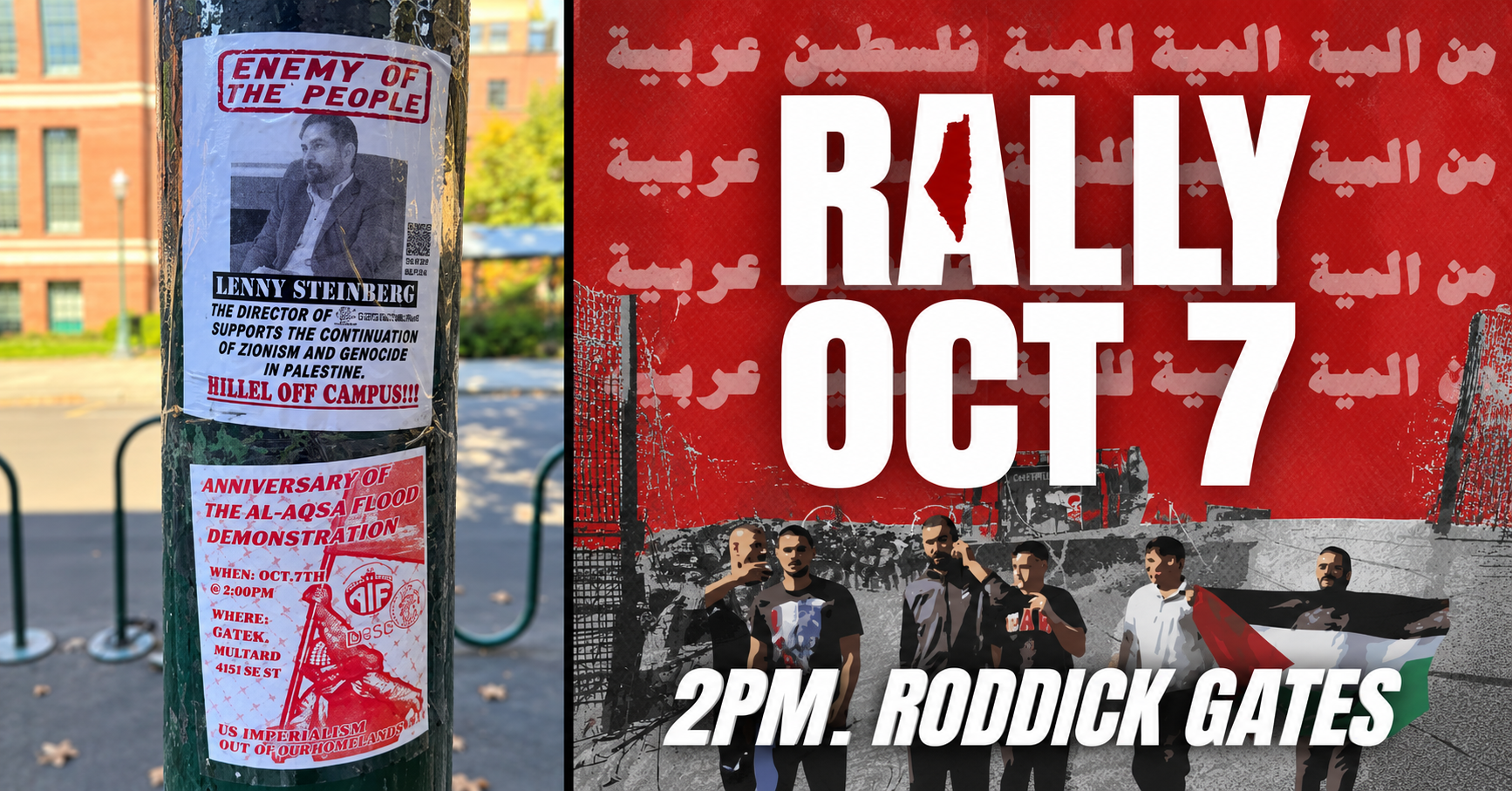
The same thing was happening in Scotland. Pro Palestinian demonstrations were held at Glasgow and Edinburgh universities and in Glasgow demonstrators marched behind a banner reading “Glory to our Martyrs.” In Sydney, reporting from today showed a poster depicting Yahya Sinwar, one of the Hamas leaders responsible for planning the October 7th attack, displayed at a pro Palestinian vigil while Jewish Australians were gathering to remember the people murdered three years ago. In Melbourne, another Gaza vigil was held outside the State Library of Victoria. In New York, organizers promoting a City Hall demonstration described the anniversary as marking “three years of resistance” and called on participants to honour Palestinian “martyrs, prisoners, and liberators.” Earlier promotional material supported by several activist groups described October 7th as the day “resistance against imperialism changed the fate of our world forever.” Some groups later distanced themselves from that wording after it attracted attention, but by then the statement had already been published.
There is a difference between protesting Israel’s conduct in Gaza and choosing October 7th to chant about martyrs, carry a picture of Yahya Sinwar or describe the massacre as resistance. People are free to protest Israel every other day of the year. When they deliberately choose the anniversary of the day Hamas murdered approximately 1,200 people and then use that day to honour martyrs and resistance, I think we are entitled to take them at their word.
We heard the same explanations immediately after the attack. October 7th needed context. The occupation had to be discussed. Gaza had to be discussed. Settlements had to be discussed. The blockade had to be discussed. Everything needed to be discussed except apparently what had happened to the people who were murdered. Three years later I still have not heard the context that explains kidnapping a nine month old baby from his home, murdering hundreds of young people at a music festival or setting fire to houses with families inside them.
It didn’t stay overseas either. Within five weeks of the massacre, gunfire hit two Jewish schools here in Montreal and four days later one of those schools was shot at again. Nobody was injured, but somehow Jewish children attending school in Montreal became targets because of a war taking place thousands of kilometres away. On July 3rd of this year, Montreal police allege that two twenty year old men approached visibly Jewish residents in Outremont, shouted insults and threw objects at them. Security video appears to show one of the men stealing several shtreimels before leaving in a vehicle. Both men were arrested, released on conditions and are expected to appear in court next year.
This morning in Toronto, police began investigating what they describe as a possible hate motivated offence after several Israeli flags were set on fire at approximately 1:30 in the morning. There have been no arrests and police have not announced a motive, so I am not going to pretend we know something the police do not know. I will simply point out that it happened on October 7th, on the third anniversary of the Hamas massacre, while Jewish communities across Canada were preparing to hold memorial services for the dead.
To its credit, the Canadian Press did produce another anniversary story today, also carried by CTV, dealing specifically with what has happened to Jews in Canada since October 7th. In that story Rabbi Lisa Grushcow of Temple Emanu-El-Beth Sholom in Westmount tells the story of attending a Pride march wearing a rainbow Star of David and being called a baby killer. Her synagogue was attacked with a firebomb in June. Rabbi Grushcow asks how “any connection or care for Israel,” which she says reflects the reality of the vast majority of Canadian Jews, has become a reason to exclude Jews from academic, professional and personal relationships.
Somewhere over the past three years the victim became the aggressor and Jews living in Canada became personally responsible for whatever somebody believes the Israeli government has done wrong. The numbers show that this is not simply a feeling inside the Jewish community. Statistics Canada recorded 527 police reported hate crimes against Jews in 2022, the year before October 7th. That number jumped to 959 in 2023, stood at 943 in 2024 and was 788 last year. It has come down from the peak, but it is still approximately fifty percent higher than it was before October 7th. Jews represent less than one percent of Canada’s population and last year were the target of more than seventy percent of all police reported religion based hate crimes in the country.
B’nai Brith Canada, which keeps its own count, recorded 6,800 incidents in 2025, the highest number since it began keeping statistics in 1982, and by July 15th of this year it had already recorded 27 violent incidents, more than twice the ten it recorded during all of 2025. Prime Minister Carney addressed this in his statement today, writing that “Since October 7, 2023, Jewish communities across our country have faced a devastating resurgence of antisemitism.” He wrote that every Jewish Canadian has the right to be visibly and fully Jewish at school, at work, on the street and in synagogue, and promised new laws, additional resources and greater protection for Jewish institutions.
Those are the right words and I am glad he said them, but Rabbi Grushcow made another statement in that Canadian Press story that probably comes closer to describing where we are. She said Canadians have to stop saying “this isn’t who we are” and recognize that “it’s who we’ve become.” Looking at what has happened to Jewish schools, synagogues, businesses and individual Jews over the past three years, I find it difficult to disagree with her.
There is another part of the October 7th discussion that has bothered me from the beginning, and that is the constant insistence that everything taking place between Israel and the Palestinians can be explained by land. In 2009 I wrote a piece called “The Anatomy of Hating Israel.” Former President Jimmy Carter had called on the Obama Administration to take Hamas off the terror watch list and Israeli Prime Minister Benjamin Netanyahu had offered the Palestinians a state with two conditions, that the new state be demilitarized and that Israel be recognized as the Jewish State. The Palestinian leadership rejected the offer.
Nine years earlier, at Camp David, Ehud Barak offered Yasser Arafat a Palestinian state in as much as ninety five percent of Judea and Samaria, all of Gaza and control over parts of Jerusalem. Arafat rejected the offer, made no counteroffer and walked away. Barely two months later the second intifada began. Israel offered a state and the answer was no, then offered another one and the answer was no again.
Then Israel tried something different. In 2005 it stopped offering Gaza and simply left it. Israel dismantled all twenty one Jewish communities, removed approximately eight thousand of its own citizens from their homes, withdrew the army and even removed Jewish bodies from cemeteries. There were no Jewish settlements left and no Israeli soldiers stationed inside Gaza. If the conflict was simply about land, that should have settled the Gaza part of it.
Instead Hamas won the Palestinian election in 2006. The Quartet, made up of the United States, United Nations, European Union and Russia, asked Hamas to meet three fairly straightforward conditions before being accepted internationally: renounce violence, recognize Israel and honour the agreements already signed by the Palestinian leadership. Hamas refused. In June 2007 Hamas seized Gaza from Fatah by force. Human Rights Watch reported that 161 Palestinians were killed in eight days, hundreds of Fatah leaders, activists and supporters were arrested and reports of beatings and torture were common. That is what took control of the territory Israel had completely evacuated two years earlier.
When Hamas crossed into Israel on October 7th, there were no Jewish settlements inside Gaza to attack and there were no Israeli soldiers occupying Gaza. The people Hamas murdered were inside Israel’s pre 1967 borders, attending a music festival or sleeping inside their homes. People can argue about the blockade, although no honest discussion of the blockade can pretend Egypt does not exist, but I have yet to hear anybody explain what a blockade has to do with kidnapping a baby or murdering hundreds of people at a music festival.
Maybe after three years it is time to acknowledge that this conflict is not simply about a border. Hamas itself called the attack Operation Al Aqsa Flood, named after a mosque, not a settlement, checkpoint or disputed piece of land. Seventeen days after the massacre, Ghazi Hamad of the Hamas political bureau appeared on Lebanon’s LBC television and said October 7th would happen again, telling the interviewer that “there will be a second, a third, a fourth.” When he was asked whether ending the occupation meant the annihilation of Israel, he answered, “Yes, of course.” Hamas was telling the world quite clearly that when it talks about occupation it is talking about Israel itself.
That thinking did not begin with Hamas. The Palestine Liberation Organization was created in 1964 following an Arab League summit in Cairo, three years before Israel took control of Judea and Samaria or Gaza. At the time Jordan controlled Judea and Samaria and Egypt controlled Gaza. There were no Israeli settlements in either territory and there were no Israeli soldiers there. Yet there was already a Palestine Liberation Organization dedicated to liberation. Three years later, after the Six Day War, Arab leaders met in Khartoum and issued the famous three noes: no peace with Israel, no recognition of Israel and no negotiations with Israel.
For decades we have been told that if Israel would only give up land there would be peace. Israel offered a Palestinian state, offered another one and then, in Gaza, stopped asking and simply packed up and left. The result was not peace. Eighteen years after the Gaza withdrawal, Hamas crossed into Israel on a Jewish holiday and murdered approximately 1,200 people.
The problem is no longer that people have forgotten what happened on October 7th. Three years later, some have decided that what happened does not deserve to be remembered on its own terms. The massacre has been turned into “resistance,” the murderers into “martyrs,” and the victims into an inconvenience that has to be pushed aside before the argument about Israel can begin. When people choose October 7th itself to march with pictures of Yahya Sinwar, honour “martyrs” and celebrate “resistance,” they are telling us exactly what they think of the people who were murdered that morning.
October 7th was not a protest, an uprising or an act of liberation. Hamas crossed into Israel and murdered families in their homes, slaughtered hundreds of young people at a music festival, raped women and kidnapped babies. That is what happened, and no amount of chanting, rewriting, academic justification or carefully sanitized journalism changes it. Remember the names of the people who were murdered, but remember something else as well: three years later there are still people willing to celebrate the men who killed them. Believe them when they tell you who they are.


Leave a Reply