
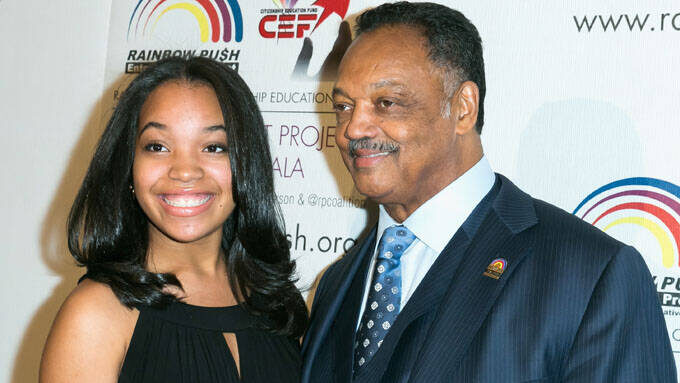
The late Reverend Jesse Jackson’s daughter has converted to Judaism, joining the people her father once dismissed as “Hymies.” Ashley Jackson completed her conversion in June and adopted the Hebrew name Miriam Yiskah. Her decision adds an extraordinary chapter to the family history of a civil rights leader whose own Jew hatred became a national political scandal.
Ashley was born in 1999 following Jackson’s extramarital affair with Karin Stanford, a member of his staff. He publicly acknowledged paternity in 2001, while still married to his wife, Jacqueline.
Ashley says her father supported her embrace of Jewish life. Before his death in February, he accompanied her to synagogue, sat beside her during services and received a standing ovation from the congregation. She remembers a loving father who encouraged her spiritual search, and she is entitled to that memory. Jews who remember his public career have considerably more to work through than a pleasant morning in shul.
Jackson carried the authority of the civil rights movement into almost everything he did. He worked with Martin Luther King Jr., led the Southern Christian Leadership Conference’s Operation Breadbasket campaign in Chicago and became part of King’s inner circle. On April 4, 1968, he was at the Lorraine Motel in Memphis speaking with King on the balcony above when King was shot. His proximity to King helped establish his standing as a national leader.
A man with that experience understood what racial hatred could do. He understood the power of language, the humiliation of ethnic insults and the responsibility that came with speaking for people who had suffered discrimination. Jews were entitled to expect that understanding to extend to them.
In 1979, Jackson travelled to the Middle East and embraced PLO chairman Yasser Arafat. The photograph became famous, while the failure of the visit deserves at least as much attention. Contemporary reporting in the Atlanta Journal and Constitution recorded that Jackson sought written commitments recognizing Israel’s right to exist and renouncing terrorism. He left without either commitment, with Arafat deferring the matter to the Palestine National Council. The hugs were considerably easier to obtain.
Jewish members of Jackson’s delegation publicly criticized his conduct during the trip. Contemporary reporting also attributed to him the statement that he was “sick and tired of hearing about the Holocaust,” along with a complaint about America being subjected to a guilt trip. Jackson subsequently argued that his words had been taken out of context and that he meant to discuss suffering experienced by both Black people and Jews. Remembering six million murdered Jews apparently required an explanation of why other people had suffered too.
The 1984 presidential campaign removed any ambiguity about his willingness to use an anti Jewish insult. Jackson referred to Jews as “Hymies” and New York as “Hymietown” in a conversation with a Washington Post reporter. When questioned, he initially claimed not to recall saying it. He also accused unidentified members of the Jewish community of “hounding” his campaign, turning criticism of his conduct into a complaint against the people he had insulted.
He eventually admitted making the remarks before a synagogue audience in New Hampshire, shortly before the presidential primary. Even then, he insisted that neither he nor his comments reflected hatred of Jews. Jackson wanted to acknowledge the words while retaining the authority to tell Jews what those words meant.
Louis Farrakhan then helped turn the scandal into something uglier. The Nation of Islam leader attacked Milton Coleman, the Black reporter who disclosed Jackson’s remarks, with language widely understood as threatening. Jackson’s Democratic rivals challenged his refusal to repudiate Farrakhan’s support, while Jackson suggested that the threats should be understood within their religious context. A journalist had reported what a presidential candidate said, and the candidate’s prominent supporter was going after the journalist.
In June, Jackson finally condemned Farrakhan’s attacks on Jews and supporters of Israel as “reprehensible and morally indefensible.” It had taken months of controversy to reach a position that should have required very little deliberation from a civil rights leader.
In August 1991, a Crown Heights accident demonstrated how quickly hatred of Jews could turn murderous. A station wagon travelling in the entourage of the Lubavitcher Rebbe, Rabbi Menachem Mendel Schneerson, struck two Black children, killing one. Rumours spread that Jewish ambulance personnel had abandoned the children while rescuing the Jewish driver. The Justice Department’s account states that police directed the first ambulance to transport the injured driver, while additional ambulances treated and transported the children.
That offered little protection to Jews in the neighbourhood. The Justice Department describes activist Charles Price urging a crowd to “get the Jews,” followed by attacks that culminated in the fatal stabbing of Australian Jewish scholar Yankel Rosenbaum. He was a Jewish man on a Brooklyn street, and that was enough to make him a target.
Jackson condemned Jew hatred and praised Zionism as a liberation movement at a Brussels conference in 1992. His support of Zionism did not erase his original offence, because a civil rights résumé does not make “Hymietown” any less of an anti Jewish slur.
Ashley Jackson has spoken about being frightened to announce her conversion during a period of rising Jew hatred. She wondered whether friends and allies would accept her decision, then found herself warmly welcomed by Jewish communities. The daughter of one of America’s most recognizable civil rights leaders had to consider whether becoming Jewish would cost her friends.
That is the part of her story his admirers should spend some time thinking about.






Leave a Reply