
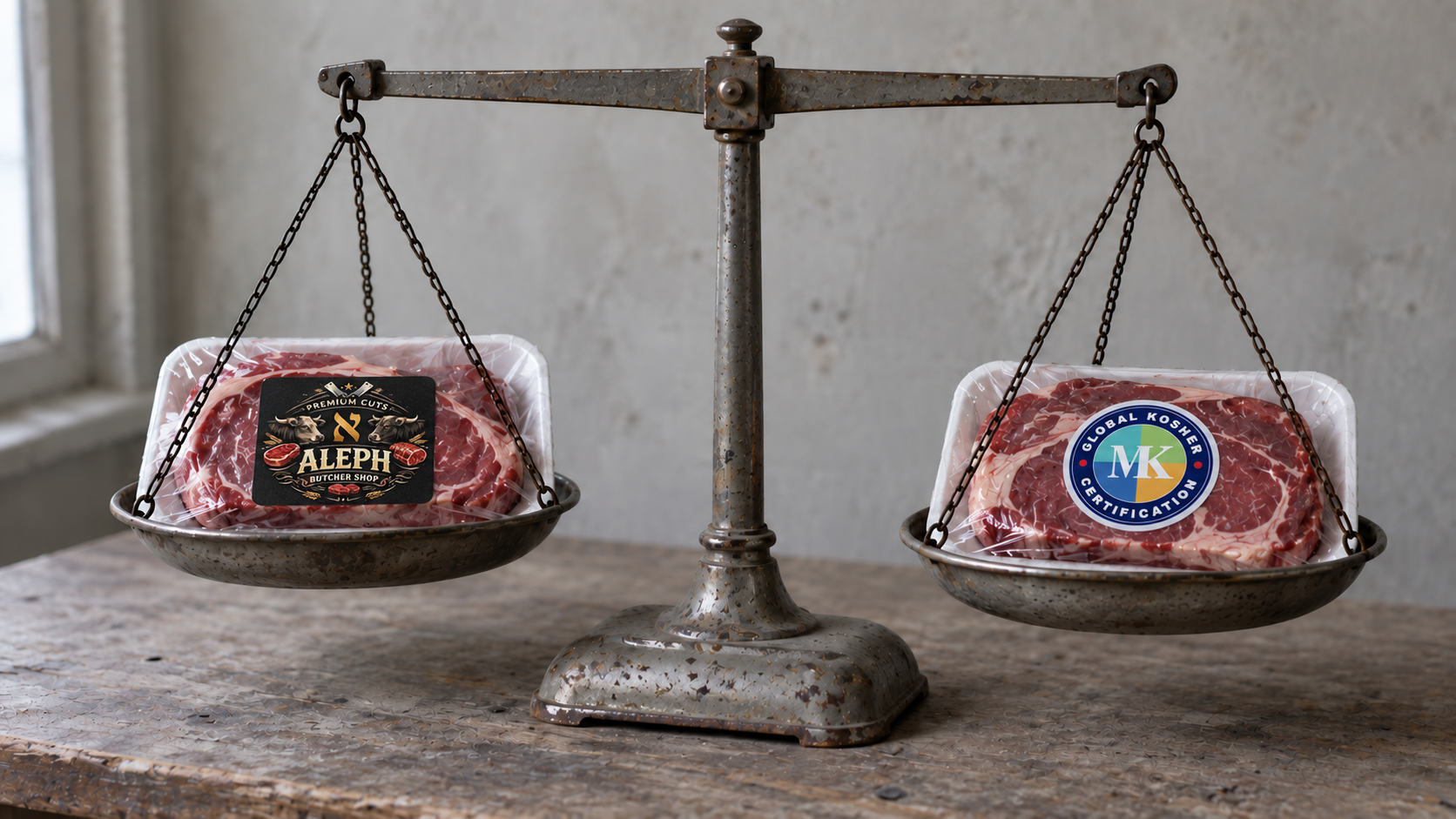
Montreal’s kosher meat war has taken another turn, with Aleph Meats now using the MK’s own commercial contracts and sworn statements to challenge its control over the city’s kosher meat market.
In a 21-page memorandum submitted to the federal Competition Tribunal on October 30, Aleph’s lawyers argue that the Jewish Community Council of Montreal (JCC), which operates MK Kosher Certification, uses its certification agreements to prevent businesses from selling kosher meat approved by competing rabbinical authorities.
The filing raises a particularly pointed question: Why can a supermarket operating an MK-certified kosher counter sell pork elsewhere in the store, but not kosher meat certified by another recognized agency? According to Aleph, the distinction has little to do with religion and everything to do with protecting the MK’s position in the marketplace.
The argument centres on commercial agreements that the MK itself submitted as evidence, including a licensing agreement with Sobeys Capital Incorporée. Under that agreement, the JCC is designated the sole certifying agency for kashrus, while sales of fresh prepackaged kosher meat are restricted to a designated kosher counter.
Aleph argues that when those provisions are combined with MK’s requirement that all meat sold by an MK-certified merchant receive its approval, competing kosher-certified meat is effectively excluded from the entire establishment. A second agreement involving Courtyard Montréal Midtown contains similar provisions, according to the filing.
Aleph also points to sworn statements from MK executive director Rabbi Saul Emanuel, who maintains that merchants and restaurants cannot retain MK certification if they sell meat that has not been approved by the MK, regardless of whether another kosher authority certifies it. Aleph’s lawyers argue that these statements demonstrate precisely the market control their client is challenging.
The JCC maintains that its requirements are religious certification standards rather than commercial exclusivity arrangements. It also argues that businesses unwilling to accept MK’s conditions are free to obtain certification elsewhere. Aleph rejects that position, arguing that a supermarket, caterer or banquet hall should not have to surrender its existing MK certification simply to offer customers another kosher-certified product.
The company is not asking the Tribunal to force MK to certify Aleph meat or recognize KSR, the agency currently supervising Aleph’s products. It wants the restrictions removed so businesses can carry products certified by different agencies.
In one of the memorandum’s more provocative passages, Aleph challenges the religious basis of MK’s restrictions by pointing out that supermarkets carrying MK-certified products are permitted to sell non-kosher meat, including pork. Its lawyers argue that a policy permitting non-kosher meat while excluding meat certified kosher by another rabbinical authority is evidence of commercial exclusivity rather than religious necessity.
The filing also challenges MK’s assertion that its supervision does not amount to market control. Aleph argues that while MK may not produce or sell meat itself, its certification requirements give it considerable influence over which suppliers can reach Montreal’s kosher consumers. Aleph further cites price comparisons showing its products selling for between 20 and 64 per cent less than comparable MK-certified Mehadrin products. It also submits comparisons with Toronto, where it says greater competition has produced lower kosher meat prices.
The JCC disputes the suggestion that its certification policies are responsible for Montreal’s higher prices. Aleph maintains that the pricing evidence, together with the contractual restrictions, is sufficient to allow the case to proceed.
The latest memorandum is Aleph’s reply to the JCC’s opposition to its application under sections 77 and 79 of Canada’s Competition Act, dealing with exclusive dealing and abuse of dominance. The company is seeking permission to proceed with a full case before the Tribunal. No ruling on the alleged anticompetitive conduct has been made.
Aleph Also Offered to Settle
Despite the increasingly bitter legal confrontation, correspondence reviewed by Montreal Jewish News shows that Aleph was also exploring a negotiated settlement with the MK.
In a September 17 letter addressed to Rabbi Tsvi Heber, Director of Community Kosher at Toronto’s Kashruth Council of Canada (COR), Aleph’s lawyer, Alexandre Michaud, wrote that his client wanted to resolve the dispute amicably and had already instructed his office to prepare a settlement offer. The letter was sent as Aleph was seeking COR certification for its meat products. Michaud addressed COR’s reluctance to certify Aleph while its litigation against the JCC remained unresolved. Aleph also argued that the Montreal Beth Din was connected to the JCC, creating a conflict of interest if the dispute were brought before that rabbinical court. Michaud proposed that Aleph could instead submit the dispute to the Beth Din of America or obtain a heter arkaos, rabbinical authorization to continue proceedings in civil court.
The September correspondence provides additional context to MJN‘s earlier reporting on the dispute between Aleph owner Mendy Boyarsky and COR, including a recorded conversation in which Heber discussed the MK litigation as an obstacle to COR certification.
Although the letter documents Aleph’s willingness to negotiate, it does not establish that a formal settlement offer was delivered to the JCC or that negotiations subsequently took place.
Aleph’s October 30 memorandum asks the Tribunal to grant permission to proceed with its competition case and award legal costs against the JCC. For now, Aleph is pursuing its challenge to the MK’s commercial restrictions while its earlier correspondence leaves open the possibility of resolving the dispute outside the courtroom.






Leave a Reply