

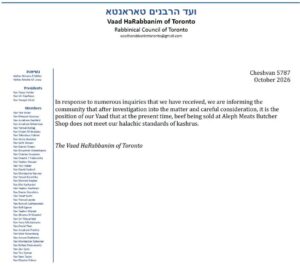
The Vaad HaRabbanim of Toronto has issued a public notice declaring that beef sold at Aleph Meat’s newly opened Toronto Butcher Shop does not meet its kosher standards. The notice, dated October 2026, says the Toronto rabbinical council investigated the matter and gave it careful consideration. It provides no explanation of what was investigated, what was found or which kosher standards Aleph’s beef fails to meet.
Aleph Meat owner Mendy Boyarsky told Montreal Jewish News that he is preparing to sue COR and its Director of Community Kosher, Rabbi Tsvi Heber, accusing them of demanding that he drop his case against Montreal’s MK as a condition for them granting COR certification.
Boyarsky said that his legal team is preparing proceedings in Ontario against COR and Heber personally. He alleges collusion with MK and says he intends to refer the matter to Crown prosecutors, alleging bribery.
“The legal action he will be facing is unprecedented and we are going full force,” Boyarsky said, “Three weeks ago, Rabbi Heber assured me that the COR wouldn’t bother us.”
A September 23 recorded conversation supplied by Boyarsky documents the dispute over certification. Heber repeatedly identifies Aleph’s legal proceedings against MK as an obstacle to moving forward with COR.
“It’s professional courtesy,” Heber says.
Boyarsky challenges the connection between his lawsuit and kosher supervision. He tells Heber he will comply with COR’s requirements for slaughter and meat production but will not drop the MK case to obtain certification.
Heber says Boyarsky withdrew from their discussions, “You’re the one who pulled, you pulled out,” he says.
“I pulled out because you gave me an ultimatum,” Boyarsky replies.
Heber maintains that the issue had been discussed before their meeting and that Boyarsky had supplied a letter from his lawyer that allowed the talks to continue. He raises dropping the proceedings, negotiating a settlement or resolving the dispute through a rabbinical court.
When Boyarsky accuses MK of putting pressure on COR, Heber responds: “I didn’t even speak to them once, not at all.”
Boyarsky says he fears abandoning the case only to have COR withdraw certification later. Heber tells him to obtain a firm contract before making a commitment. The conversation ends with both men willing to meet again, but without an agreement.
Based in Côte Saint-Luc’s Cavendish Mall, Aleph entered the market promising lower-priced kosher meat under KSR certification.
Boyarsky’s dispute with MK started with a June 20 demand letter accusing the Jewish Community Council of Montreal, which operates MK, of blocking access to businesses under its supervision. Aleph then applied to the federal Competition Tribunal for permission to bring proceedings alleging exclusive dealing and abuse of dominance under the Competition Act.
The company alleges that MK’s restrictions prevent it from supplying grocery stores, caterers and event venues and limit its access to slaughterhouse services. Aleph wants those restrictions removed and is seeking financial remedies.
In its response, previously reported by MJN, the JCC denies anti-competitive conduct and says meat sold or served under MK supervision requires MK’s approval, regardless of another agency’s certification. It has asked the Tribunal to dismiss Aleph’s application.
Aleph submitted additional evidence on October 1, including a 2019 MK directive, testimony about catering restrictions at Shaare Zedek Congregation and a warning from its Argentine supplier that it must substantially increase its orders to maintain its beef supply.
In his supplementary affidavit, Boyarsky reproduces a January 30, 2019 directive attributed to MK executive director Rabbi Saul Emanuel, addressed to establishments, hospitals, restaurants and kosher supervisors.
“Currently only Marvid chickens certified by the MK may be used at your establishment. No other chickens may be used,” it states. Boyarsky submited the directive as evidence that the restrictions extend beyond Aleph and predate its arrival in the market.
The filing also quotes an affidavit from Rabbi Alan Bright of Shaare Zedek, describing what happened after the synagogue relinquished MK certification. Bright says caterers refused to serve the synagogue because they feared losing their own certification. According to his affidavit, MK subsequently allowed food deliveries but prohibited catering services or wait staff under threat of losing certification.
He also describes restrictions on kosher equipment rentals, forcing the synagogue to acquire its own dishes, linens and cutlery. Bright says the restrictions have reduced congregants’ choices when arranging events and placed additional work on synagogue staff.
Aleph’s filing also includes a letter from Argentine supplier COCARSA, which has temporarily accommodated smaller kosher slaughter runs of approximately 7,000 to 8,000 kilograms of boneless beef. Effective June 1, 2027, the supplier says its minimum order will rise to 25,000 kilograms, approximately one shipping container. It says it cannot continue supplying Aleph below that threshold.
Boyarsky says the company needs commercial customers to reach those volumes. His supplementary affidavit reports approximately $1.004 million in revenue since launch and includes a business plan projecting $10 million in annual revenue by the end of 2027, with three-quarters coming from commercial sales.
In his recorded conversation with Heber, Boyarsky says he would consider settling the MK dispute in exchange for access to supermarkets and Canadian slaughterhouses.
Dropping the case simply to obtain COR certification for his new store, he says, is “off the table”.


Leave a Reply