
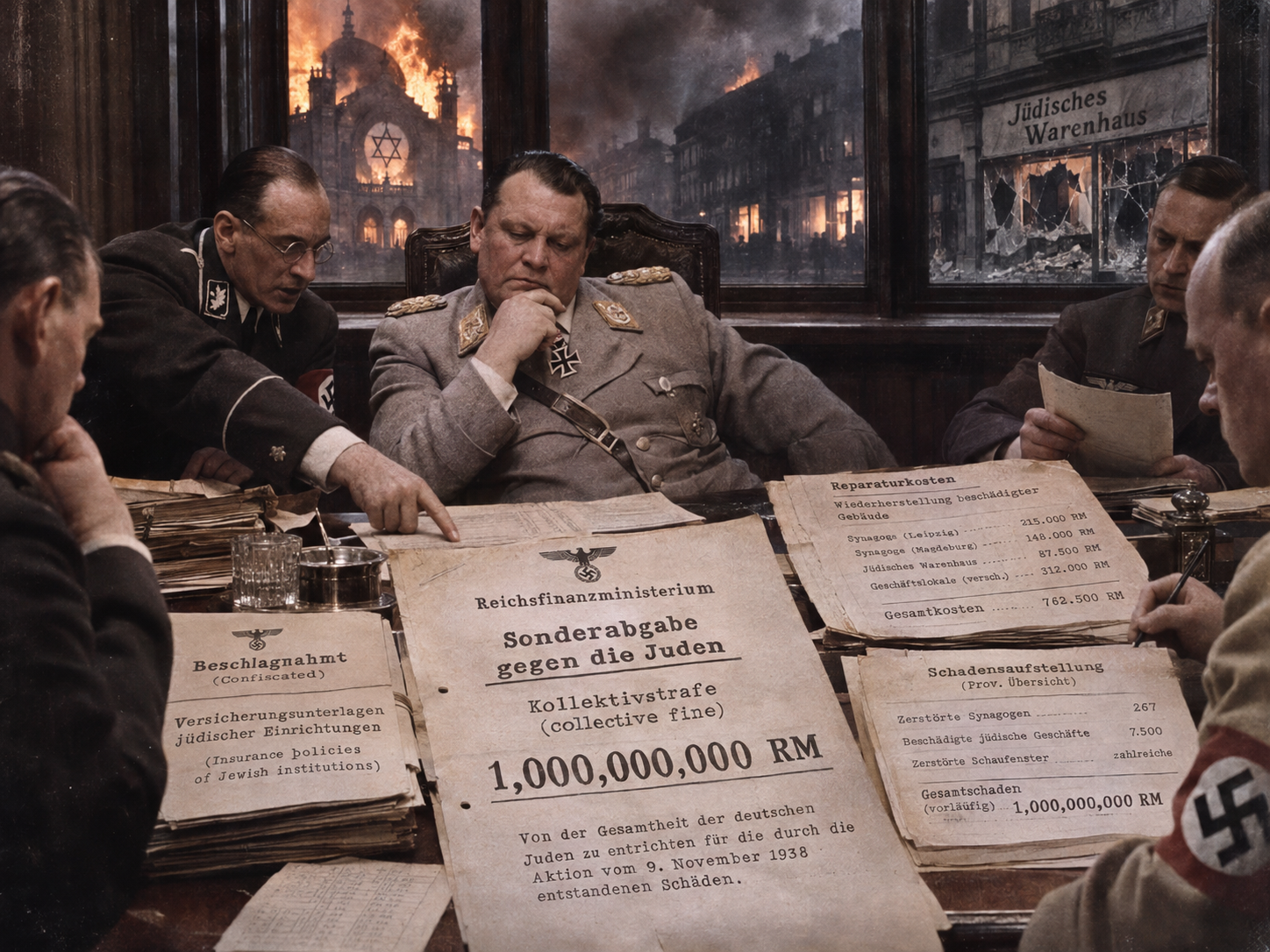
On November 12, 1938, three days after the beginning of Kristallnacht, Hermann Göring convened a meeting of more than 100 Nazi officials and representatives of the German business community. The subject was the destruction of Jewish property during the pogrom, and Göring was furious. Not because Jews had been murdered, synagogues burned or thousands of Jewish men dragged off to concentration camps. He was upset because the destruction had cost Germany an enormous amount of money. His solution was remarkably simple. The Jews would have to pay for the damage the Nazis had done to them.
Most people know the basic history of Kristallnacht, which took place on November 9 and 10, 1938. Nazi-organized mobs rampaged through Germany, Austria and the Sudetenland, burning synagogues, smashing Jewish businesses, invading Jewish homes and beating Jews in the streets. More than 1,400 synagogues and Jewish places of worship were destroyed, approximately 7,500 Jewish businesses were attacked, and some 30,000 Jewish men were arrested and sent to concentration camps. Police were instructed not to interfere with the violence against Jews, while firefighters were generally concerned with preventing the flames from spreading to neighbouring non-Jewish property.
What happened afterward is a particularly ugly chapter that receives considerably less attention than the photographs of burning synagogues and shattered storefronts.
The transcript of Göring’s November 12 meeting, preserved in German historical archives and introduced as evidence during the Nuremberg trials, offers a remarkable glimpse into the minds of the men running Nazi Germany. As officials discussed the enormous financial losses caused by the destruction, Göring complained, “I wished you had killed 200 Jews, and not destroyed such values.”
Read that statement again. The problem, as far as Göring was concerned, was not that Jews had been murdered. It was that valuable merchandise and property had been destroyed in the process.
The Nazi government imposed a collective fine of one billion Reichsmarks on Germany’s Jews, supposedly as punishment for the events that had taken place. Jewish owners were ordered to repair their damaged properties at their own expense, while insurance companies were instructed to pay claims that would then be confiscated by the German state. Jews possessing more than 5,000 Reichsmarks in assets were required to surrender 20 percent of their wealth. According to the Jewish Museum Berlin, the special levy eventually brought in approximately 1.127 billion Reichsmarks, while another 225 million Reichsmarks in insurance payments were seized.
Apparently, being beaten, robbed and having your business destroyed wasn’t punishment enough. You also had to receive a bill from the government that organized the attack.
The Nazi leadership followed the financial penalties with additional measures removing Jews from German economic life. Jewish-owned retail businesses were prohibited from operating, and Jewish children were barred from German public schools. The attacks that had begun in the streets were now being followed by regulations intended to make it virtually impossible for Jews to continue living normal lives in Germany. In an earlier Montreal Jewish News article, I examined the years of discrimination that preceded Kristallnacht. The measures introduced afterward make it equally clear that November 1938 was not the conclusion of anything. It was another stage in the systematic destruction of Jewish life.
The obvious question is what the Jews were supposed to do. They were being stripped of their ability to earn a living, deprived of their property and threatened with arrest or worse. Emigration became increasingly urgent, but finding a country willing to accept them was another matter entirely. Canada, which today prides itself on welcoming people fleeing persecution, was remarkably reluctant to admit Jewish refugees.
The reluctance was not simply the result of bureaucratic confusion or an immigration department overwhelmed by applications. A 1938 memorandum prepared for Prime Minister William Lyon Mackenzie King by officials from External Affairs and Mines and Resources made the government’s position perfectly clear: “We do not want to take too many Jews, but in the circumstances, we do not want to say so.”
The memorandum went on to recommend making the distinction between Jewish and non-Jewish immigrants discreetly, rather than introducing an openly discriminatory policy. Canadian officials understood the political embarrassment that would come from admitting publicly that they did not want Jewish refugees. They were considerably less concerned about the consequences for the people trying to escape Nazi persecution.
One Montreal businessman, however, managed to make a difference.
Karl Cahn was a Jewish businessman from Mainz, Germany, whose family operated a jewelry business. Among their customers was William Birks, son of the founder of the famous Montreal jewelry company Henry Birks & Sons. When Cahn was arrested during Kristallnacht and sent to the Buchenwald concentration camp, his family desperately sought assistance. Karl’s mother contacted Birks, who had maintained a longstanding business relationship with the family.
Birks went directly to Prime Minister Mackenzie King and appealed for permission to bring the family to Canada. The intervention succeeded. Canadian visas were issued, allowing Cahn to be released from Buchenwald, and on March 5, 1939, Karl arrived in Halifax with his wife, mother-in-law and three sons.
The Montreal Holocaust Museum preserves the family’s documents, including Cahn’s release certificate from Buchenwald, the correspondence between Birks and Mackenzie King, and the authorization allowing the family to immigrate to Canada. The museum also holds the identification papers of Karl and his wife Marie, stamped with the large red letter J that the Nazis required Jews to carry.
William Birks deserves credit for using his connections to rescue a family facing persecution. Unfortunately, thousands of other Jewish families did not have a wealthy Canadian businessman who could contact the prime minister on their behalf. According to the Montreal Holocaust Museum, approximately 4,000 Jews were permitted to immigrate to Canada between 1933 and 1939. While Birks was helping the Cahns escape, Canada’s immigration authorities were maintaining policies that prevented most other Jewish refugees from entering the country.
The following year provided an even more notorious example. In May 1939, the MS St. Louis left Germany carrying 937 passengers, almost all Jews seeking refuge from Nazi persecution. Cuba refused to admit most of them, and neither the United States nor Canada agreed to accept the passengers. The ship eventually returned to Europe, where four countries agreed to take them. When the Nazis later occupied much of Western Europe, many found themselves trapped again. According to the United States Holocaust Memorial Museum, 254 of the passengers were ultimately murdered in the Holocaust.
Canada’s refusal to admit the passengers and their unofficial immigration policy of ‘one is too many’, became such a disgrace that Prime Minister Justin Trudeau formally apologized in Parliament in November 2018. It was a reasonable apology, although it arrived approximately 79 years too late to help anyone aboard the ship.
Kristallnacht is generally associated with Germany, but the methods used against Jews were not confined to German territory. Just over two years later, a similarly horrific pogrom took place in Bucharest, Romania, and one of the witnesses would eventually make Montreal his home, his name was Baruch Cohen.
Cohen was born in Bucharest in 1919 and was 21 years old when the Romanian Iron Guard launched a three-day campaign of terror against the city’s Jews between January 21 and 23, 1941. Jewish homes and businesses were looted, synagogues were attacked and more than 100 Jews were murdered. Cohen would later describe those events as the “Bucharest Kristallnacht,” a comparison that was hardly an exaggeration.
The horrors he witnessed were unimaginable. During the pogrom, Cohen’s father disappeared. When the violence subsided, Cohen went searching for him, eventually making his way to a Bucharest slaughterhouse where Jewish victims had been taken. What he found there would remain with him for the rest of his life. Murdered Jews were hanging from meat hooks, their bodies displayed with signs identifying them as kosher meat. His father eventually turned up alive on the outskirts of Bucharest, but the other Jews whose bodies Cohen had seen were not so fortunate.
The details of Cohen’s search are recounted in a 2018 review of his memoir, No One Bears Witness for the Witness, published by the Montreal-based Canadian Institute for Jewish Research. The massacre itself is also documented by the United States Holocaust Memorial Museum, which records the murder and mutilation of Jewish civilians at the Bucharest slaughterhouse.
Cohen wrote about the pogrom in the September–October 2006 issue of Martyrdom & Resistance, published by the American Society for Yad Vashem. His opening words were straightforward: “I was 21 years old. I was there. I am a witness.”
He described the looting of Jewish neighbourhoods, the destruction of synagogues, the torture and murder of Jewish civilians, and the humiliation inflicted upon the victims. The Nazis had burned synagogues and smashed Jewish businesses in 1938. In Bucharest, the Iron Guard carried out similar attacks while adding some particularly grotesque acts of cruelty. The violence was not identical in its political circumstances, but the victims were targeted for the same reason. They were Jews.
Cohen survived the war, although he endured forced labour and suffered serious injuries. He eventually moved to Israel with his family before immigrating to Montreal in 1959. He built a successful career and, following his retirement, devoted much of his time to Holocaust research and education. He became Research Chair at the Canadian Institute for Jewish Research, lectured to students and worked to preserve the history of the Romanian Holocaust, which has received far less attention than the destruction of Jewish communities elsewhere in Europe.
When Cohen died in September 2018 at the age of 98, Montreal lost one of its important Holocaust witnesses. That November, a special tribute was held at Beth Zion Congregation during the annual Romanian Holocaust commemoration, an event Cohen had helped organize for years. His grandson Mark Bergman spoke about him, and organizers emphasized Cohen’s determination to involve young people in Holocaust remembrance.
There is something particularly disturbing about the fact that a man who witnessed Jewish bodies hanging in a slaughterhouse spent the latter part of his life trying to convince people that the history of those murders needed to be preserved. It was not enough for Cohen to have survived. He wanted future generations to know what had happened and to understand how an entire society could descend into such barbarism.
The stories of Karl Cahn and Baruch Cohen are very different, but both belong in the history of Montreal’s Jewish community. Cahn was able to escape because someone with influence persuaded the Canadian government to let him in. Cohen survived persecution in Romania, eventually reached Canada years after the war, and dedicated much of his later life to keeping the memory of the victims alive. One was rescued from a concentration camp with the help of a Montreal businessman. The other survived a pogrom and forced labour before making Montreal his home.
They also remind us of something that gets lost in the annual speeches about Kristallnacht. The problem in 1938 was not that the world lacked information. Newspapers were reporting the violence, governments knew that Jews were being persecuted, and refugees were desperately trying to obtain permission to leave Europe. The Canadian government had enough information to understand the crisis and enough authority to admit more refugees. It simply chose not to.
We have become very good at commemorating the Holocaust. Every year, politicians issue statements, Jewish organizations organize ceremonies and schools teach children about the destruction of European Jewry. All of that is important, particularly as the generation of survivors disappears. But Holocaust remembrance should also require some serious examination of the decisions made by countries that were in a position to help and decided against it.
Canada did not organize Kristallnacht, and it was not responsible for the Bucharest pogrom. Those crimes belong to the people and governments that committed them. Canada’s responsibility was different. It had a country where Jewish refugees could have found safety, and its government deliberately restricted their ability to enter.
There will undoubtedly be plenty of solemn speeches marking the 88th anniversary of Kristallnacht. We will hear about the synagogues that burned, the businesses that were destroyed and the importance of ensuring that such events never happen again. We should remember all of it, including the extraordinary cruelty of making Jewish victims pay for the destruction inflicted upon them.
But Canadians should also remember Karl Cahn, Baruch Cohen and the thousands of Jews who were desperately looking for somewhere to go.
It is easy to condemn the Nazi government in 2026. The real test for Canada came in 1938, when Jews were being persecuted and our government had the opportunity to offer them refuge.
Most of the time, it said no.




Leave a Reply