
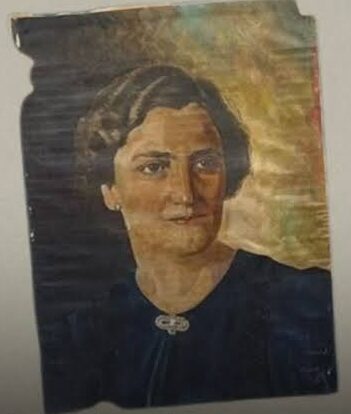
A German doctor who inherited a portrait of his mother has discovered that the painting, brought home by his father during the Second World War, was painted on parchment cut from a Jewish Torah scroll. More than 80 years after the Nazi soldier carried it out of occupied Belarus, the sacred parchment has finally been returned to the Jewish community from which it was taken.
The discovery began when the doctor noticed strange writing on the back of the portrait following his parents’ deaths. He photographed the lettering and searched online, eventually discovering that it was Hebrew. What he had inherited was far more than an old family painting. His father had brought home a piece of a Sefer Torah, one of Judaism’s holiest religious objects, which had been cut apart and used as an ordinary painting surface.
According to Chabad, the doctor’s father served with the German military in Babruysk, now part of Belarus, between August 1941 and August 1943. He worked as a clerk at German Field Command 581 and, according to the family’s account, had commissioned a Russian prisoner of war who was a professional artist to paint a portrait of his wife back in Germany. Somehow, the artist obtained parchment from a Torah scroll and used it for the painting. Whether the Torah had been deliberately cut apart for that purpose or the artist used an already desecrated fragment remains unknown.
The location makes the discovery particularly disturbing. Before the war, Babruysk was a major centre of Jewish religious and cultural life, with more than 26,000 Jewish residents in 1939. German troops occupied the city in June 1941, established a ghetto and began systematically murdering its Jewish population. Most of the city’s Jews were killed during mass executions that year. The Nazis also destroyed synagogues, religious books and Torah scrolls, sometimes cutting the sacred parchment into pieces for use in shoes, wallets and other everyday objects.
The doctor contacted Chabad in Munich, where his message was passed to Rabbi Yochanan Gordon. Gordon arranged to meet him the following morning and immediately recognized the distinctive handwritten lettering of a Torah scroll. The doctor explained the painting’s history and insisted that his father had worked only as a military clerk and had not participated in the murder of Jews. During the meeting, he reportedly broke down in tears and expressed his sorrow over what had happened to the sacred parchment.
Rather than keep the portrait as a family heirloom, the doctor wanted it returned to the Jewish community in Babruysk. Gordon contacted Rabbi Shaul Hababo, the city’s Chabad representative, and the two arranged to meet in New York during the annual International Conference of Chabad-Lubavitch Emissaries. The handover took place earlier this month, returning the fragment to the community more than eight decades after the German soldier had taken it away.
The return also raised an unusual question under Jewish law. A damaged Torah scroll generally cannot simply be displayed or discarded. Even its fragments retain their sanctity and must ordinarily be buried respectfully. Gordon consulted a rabbinic authority who referred him to an earlier ruling by the late Rabbi Moshe Feinstein, which permitted displaying Torah fragments desecrated by the Nazis when doing so would educate visitors about the destruction of Jewish religious life.
The parchment will now be displayed at the Jewish Spiritual Center of Belarus, a museum housed in Babruysk’s historic synagogue, alongside a complete Torah scroll rescued from the Nazis. Visitors will be able to see the remains of a Torah that was cut apart and turned into a painting next to another that survived the war intact.




Leave a Reply