
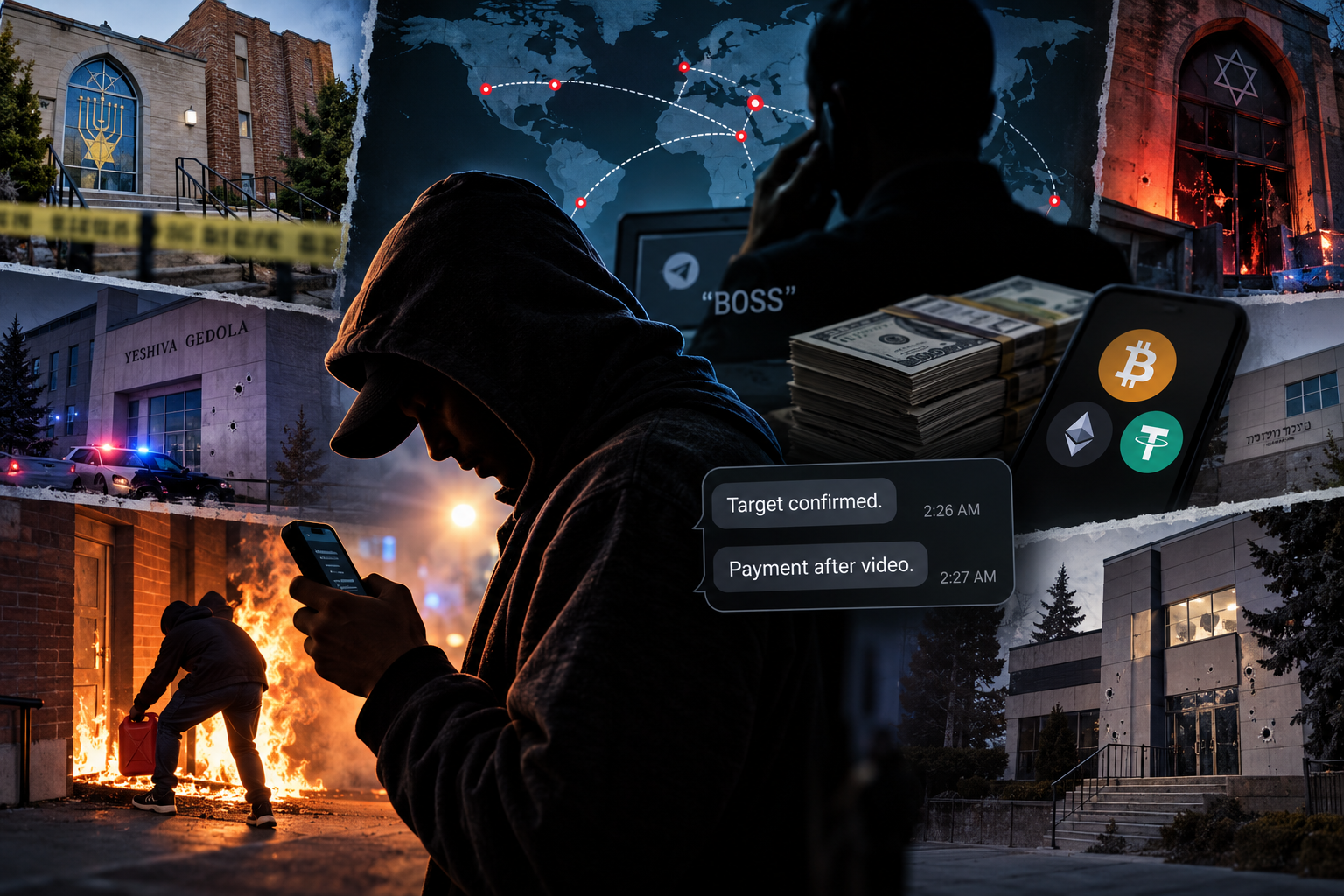
At approximately 2:30 in the morning on October 12, a man drove up to the historic Kadavumbhagam Synagogue in Kochi, India, poured petrol over materials outside the building, set them on fire, recorded the attack on his telephone and drove away. Police arrested 32 year old Ebin B. Paul, whose electronic communications revealed that he had been in contact with an unidentified individual he called “Boss”. Investigators also discovered messages in which Paul offered to carry out criminal assignments for money. According to The New Indian Express, police are examining possible cryptocurrency payments and have asked Telegram for assistance in identifying the mysterious individual who may have directed the attack.
The circumstances bear a remarkable resemblance to attacks against Jewish institutions in Canada, Australia and Europe, particularly when examining the timing. Montreal’s Yeshiva Gedola was shot at twice in November 2023, first during the night of November 9 and again on November 12 at approximately 4:45 a.m. Toronto’s Bais Chaya Mushka girls’ school was shot at three times in 2024, each between approximately 2:30 and 5 in the morning. Montreal’s Beth Tikvah Synagogue was firebombed around 3 a.m. in December 2024, Melbourne’s Adass Israel Synagogue was set ablaze shortly after 4 a.m. that same month, and three Toronto area synagogues were shot at late at night or shortly after midnight during the first week of March 2026. On March 13, a synagogue in Rotterdam, Netherlands, was attacked with explosives around 3:40 a.m. These incidents are not a complete inventory of attacks against Jewish institutions, but the consistency in the hours is certainly worth examining.
There may be a relatively simple explanation for why so many of these attacks happen when most people are sleeping. The criminals carrying them out may have little interest in Jews and even less interest in getting caught. Someone who has accepted a few thousand dollars to shoot at a school or throw a Molotov cocktail at a synagogue would probably prefer to do it when the streets are deserted, the buildings are empty and there is little chance of encountering someone who might interfere. He wants to complete the assignment, collect his money and go home. Getting arrested, injured or killed would rather defeat the purpose of earning a paycheque.
There is evidence supporting that possibility, including testimony from a Montreal courtroom. In June, Mohamed Ilyess Akodad told the court that he had accepted a $15,000 assignment to set fire to two buildings and a vehicle in Dollard-des-Ormeaux. The buildings were Congregation Beth Tikvah and the neighbouring Federation CJA offices. Akodad claimed that he had no idea he was targeting Jewish institutions when he accepted the job. He testified that he panicked during the attack, nearly injured himself while attempting to firebomb the synagogue and abandoned the remaining assignment. When he met the people who had hired him the following day, they reportedly complained that he had not caused enough damage and paid him only $3,000. According to court reporting published by TVA Nouvelles, Akodad admitted that he wasn’t suited to that kind of work.
While Akodad was frightened enough to abandon the operation, the people who had hired him were apparently more concerned that he had failed to burn down the buildings. They had selected the Jewish targets, arranged the assignment and offered substantial payment for their destruction. Akodad was simply the person they sent to do it. Whether he personally hated Jews was almost irrelevant to the people who were paying him.
An investigation in the Netherlands has produced even more direct evidence of this arrangement. In June, six young suspects appeared before a Rotterdam court in connection with the March synagogue explosion. Four of them, aged between 17 and 23, had allegedly been offered €3,000 to carry out the attack. They admitted involvement but claimed that they had not known the building was a synagogue, something prosecutors disputed because of the Jewish symbols displayed on the property. Prosecutors themselves said they did not believe the actual perpetrators were ideologically motivated, although they classified the attack as terrorism because its purpose was to frighten the Jewish community. According to DutchNews, the suspects had been recruited through social media, with others allegedly supplying instructions, addresses and money.
The practice is hardly limited to Europe. In June, Toronto Police Chief Myron Demkiw announced that investigators had uncovered criminal networks recruiting young people through encrypted messaging applications to carry out shootings for payment. He specifically identified a similar operating method in attacks against Jewish schools and synagogues. According to Toronto Police, the criminals are sometimes required to record their attacks as proof that the assignment has been completed before receiving payment. For the person pulling the trigger, the video confirms that he has earned his money. For whoever financed the attack, the same recording can be distributed as propaganda, frightening Jewish communities far beyond the location where the shots were fired.
Australia has already established that foreign governments can use criminal intermediaries to attack Jewish institutions while concealing their own involvement. In August 2025, Australian intelligence concluded that Iran’s Islamic Revolutionary Guard Corps had directed the December 2024 firebombing of Melbourne’s Adass Israel Synagogue and an earlier attack against a kosher business in Sydney. Investigators uncovered a network of intermediaries connecting those carrying out the attacks to their organizers. The Melbourne incident also demonstrated how dangerous these operations can become. Although the synagogue was attacked shortly after 4 a.m., worshippers were already inside preparing for morning prayers. One person suffered burns and the building was extensively damaged. According to the Australian government’s findings, the objective was to frighten the Jewish community and create divisions within Australian society.
A few bullets fired into an empty Jewish school can accomplish a great deal for the people organizing the attack. Parents become frightened about sending their children to class, congregations increase security arrangements, institutions spend considerable amounts of money protecting themselves and police resources are redirected. The actual damage to the building may be relatively minor, but the consequences for the Jewish community can continue for months. The person financing the operation doesn’t have to be anywhere near the synagogue, and he doesn’t have to worry about being identified by witnesses or surveillance cameras.
The two shootings at Montreal’s Yeshiva Gedola are particularly interesting in this context. On November 9, 2023, bullets struck both Yeshiva Gedola and Azrieli Talmud Torah during the night. Three days later, Yeshiva Gedola was attacked again shortly before 5 a.m. Abdirazak Mahdi Ahmed subsequently pleaded guilty to involvement in the November 12 shooting, but prosecutors did not establish an anti Jewish motive. As Montreal Jewish News previously reported, there has been no publicly established evidence that Ahmed was hired to carry out the attack, and the November 9 shootings remain unsolved. Nevertheless, the selection of a quiet Orthodox school on a residential street, twice within four days and both times before students arrived, deserves to be considered alongside the methods being uncovered elsewhere.
There is another dimension to this developing pattern that ought to concern law enforcement. Traditionally, investigators examining an attack on a synagogue would look at the suspect’s background, political beliefs, online activity and associations to establish a motive. That approach becomes considerably more complicated when the person committing the attack has no ideological connection to the target. A criminal hired to firebomb a synagogue may have never expressed an anti Jewish opinion, attended an anti Israel demonstration or shown any previous interest in the Middle East. His criminal record may be extensive, but his relationship with the Jewish community may be nonexistent. Investigators looking exclusively for evidence of personal hatred could miss the motivation of the person who commissioned the crime.
The United States has also uncovered evidence of organized operations involving attacks against Jewish institutions. In May 2026, American prosecutors charged Mohammad Baqer Saad Dawood Al-Saadi, an alleged operative working with Iranian backed terrorist organizations, with participating in the planning and coordination of attacks across Europe. According to the U.S. Department of Justice, the alleged operation involved intermediaries, remote instructions and the use of attack recordings as propaganda. The charges have not been proven in court, but the investigation illustrates how people directing attacks can operate across international borders while leaving others to commit the actual crimes.
There is a particularly disturbing aspect to this arrangement. The people financing these attacks appear to have discovered that they don’t need to recruit committed antisemites to terrorize Jewish communities. They can hire ordinary criminals, provide an address, supply the necessary money and let somebody else take the risks. If the criminal is caught, he faces the charges, hires a lawyer and potentially goes to prison. The person who selected the Jewish institution and paid for the attack may never even be questioned. He can simply find somebody else willing to do the job.
In Montreal, Akodad described the people who hired him, but those individuals have not been publicly identified or brought to justice. In India, police have arrested Paul, recovered his communications and are still searching for the mysterious “Boss” who may have ordered the attack. These investigations cannot be considered complete simply because the person holding the weapon or lighting the fire has been arrested. The people supplying the money, selecting the targets and arranging the operations are the ones who need to be identified and prosecuted. Until that happens, the criminal networks responsible for commissioning these attacks remain capable of continuing their operations.
There is something particularly outrageous about the possibility that Jewish communities around the world are being terrorized by criminals who don’t even care about Jews, working for people whose hatred is so great that they are prepared to pay strangers to attack Jewish institutions. Children are frightened, congregations are forced to spend fortunes on security, and Jewish communities are left wondering which school or synagogue will be targeted next. Meanwhile, the people allegedly financing some of these crimes can remain comfortably removed from the consequences, watching the results on their telephones.
Arresting the hired criminal is certainly necessary, but allowing the person who ordered the attack to remain free accomplishes little. As long as those financing the violence remain unidentified and unpunished, there is nothing stopping them from offering the next criminal a few thousand dollars to attack another synagogue.





Leave a Reply