
By Jack Forrester
What unfolded at Bondi Beach on the first night of Chanukah is now understood to have been far more calculated, more lethal, and closer to catastrophic than initially known, as investigators piece together a terror attack that combined firearms, explosive devices, prior surveillance, and ideological motivation, aimed squarely at a public Jewish gathering.
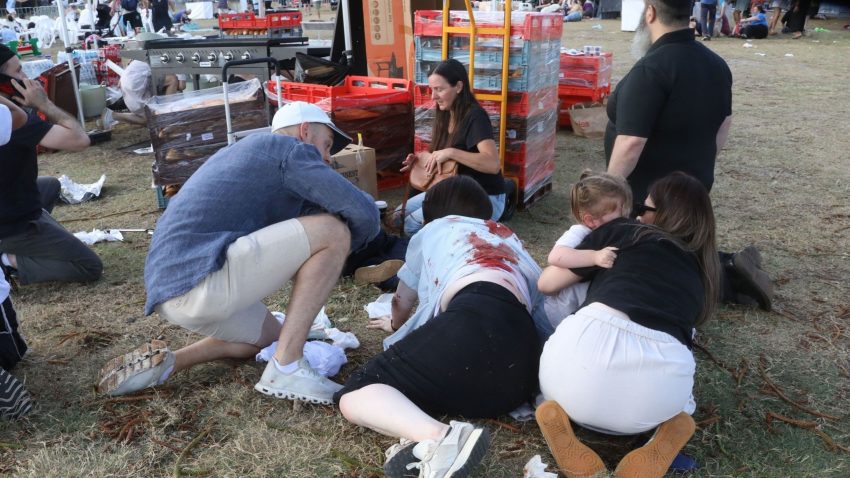
The December 14 attack took place shortly before 6:50 p.m. at Archer Park, steps from the Bondi Beach promenade, during the annual Chanukah by the Sea celebration organized by Chabad of Bondi. Hundreds of families were present when two attackers, later identified as a father and adult son, opened fire on the crowd with military-style weapons. Police say more than 80 rounds were discharged in a span of roughly ten minutes, turning the open park into a killing field as families scattered in all directions, some fleeing toward the beach, others toward residential streets.
New eyewitness accounts have shed light on the final moments of Rabbi Eli Schlanger, 41, one of the event’s organizers and a central figure in Sydney’s Jewish community. Witnesses say that, heroically, as one of the gunmen paused to reload, Schlanger stepped forward deliberately, raised his hands, and pleaded with the attacker to stop shooting. Those nearby say he spoke calmly, attempting to slow the chaos and draw attention away from fleeing families and children. He was shot at close range and collapsed near the menorah lighting area where moments earlier he had been welcoming attendees.
Schlanger’s wife, Chaya, was shot in the back while trying to escape with their two-month-old son. She remains hospitalized but is expected to recover. Their infant sustained shrapnel wounds and continues to receive medical treatment. Friends who arrived at the scene described Chaya repeatedly urging first responders to wake her husband, telling them that he believed in miracles. He was pronounced dead at the scene.
The death toll has now reached 15, with victims ranging in age from a 10-year-old girl to elderly community members, including at least one Holocaust survivor. Among the dead were parents attending with children, retirees, and individuals who were not part of the event but were caught in the gunfire while walking nearby. Several victims are reported to have been killed while attempting to shield others or confront the attackers. Dozens more were injured, many with life-threatening gunshot wounds. Hospitals across Sydney remain on alert as several victims continue to recover from complex surgeries.
One of the attackers was shot and killed by police at the scene. The second was critically wounded, taken into custody, and has since been charged with multiple counts of murder and terrorism-related offences. Police later confirmed the discovery of multiple undetonated improvised explosive devices inside a vehicle linked to the attackers, as well as an additional device located and neutralized near the scene. Investigators now say the explosives failed to detonate, a development that authorities acknowledge likely prevented mass casualties on an even larger scale.
Security officials have also confirmed that the attackers had conducted reconnaissance of Jewish sites in Sydney prior to the assault and that extremist material, including an ISIS flag, was recovered from one of the vehicles. While no formal claim of responsibility has been made, Islamic State has publicly praised the killings, describing them as a “source of pride,” a statement that has intensified concerns about ideological inspiration and the broader radicalization environment in Australia.
In the immediate aftermath, Bondi lifeguards and surf lifesaving volunteers played a critical role, using surfboards as makeshift stretchers and sheltering approximately 250 people inside the Bondi Surf Lifesaving Club while gunfire was still ongoing. One civilian, Ahmed Al Ahmed, has been widely credited with disrupting one of the attackers by tackling him after hearing shots and seeing people fall. Al Ahmed was shot multiple times during the struggle and has undergone complex surgery for nerve damage. A fundraising campaign launched in his name has raised more than $1.5 million.
Funerals for the victims have begun under heavy police protection, with Rabbi Schlanger’s funeral drawing thousands of mourners from across Australia and abroad. He was remembered as a soft-spoken leader who believed deeply in public Jewish life and refused to retreat from it, even amid rising hostility. Political leaders from across the spectrum attended, while Jewish institutions nationwide heightened security.
The attack has triggered intense political fallout. Australia’s federal and state governments have announced fast-tracked changes to hate speech laws, expanded terror monitoring, and new firearm license audits, while Jewish leaders have called for concrete security funding rather than symbolic gestures. Critics have also questioned whether authorities underestimated the risk posed by escalating anti Jewish rhetoric and repeated protests in Sydney since October 2023, including the widely condemned chants of “gas the Jews” outside the Sydney Opera House last year.
Despite the trauma, Chabad leaders and families of victims have vowed that public Jewish celebrations will continue. Rabbi Schlanger’s father in law publicly stated that the final Chanukah candle lighting would still take place at Bondi Beach, insisting that retreating from public Jewish life would hand the attackers a victory they do not deserve.
As police continue to widen their investigation into possible networks and intelligence failures, Jewish communities across Australia and beyond are reassessing security, visibility, and the cost of being openly Jewish in an increasingly hostile climate. At Bondi Beach, the menorah now stands not only as a symbol of light, but as a marker of loss, defiance, and a line many say they are no longer willing to retreat behind.


