



By Joseph Marshall
The British government announced Monday that it will spend £251 million over the next three years to place more police officers in Jewish neighbourhoods, increase protection around synagogues and schools and strengthen the country’s ability to investigate and prevent attacks against Jewish communities.
Britain has decided that protecting Jewish communities is a job for the police. Canada has decided that Jewish schools, synagogues and community centres should apply for grants, raise part of the money themselves and wait for approval.
The British plan will add more than 500 police officers across England and Wales, including approximately 300 in London and 80 in Greater Manchester. Another £43 million will be divided among police forces serving seven areas with significant Jewish populations, while £59 million will go to counterterrorism policing. The package also includes £41 million for national coordination, investigations, anti-Jewish hate training for police officers and the rapid deployment of additional officers when threats arise.
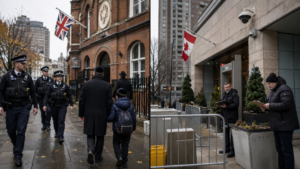
Officers will be assigned to Jewish neighbourhoods and around synagogues, schools and community centres. Police patrols will be increased during periods of heightened risk, and specialist and plainclothes officers will be deployed through Project Servator to identify suspicious behaviour before an attack takes place.
The funding follows a series of attacks against British Jews and Jewish institutions. Four ambulances belonging to the Jewish volunteer emergency service Hatzola were set on fire in London in March. Two Jewish men were stabbed in Golders Green the following month in an attack police declared an act of terrorism. Last October, two people were killed and three others injured in a car-ramming and stabbing attack outside the Heaton Park Hebrew Congregation synagogue in Manchester. Britain raised its national terrorism threat level from substantial to severe following the latest attacks, meaning authorities consider another attack highly likely.
British Prime Minister Keir Starmer called the rise in anti-Jewish hatred “a test of our values as a country” and said the new funding would bring a significant change in policing and protection.
“Today’s funding builds on that work, delivering a step-change in protection and policing so Jewish communities can live and celebrate their faith free from fear,” Starmer said.
Policing Minister Sarah Jones said the government would provide visible police protection around Jewish institutions and “do everything in our power” to fight anti-Jewish hatred.
The British government is also providing £32.4 million this year for guards and physical security at synagogues, Jewish schools and community centres. That program operates alongside the new police funding rather than replacing it. Jewish institutions can receive help with their own security while the police and counterterrorism agencies remain responsible for patrolling neighbourhoods, investigating threats and preventing attacks.
Mark Gardner, chief executive of Britain’s Community Security Trust, said the increase in policing “comes not a moment too soon,” describing the current period as critical for the future of British Jewish life.
Jewish leaders welcomed the package while warning that police protection cannot solve the entire problem. Russell Langer of the Jewish Leadership Council said security and policing alone cannot address record levels of anti-Jewish hatred and called for sustained government leadership and action.
Canada has also increased its spending on security for threatened communities, although it has adopted a different model. The federal government announced an additional $75 million over five years for the Canada Community Security Program in its April economic update. The program is open to Jewish institutions, along with other religious, cultural and community organizations considered at risk of hate-motivated crime. Ottawa says it is simplifying the application process and giving organizations more flexibility in how security funding can be used.
Public Safety Minister Gary Anandasangaree said “every Canadian deserves to feel safe in their community” and that the increased funding would help threatened communities obtain the tools they need to improve security.
The Canadian program can pay for surveillance cameras, alarms, protective barriers, reinforced windows and doors, emergency planning, security training and time-limited private security guards. These measures may save lives, but they leave much of the responsibility for security with the individual institution.
Under the current rules, the federal government will normally cover up to 70 per cent of an approved project. The school, synagogue or community organization is expected to find the remaining 30 per cent. Organizations must generally be able to pay the full cost in advance, and funding provided through contribution agreements is normally reimbursed after the project has been completed.
Public Safety Canada advises organizations to leave at least six months between submitting an application and beginning a project. Applications are assessed, agreements are finalized and projects are sent for final approval before work can begin. The department also warns that a high volume of applications may cause further delays.
The synagogue, school or daycare must therefore identify the threat, obtain estimates, prepare the application, find its share of the money, arrange the work and wait for approval.
Britain is sending police officers.
The comparison is not exact. Policing in Canada is divided among federal, provincial and municipal governments, while the British announcement is a national policing and counterterrorism package. The Canadian program was designed primarily to help institutions improve their own physical security, not to finance local police patrols.
The practical difference remains difficult to ignore. Britain is treating attacks against Jewish communities as a policing and national security problem. Canada continues to treat much of the response as a security improvement project to be managed by the institutions being threatened.
Ottawa announced a separate investment of up to $10 million in March specifically for Jewish community security. The money, also distributed through the Canada Community Security Program, is intended to support security operations centres that monitor threats and coordinate protection at Jewish institutions, along with security projects at schools, daycares, camps and places of worship.
Evan Solomon, the federal minister responsible for the announcement, described the $10 million as “an important first step.”
That wording reflected the size of the problem. Before the latest $75-million increase, the Centre for Israel and Jewish Affairs and Jewish federations across Canada estimated that the annual cost of protecting Canadian Jewish institutions could soon reach $100 million. They said Canada’s per-capita investment in Jewish security was approximately one-third of Britain’s and warned the federal government not to wait for a mass-casualty attack before acting.
The additional Canadian funding is substantial and has been welcomed by Jewish organizations. It will allow schools, synagogues and community centres to install equipment and hire guards that many could not otherwise afford. It does not change the fact that money once used for education, childcare, religious programming and social services is now being spent protecting doors and windows.
The threat is not theoretical. Statistics Canada recorded 920 police-reported hate crimes targeting Jews in 2024. Jewish Canadians were targeted in 70 per cent of all religion-motivated hate crimes recorded that year, despite representing approximately one per cent of the Canadian population.
Canadian Jewish schools and synagogues have been struck by gunfire. Synagogues have been firebombed, Jewish-owned businesses have been vandalized and visibly Jewish Canadians have been assaulted in the street.
Prime Minister Mark Carney acknowledged the failure during a June 1 speech at Toronto’s Holy Blossom Temple, saying Canada’s civic compact was failing Jewish Canadians. He pointed to the additional $75 million, proposed anti-hate legislation and greater coordination with police and intelligence agencies as part of the government’s response.
Carney also acknowledged the limits of physical protection.
“A country in which Jewish day schools require guards, in which synagogues require barriers, in which Jewish children attend school behind perimeters of protection, is a country that is protecting its citizens but is failing its civic compact,” he said.
The statement is difficult to dispute. The question is whether Canada’s response matches the government’s own description of the threat. Cameras, reinforced doors and private guards are necessary. So are grants to help Jewish institutions pay for them. None of that explains why a Jewish school or synagogue should be expected to operate as its own small security agency while government reimburses part of the cost months later.
Britain’s announcement recognizes that protecting a threatened Jewish community is not a charitable contribution to that community, it is a fundamental responsibility of government. Canada’s annoncement once again told the Jewish Community that they are on thier own. Apply for a grant, wait and pray for the best.


Discover more from Montreal Jewish News
Subscribe to get the latest posts sent to your email.