


By Joseph Marshall
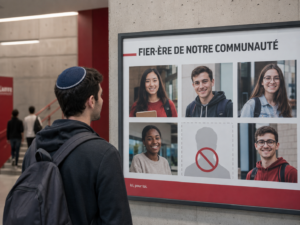
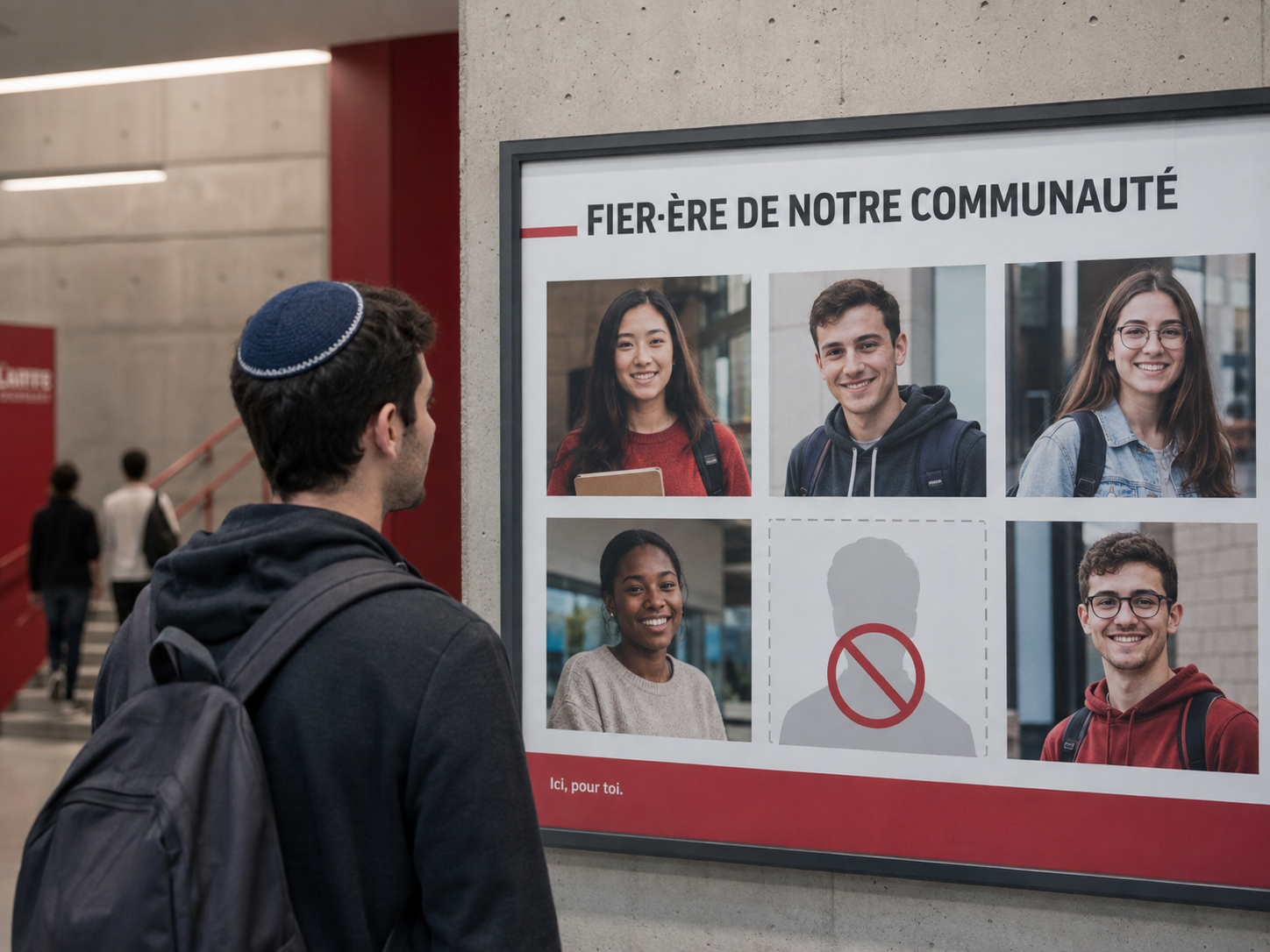
Jewish students at Vanier College are still permitted to wear a kippah to class, walk through the halls wearing it and attend college activities wearing it. What Vanier apparently cannot do, however, is choose one of those students to appear in an ordinary promotional photograph while the kippah remains on his head.
The unusual restriction took effect September 1 as part of Quebec’s new Law 9, formally known as the Loi sur le renforcement de la laïcité au Québec, which significantly expands the province’s secularism rules.
In information published for students and staff, Vanier College says that wearing religious symbols remains permitted. Farther down the same page, however, the college explains that images depicting religious symbols, including photographs of people wearing them, cannot be featured in Vanier’s promotional communications or on its social media.
Vanier acknowledges what that means for the faces the college will be able to use to represent itself, warning that its marketing materials may consequently be “less diverse.”
For a Jewish student, the practical effect is fairly straightforward. He can wear a kippah at Vanier, but if the college is selecting students to pose for a brochure, an open-house advertisement or another promotional photograph, his visible kippah becomes a problem.
The same restriction applies to other religious symbols, including Muslim hijabs and Sikh turbans.
This is not simply Vanier College taking an unusually aggressive interpretation of vaguely written legislation. The issue was discussed in remarkably specific terms while the bill was being studied by a committee of the Quebec National Assembly earlier this year.
During the February 19 committee hearing, Liberal MNA Madwa-Nika Cadet asked Secularism Minister Jean-François Roberge what would happen if a student wearing a religious symbol won a mathematics prize and the school wanted to publish a photograph congratulating that particular student.
Roberge said that would be permitted because the purpose of the photograph would be to recognize the specific student and the accomplishment. The student could not reasonably be replaced by somebody else simply for the photograph.
Cadet then changed the example.
What if a school were selecting actual students to appear in promotional material for an open house and one of the students selected wore a religious symbol?
Roberge’s answer was different. The student, he said, should not be wearing the symbol in that photograph.
Roberge explained that in a generic promotional image, where the institution is choosing who will represent it, displaying someone wearing a religious symbol could amount to highlighting the representation of that symbol. He gave a similar example involving a promotional photograph of students playing soccer, saying the players selected for such an image would not be shown wearing religious symbols.
Later in the same committee discussion, Liberal MNA Michelle Setlakwe sought clarification on the distinction, asking whether a person could be highlighted provided the religious symbol itself was not the object being highlighted. Roberge agreed, adding that a religious symbol could appear incidentally in some circumstances, but could not itself be deliberately emphasized.
The line created by the law therefore depends partly on why a photograph is being published.
A Jewish student who wins a major academic prize could potentially appear on Vanier’s social media wearing his kippah because the college is reporting on that particular student. A Jewish student selected simply because Vanier believes he would be a good face for the college in an advertising campaign could not be portrayed the same way.
Vanier’s own published guidance takes a particularly clear approach to promotional material, saying that images showing people wearing religious symbols cannot be featured.
Law 9 was adopted by the National Assembly on April 2 by a vote of 77 to 27 and was sanctioned the same day. Among its other provisions, it prohibits individual and collective religious practices in many public institutions, including CEGEP campuses. Vanier has consequently closed its prayer room and says both individual and group prayer are now prohibited on college property.
The communications provision has received considerably less public attention.
The Quebec government describes the requirement by saying public bodies cannot “highlight” a religious symbol in institutional communications. During committee hearings, Roberge explained that the provision was intended to prevent government institutions from appearing to promote a particular religion or give special visibility to a religious symbol.
For visibly religious students, however, the distinction between promoting a religion and simply showing the people who actually attend a public institution becomes less theoretical.
Vanier is an English-language public CEGEP in Montreal with students from a wide range of religious and cultural backgrounds. Under the rules now in force, those students remain free to arrive on campus visibly Jewish, Muslim, Sikh or otherwise religious.
They just may not all be equally available when it comes time for the college to choose the faces it wants the public to see.


Discover more from The Montreal Jewish News
Subscribe to get the latest posts sent to your email.