
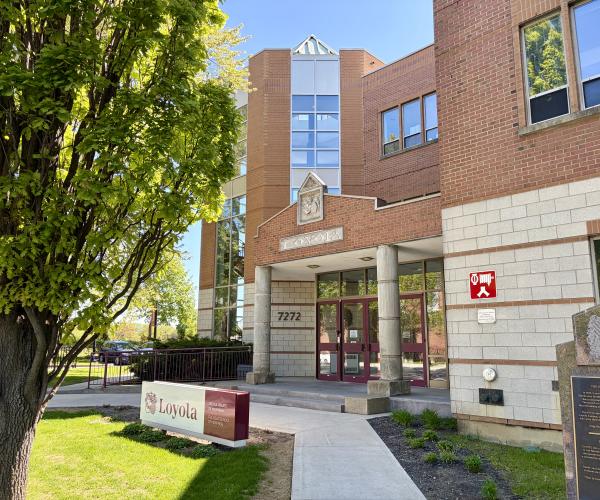
Loyola High School has served Montreal’s Jesuit Catholic community for more than a century. Now it has decided that it would rather walk away from millions of dollars in Quebec government funding than change the fundamental character of the school to comply with Quebec’s new secularism law.
For Montreal’s Jewish schools, facing the same law and many of the same questions, Loyola’s decision is hard to ignore.
Loyola’s conversion to an independent private school won’t be cheap. The school currently receives approximately $6,350 per student from Quebec, worth about $5.2 million annually and representing roughly 28 percent of the school’s revenue. Leaving the subsidized system will also mean leaving the government pension plan and replacing it with a private plan, something the school estimates will cost another $1 million annually. Loyola calculates that the total financial hole amounts to approximately $7,500 per student every year.
Current tuition and fees at Loyola are approximately $12,530. The school says that if the entire difference had to be made up through tuition today, that figure would climb to approximately $20,000 to $21,000. Loyola plans to increase financial aid and launch a major fundraising campaign in an effort to keep the school accessible while it separates itself from the provincial funding system.
At the centre of Loyola’s decision is Law 9, formally known as the Act respecting the reinforcement of laicity in Quebec, which was adopted in April. Beginning April 2, 2029, Quebec says that a private school will no longer qualify for government subsidy if its educational services are based on religious norms, if it transmits religious convictions through its teaching, or if it selects students or staff based on religious criteria.
Loyola says remaining subsidized would mean mandatory religious instruction could no longer be used to transmit Catholic beliefs, while religious practices including Mass, prayer and retreats would have to become optional and take place outside the hours devoted to educational services. The school concluded that it could comply with the law, or it could remain the Jesuit Catholic institution it has been for 130 years, but it was not prepared to change its religious mission in order to keep the money.
For Montreal’s Jewish schools, the financial calculation may be considerably more difficult. Enrolment has been declining, tuition is already high and many Jewish schools depend on government subsidies simply to remain viable.
The Association of Jewish Day Schools represents nine elementary schools and six secondary school entities in Montreal, including Akiva, Maimonide, Hebrew Academy, JPPS Bialik, Solomon Schechter, Azrieli Talmud Torah Herzliah and Yeshiva Yavne. Approximately 4,100 students attend schools within the association. While the schools vary considerably in religious orientation, Association Director General Sidney Benudiz recently acknowledged that none of them are completely secular and that all incorporate Jewish identity, Jewish values and Jewish knowledge into their educational programs.
Jewish day schools do not simply teach mathematics, French and English in one part of the building and Judaism somewhere else after the bell rings. Depending on the school, students may study Torah, Talmud, Jewish history and Hebrew as part of their regular schedule. Students may begin their day with prayer. Religious practice and Jewish observance can form part of school life, and in more Orthodox institutions, the religious character of the school is not an extracurricular activity added onto the Quebec curriculum. It is the reason the school exists.
None of the provisions affecting Loyola are limited to Catholic institutions. The same rules will apply to subsidized Jewish schools, including restrictions on religious instruction, religious norms and the use of religious criteria in selecting students or staff.
That last provision could become particularly difficult for Jewish schools. A religious Jewish school employs rabbis, Judaic Studies teachers and other staff specifically to provide Jewish religious education. How Quebec will distinguish between a religious criterion and a legitimate qualification to teach a religious subject remains one of the questions schools will have to confront as the 2029 deadline approaches.
In November 2025, Federation CJA said it strongly opposed portions of the bill that extended Quebec’s secularism rules to private schools, specifically including Jewish day schools. CIJA described the measures as unnecessary and pointed out that Quebec’s subsidized Jewish schools were not responsible for the problems in the public system that the government had cited in arguing for stronger secularism legislation.
Benudiz told La Voix Sépharade this month that uncertainty surrounding continued government subsidies is one of the major financial challenges facing Jewish education in Montreal. He said Law 9 contains provisions that remain open to interpretation and that the schools are attempting to understand the new rules, adapt to them and seek accommodations that would allow them to continue operating as they have.
The financial stakes are considerable even before Law 9 is factored into the equation. Benudiz said Jewish elementary school tuition currently ranges from approximately $11,000 to $16,000 annually, while secondary school tuition ranges from approximately $16,000 to $18,000. Public funding, he said, covers only about 60 percent of the actual cost of providing the general studies program, with families and the Jewish community already making up the remainder while also paying for the Jewish studies component.
Unlike Loyola, no broad figure has been made public showing what it would cost Montreal’s Jewish schools collectively to leave the subsidized system. Loyola’s exercise gives some idea of the size of the calculation facing any Jewish school considering it. A loss of thousands of dollars per student, combined with higher pension costs and an educational system already dependent on tuition, fundraising and community assistance, could force some Jewish schools to close or merge. That would reduce the choices available to Jewish families and make Jewish day school education even more expensive.
There is also no reason to assume every Jewish school will reach the same conclusion. Montreal’s Jewish school system ranges from institutions in which Jewish culture and identity form one portion of a broader academic program to Orthodox schools where religious study and observance occupy a substantial portion of the day. A solution that allows one school to remain subsidized may be completely unacceptable or unworkable for another.
CIJA opposed the private school provisions before the law was adopted, and the Association of Jewish Day Schools is now talking about interpretation, adaptation and accommodations. Loyola went through that process and reached a different destination. It studied the law, studied its finances and decided that Quebec’s money came with conditions it was not willing to accept.
The deadline is still two and a half years away, but it is no longer theoretical. One major Montreal religious school has already decided that preserving its religious identity is worth giving up $5.2 million a year in provincial funding and accepting the financial consequences that come with it. Montreal’s Jewish schools have not made that decision. For now, they are trying to find a way to remain both Jewish and subsidized.
Loyola has decided that Quebec will no longer allow it to comfortably be both.


Leave a Reply