
By Len Farrel
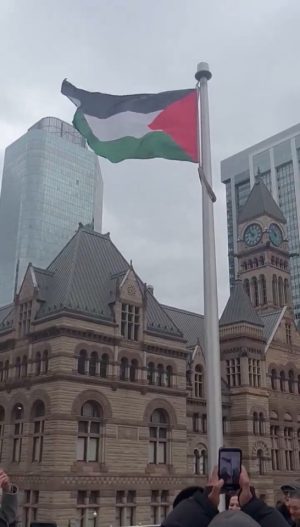
The Palestinian flag rose over Toronto City Hall for the first time on Monday, and with it came a wave of anger and disbelief from many in the Jewish community who watched their city elevate a symbol that has been at the center of some of the most aggressive anti Israel rhetoric of the past two years. What unfolded at Nathan Phillips Square was more than a flag raising. It was a political statement sanctioned by the City of Toronto and carried out over the objections of thousands of residents, major Jewish organizations, and even after a last minute emergency court challenge.
The ceremony was staged by the International Centre of Justice for Palestinians, which framed the day as a celebration of Palestinian nationhood. Dozens gathered on the rooftop of City Hall chanting “free free Palestine,” waving flags and cheering as the banner went up. In the square below, more supporters joined them while a handful of pro Israel demonstrators stood in disbelief as the city’s courtesy flagpole was used to legitimize a cause that many in the Jewish community associate directly with violence, intimidation, and a torrent of antisemitism that has swept across Toronto since the Israel Hamas war began.
For some of the speakers, this was not simply a symbolic event. It was an open political declaration. One speaker used the moment to accuse “anti Palestinian racists” of trying to “erase” Palestinian identity, while others celebrated Canada’s recent recognition of a Palestinian state and thanked Toronto for the platform. Organizers described the flag raising as overdue and triumphant. They openly linked it to what they called a two year genocide in Gaza and claimed the event showed the Palestinian struggle would be “visible across public life in Toronto.”
None of that softened the alarm among Jewish groups and residents who had begged the city to stop the event. More than twenty thousand people signed a petition calling on Toronto to halt the ceremony, warning it would “endorse a hate based movement that specifically targets our Jewish community.” B’nai Brith Canada cautioned that the flag raising would “inadvertently cause division and tension” in a city still struggling with harassment, vandalism, and intimidation directed at Jews. City councillor James Pasternak said he urged the city to reverse what he called a divisive and unjustified decision.
The Tafsik Organization attempted to block the event in court, filing an urgent judicial review that argued the flag raising violated city policy and would further inflame antisemitism in Toronto. Their position was clear: the Palestinian flag, especially in the context of the past two years, is not a neutral emblem but a deeply polarizing symbol used in rallies where Jewish Torontonians have been threatened and harassed. Tafsik also raised concerns that the organizations involved in the ceremony included groups with a documented history of antisemitic activity. But in an early morning decision on the day of the ceremony, an Ontario Superior Court judge dismissed the injunction request, clearing the way for the flag to be raised just hours later. ICJP’s lawyer celebrated the ruling, dismissing the concerns of Toronto’s Jewish community as “anti Palestinian tropes” and “demonstrable falsehoods.”
While organizers were cheering on the rooftop, police were responding in Nathan Phillips Square. Officers arrested a man for assault with a weapon and administering a noxious substance during a confrontation following the demonstration. No injuries were reported, but the incident underscored what Jewish leaders had warned about: heightened tensions and a volatile environment.
The city justified its decision by pointing to its flag policy, which allows the flags of countries recognized by Global Affairs Canada to be flown on the courtesy pole. Canada’s recent recognition of a Palestinian state made the request eligible. City staff described the program as non partisan and first come, first served. But that explanation did nothing to reassure those who felt that Toronto had abdicated its responsibility to consider the real world impact of its choices. Jewish residents argued that City Hall had not simply followed a procedure. It had made a political decision with real consequences for a community already facing unprecedented hostility.
Meanwhile, the ICJP used the platform to publicly accuse Toronto opponents of racism and to assert that the city’s hosting of the flag proved that Palestinian identity would be “seen and heard” in Canada’s largest metropolis. For those who have experienced the anti Israel rallies that have routinely spilled into hateful rhetoric, those words rang as further provocation.
The flag came down at the end of the day, as city rules require, but the damage to community trust will not disappear as quickly. Across Toronto, many Jewish residents were left wondering how their city could elevate a symbol celebrated at rallies where Jews have been targeted, and do so over their explicit objections. The ceremony may have lasted only a few minutes, but its message was unmistakable. Toronto chose to raise a flag that many of its Jewish citizens view not as a gesture of inclusion, but as a symbol of hostility directed at them.



Leave a Reply