
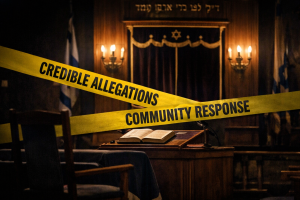
Last week, a person working within a Montreal Jewish institution was quietly removed from their position after allegations of sexual misconduct surfaced. There has been no criminal conviction and, at this stage, no charges have been laid. Still, the allegation was considered credible enough that the institution determined the individual could no longer continue in their role.
Beyond that, very little is being said publicly, and for now that is intentional. We are not publishing the name of the person involved, the institution where they worked, the identity of the complainant or even the specific nature of the alleged misconduct. We believe that before we publish the name of an individual in the community and affect that individual’s livelihood, there must be a public accusation against them. We believe that quiet allegations are not convictions and until a matter reaches the judicial system, or until a public allegation is announced by a victim, responsible reporting requires caution and restraint.
That said, the fact that the individual was removed from their position matters.
For many years situations like this would have been handled in a very different way. Complaints were often dealt with quietly and internally, sometimes through informal conversations among leadership rather than through clear procedures. Institutions worried about embarrassment, communities worried about scandal, and the instinct was often to contain the situation rather than confront it. In some cases people simply moved on to positions elsewhere, leaving unresolved questions behind and allowing the cycle to continue somewhere else.
The decision taken last week does not resolve anything by itself, but it may signal that attitudes within parts of Montreal’s Jewish community are beginning to shift. The idea that allegations of sexual misconduct can simply be ignored or quietly buried is becoming harder to sustain.
For decades the community reassured itself with a comforting narrative about safety. We told ourselves that our schools were safe, our synagogues and communal institutions were safe, and our youth programs were safe. Because our community is close knit and because many of our leaders are respected figures, it was easy to believe that the kinds of scandals that have shaken other institutions in wider society could not happen here.
It is a reassuring belief. Unfortunately, it is not reality.
Sexual abuse and sexual exploitation exist wherever there are power imbalances and environments where people hesitate to question authority. Jewish communities, like every other community, are not immune.
Those who abuse positions of trust rarely appear suspicious at first glance. More often they are seen as committed members of the community. They may be educators, youth workers, counselors, volunteers, communal leaders or rabbis. They cultivate reputations as people who care deeply about helping others and become trusted figures within institutions. That trust can become the very mechanism that allows boundaries to be crossed without immediate scrutiny.
In many cases abuse does not begin with something obvious or dramatic. It develops gradually through subtle steps that erode normal boundaries. Personal attention becomes excessive, private meetings become routine, and emotional closeness slowly becomes inappropriate. Because the individual involved is respected, people hesitate to interpret the behaviour as problematic until the situation has already progressed too far.
The broader Jewish world has confronted this reality more than once. Rabbi Baruch Lanner, once a prominent figure in Orthodox youth organizations in the United States, was eventually convicted after years of allegations circulated quietly within the community. Rabbi Yehuda Kolko in Brooklyn was convicted of sexually abusing a child after accusations had long been whispered about before authorities became involved.
In Washington, Rabbi Bernard Freundel secretly installed hidden cameras in a mikvah, recording women while they were undressing, including converts who trusted him during an extremely sensitive religious process. In New Jersey, Rabbi David Kaye was caught in a Dateline NBC sting operation attempting to meet someone he believed to be a thirteen year old girl for sex.
Then there was Chaim Walder, one of the most widely read children’s authors in the Orthodox world. His books sat on the shelves of Jewish homes and schools around the world and were widely praised for helping young people navigate difficult emotions. When numerous allegations surfaced accusing him of abusing women and young people who had sought his help, the revelations shocked communities that had trusted him.
Montreal has also had to confront difficult questions. In recent years allegations surfaced against a Montreal rabbi involving alleged abuse dating back decades. The case eventually reached the courts, and the rabbi, Shlomo Leib Mund, was acquitted by the judge. The outcome highlighted an important principle. Allegations must be taken seriously, but justice ultimately depends on evidence and due process.
At the same time, it is important to state something clearly. The overwhelming majority of teachers, rabbis, youth workers and volunteers in Montreal’s Jewish community are decent and honorable people who devote their lives to strengthening communal life. They educate our children, support families and contribute enormously to Jewish institutions across the city. They are not predators, and it would be irresponsible to treat them as if they were.
But acknowledging that reality does not remove the danger posed by the small number of individuals who misuse positions of trust.
Sexual exploitation in communal and religious settings is not limited to children. Adults can also find themselves vulnerable. Converts often rely heavily on religious leaders during the deeply personal process of joining the Jewish people. Individuals experiencing grief, loneliness or personal crises sometimes turn to trusted figures for guidance and support. In those moments the imbalance of power can be significant, and when that trust is abused the consequences can be devastating.
Communities have not always responded well when such situations arise. The instinct to protect institutional reputation or avoid public embarrassment has sometimes overshadowed the need to address allegations honestly. Complaints were occasionally handled quietly and victims sometimes felt pressure to remain silent so that the community would not have to confront uncomfortable questions.
The intention may have been to protect institutions, but the effect was often to protect those responsible for wrongdoing.
When credible allegations arise they must be taken seriously and examined through proper processes rather than handled informally behind closed doors. Protecting the reputation of an institution can never come before protecting the people who rely on it. At the same time, allegations alone cannot become convictions. Justice requires evidence, fairness and due process, because communities cannot become mobs any more than they can become shields that allow accusations to simply disappear.
Montreal’s Jewish community is strong and deeply connected to its institutions. But strength should not come from pretending problems cannot exist here. Real strength comes from confronting difficult realities honestly and ensuring that the people who place their trust in communal institutions are protected.
Every community faces challenges. The real test is not whether those challenges exist, but how seriously the community takes its responsibility to deal with them.
And that responsibility begins the moment silence is no longer the default response.
Howie Silbiger is the host of The Howie Silbiger Show on truetalkradio.com and Political Hitman on Israelnewstalkradio.com. He is the Editor in Chief of The Montreal Jewish News.




Leave a Reply