
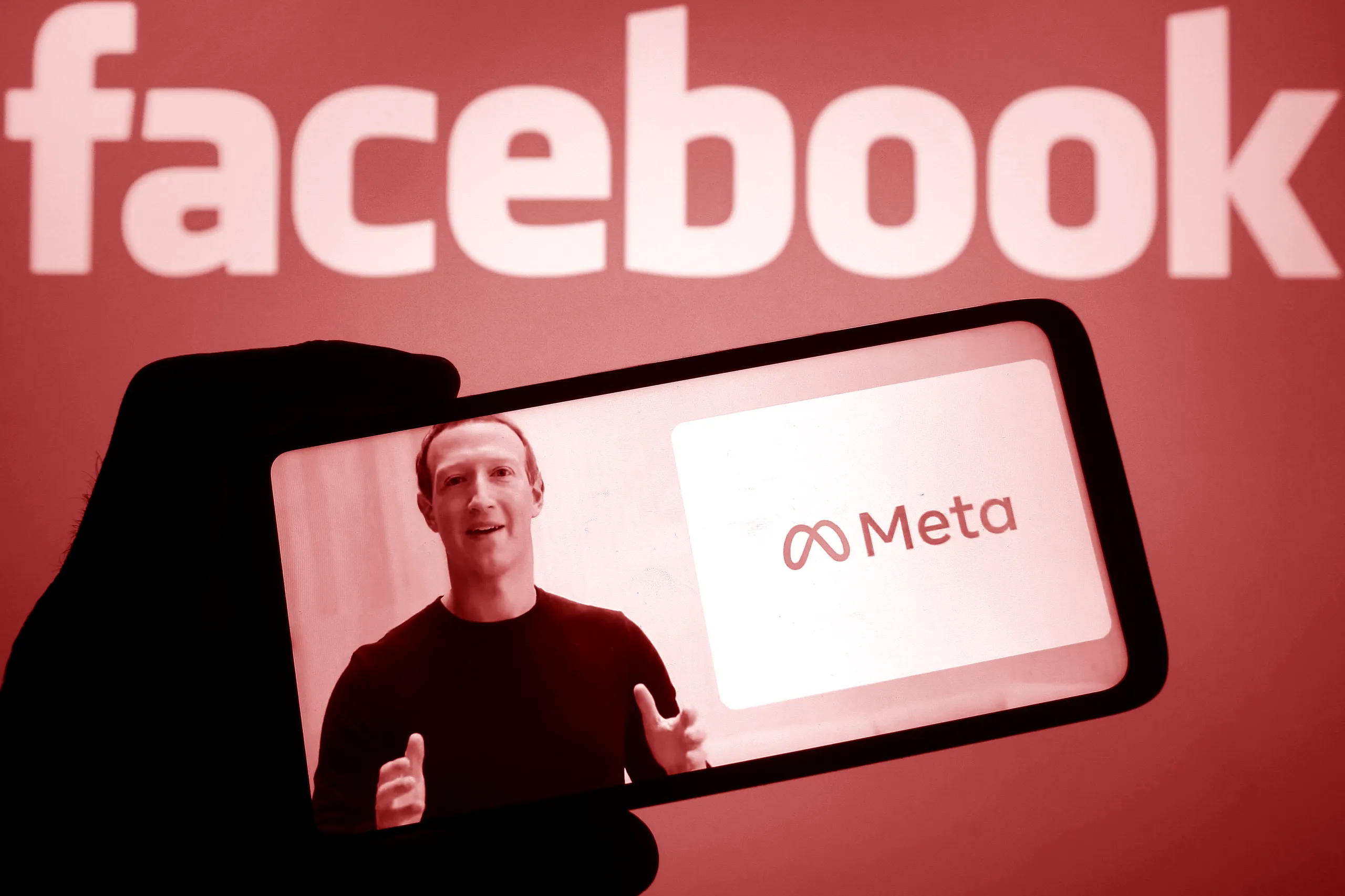
Mark Zuckerberg’s Meta seems to have no difficulty deciding when Jewish and pro-Israel voices should be restricted. Facebook and Instagram can remove posts, suspend accounts, limit their visibility and prevent their content from reaching new audiences. Yet, when it comes to Holocaust denial, glorification of Adolf Hitler and outright Nazi propaganda, those same sophisticated moderation systems suddenly seem remarkably ineffective.
An investigation published by Britain’s Telegraph earlier this week, followed by a report in The Jewish Chronicle, uncovered an extraordinary amount of Nazi propaganda circulating on Instagram. Videos praising Hitler, denying the existence of gas chambers and imagining a world in which Hitler had successfully exterminated the Jews have attracted millions of views. One Holocaust denial post reportedly received almost 80,000 likes. Artificial intelligence is being used to produce videos depicting Hitler as a beloved celebrity, enthusiastically welcomed by adoring crowds.
Luc Bernard, a Holocaust educator who has worked with Meta to identify harmful content, accused Instagram of spreading Nazi propaganda and radicalizing young people. He described thousands of pro-Hitler videos accumulating hundreds of millions of views, many in direct violation of the company’s own community standards. Researcher Rachel Moiselle warned that Instagram’s recommendation system can feed users a steady stream of similar material after they encounter a single Nazi video.
This is not some newly discovered problem with social media. Facebook has been accused of inconsistently enforcing its community standards against Jews and Israelis for more than a decade, and some of those accusations have been supported by rather embarrassing demonstrations of how the company applies its rules.
In December 2015, Israeli legal organization Shurat HaDin conducted an experiment. It created two nearly identical Facebook pages, one called Stop Palestinians and the other Stop Israelis. Both pages published inflammatory messages, including calls for violence. The organization then reported both pages to Facebook through the company’s normal reporting system.
Facebook promptly removed the anti-Palestinian page, declaring that it contained credible threats of violence and violated community standards. The page calling for violence against Israelis was allowed to remain online, with Facebook informing the researchers that it did not violate the rules. Only after the experiment became public did Facebook reverse its decision, remove the second page and acknowledge that it had made a mistake. The incident was documented by the Observer in January 2016.
A few months later, another incident attracted international attention. Facebook removed a post from Israel Video Network declaring that the land was called Israel, not Palestine. Former Israeli parliamentarian Dov Lipman arranged a test using an almost identical statement supporting Palestine instead of Israel. Facebook determined that the pro-Palestinian version did not violate its community standards. The original pro-Israel post was eventually restored after the incident attracted publicity, and Facebook apologized. The Washington Post reported the incident in June 2016.
Two separate incidents, months apart, with the same basic outcome. Facebook’s initial moderation decisions treated comparable content differently, and the company acknowledged its mistakes only after being publicly challenged. These were not complicated disputes involving sophisticated political arguments. One experiment involved explicit calls for violence and the other involved two nearly identical political statements.
Then came October 7, 2023, when Hamas terrorists demonstrated how Facebook could be turned into an instrument of terrorism.
As Hamas terrorists moved through Israeli communities murdering civilians, they used their victims’ own Facebook accounts to broadcast their atrocities. In Kibbutz Nahal Oz, terrorists invaded the home of the Elyakim Arava family, wounded Noam Elyakim and held the family at gunpoint. They used Dikla Arava’s Facebook account to livestream the ordeal while relatives and friends watched helplessly. The terrorists then forced 17-year-old Tomer to accompany them through the community, using him to persuade neighbours to open their doors. Noam and Dikla were murdered, Tomer was also killed, and two young girls, eight-year-old Ella and fifteen-year-old Daphna, were kidnapped to Gaza. Israel’s public broadcaster Kan later documented the entire sequence of events.
In Nir Oz, Hamas terrorists murdered 74-year-old Bracha Levinson inside her home, accessed her Facebook account and broadcast images of her body lying in a pool of blood. Her friends and relatives discovered what had happened through Facebook itself. CNN’s Anderson Cooper documented the incident while reporting from the destroyed community.
Hamas had not simply used social media to announce its political positions. Its terrorists were using Facebook to terrorize the families of the people they were murdering. The broadcasts were taking place as the attacks unfolded, and the footage became part of the enormous body of evidence documenting the October 7 massacre.
Yet, as that evidence circulated, Facebook began removing posts intended to expose the crimes Hamas had committed. Two Facebook posts containing testimony about sexual violence against Israeli women, accompanied by footage of women being abducted, were removed under Meta’s policies concerning dangerous organizations and individuals. The users appealed, and in April 2024 Meta’s own Oversight Board documented the removals. Meta had restored the posts after the appeals reached the Board.
In another case, Instagram removed footage showing an Israeli woman being abducted by Hamas. The video was eventually reinstated with a warning screen, but Meta’s Oversight Board criticized the company for restricting the distribution of such material even after determining that it should remain available to document the atrocities. The company had managed to classify evidence of terrorism as material that should not be recommended to other users.
Jewish content creators have been complaining about similar restrictions for years. In March 2024, The Jerusalem Post interviewed six Jewish and pro-Israel Instagram creators about their experiences following October 7. Canadian creator Anat Ishai, known as Challah Mom, reported that her content had been classified as non-recommendable after she began posting extensively about the Hamas attacks. She said her reach had dropped from millions to approximately 50,000. Another creator, Shai Albrecht, described becoming difficult to find after opponents repeatedly reported her account.
The practice is commonly described as shadow banning. A page or account may technically remain active, its owner can continue publishing, and existing followers may still see the material, but the platform stops recommending it to other users. In some cases, account holders receive little useful information about why their visibility has been reduced or when the restrictions will end. The precise reasons behind individual account restrictions are not always independently verifiable, but the complaints from Jewish creators are longstanding.
And all the while, Facebook and Instagram have continued to host material that would make a Nazi propagandist proud.
In January 2024, Meta’s Oversight Board overturned the company’s decision to leave a Holocaust denial post on Instagram. The post contained fabricated claims concerning the number of Jews murdered during the Holocaust. The Board found that the material violated Meta’s existing prohibition against Holocaust denial, which the company had publicly announced back in 2020. The post had nevertheless survived automated and human reviews.
The problem has continued well beyond individual moderation mistakes. In April 2026, the Anti-Defamation League published the results of an investigation involving 253 extremist Instagram accounts and posts. Researchers reported material connected to white supremacist organizations, terrorist propaganda and Nazi merchandise through the same system ordinary Instagram users must use. After allowing two weeks for responses, Instagram had removed only 19 of the 253 accounts and posts. In 20 cases, the company indicated that it lacked the capacity to review the reports.
Meta later maintained that more than two-thirds of the flagged material had been removed by the time the investigation was published, while insisting that some of it did not violate its policies. That response hardly resolves the problem identified by the researchers. Ordinary users reporting extremist material should not require the intervention of a major Jewish organization and international media attention before appropriate enforcement takes place.
The World Jewish Congress provided another disturbing set of findings in August 2026. Its investigation of 754 antisemitic social media posts documented by Jewish communities across Europe found that 81 percent remained publicly accessible when researchers checked their status in May. Facebook had the lowest removal rate among the platforms examined, at 13.9 percent. Particularly troubling was the treatment of antisemitism presented as criticism of Israel. Only 5.2 percent of posts in that category were removed, while none of the 28 reported posts comparing Israeli policy to Nazism had been taken down.
We have previously reported in the Montreal Jewish News on the growing recognition of anti-Zionism as a vehicle for antisemitism. The word Zionist is increasingly used as a substitute for Jew, and social media has helped normalize the practice. The substitution allows old antisemitic conspiracy theories to be repackaged as political commentary, while the people distributing them insist that they have no particular problem with Jews.
There is an enormous difference between criticizing an Israeli government and celebrating the slaughter of Jewish civilians. We discussed that distinction in our coverage of the continued glorification of the October 7 massacre. Facebook and Instagram have allowed an environment in which that distinction is regularly ignored by people spreading antisemitic propaganda, while legitimate Jewish accounts are left trying to understand why their material has been restricted.
Meta is not a small company trying to manage a few thousand accounts. It is one of the world’s largest technology corporations, operating platforms that reach billions of people. It has invested enormous sums in artificial intelligence, automated content analysis and sophisticated systems capable of identifying user behaviour, selecting advertisements and determining which videos people will see. Instagram’s recommendation algorithms are central to its business. The company is perfectly capable of influencing what appears on a user’s screen.
Against that background, its repeated inability to enforce its own rules against openly Nazi material is difficult to excuse. We are not talking about a complex argument over the legality of an Israeli settlement or an opinion about the conduct of a war. We are talking about videos celebrating Adolf Hitler, denying the Holocaust and suggesting that the world would have been better had the Nazis finished exterminating the Jews.
After the latest revelations, a Meta spokesperson told The Jewish Chronicle that the company was investigating the material and maintained that extremist views and violence have no place on its platforms. It is the same sort of corporate reassurance that has accompanied years of documented failures.
Mark Zuckerberg and his executives have had more than enough opportunities to correct these problems. They have been warned by Jewish organizations, challenged by journalists, embarrassed by independent investigations and overruled by their own Oversight Board. They have seen their platforms used to broadcast a terrorist massacre, removed material documenting that massacre and watched as Nazi propaganda continued to accumulate enormous audiences.
Facebook and Instagram’s community standards are supposed to apply equally to everyone. The documented history shows that they have not always been enforced equally, and the latest investigations demonstrate how badly the system continues to fail Jewish users.
The company does not need another public relations campaign telling Jews that it takes antisemitism seriously. It needs to explain why its powerful moderation machinery can identify and restrict perfectly legitimate Jewish content while Holocaust denial and Nazi propaganda repeatedly escape enforcement.
For a company that knows so much about what its users think, say, watch and believe, Meta has spent an extraordinary amount of time failing to recognize Jew hatred when it is staring them right in the face.


Leave a Reply