

By Howie Silbiger
Two locations of a Jewish-owned bakery in Toronto were attacked overnight. One was struck by gunfire. A window was smashed at the other. Thankfully, no one was injured, which provided everyone in authority with the usual opportunity to express concern, condemn hatred and announce that the incidents were being investigated as possible hate crimes. Days earlier, a visibly Jewish man leaving a Manhattan synagogue was stabbed with a screwdriver by an attacker witnesses said shouted “Allahu Akbar.” That attack, too, was processed through the familiar language of hate crime.
Hate crime describes the victim. Terrorism describes the purpose.
When someone fires into a Jewish business, burns a synagogue, shoots at a Jewish school or attacks a Jew in the street in order to frighten an entire community, influence public behaviour or punish Canadian and American Jews for events in another country, that is terrorism in every ordinary understanding of the word. The fact that prosecutors may not yet be able to prove membership in a designated terrorist organization does not magically turn terrorism into mischief.
Governments insist on treating each attack as a separate file; One broken window, one fire, one shooting, one unstable individual, one hate crime, one isolated incident. After enough isolated incidents, one begins to wonder what exactly they are isolated from.
I am not suggesting that every attacker receives instructions from the same commander or that every act of violence is planned in one underground headquarters. Terrorism has never required that. It can be directed, financed, encouraged, inspired, copied or committed by someone who has absorbed the message and decided to act. What connects these attacks is the target, the political message and the intended result. Jewish institutions, Jewish businesses and visibly Jewish people are being attacked in order to make Jews feel unsafe in their own cities.
Canadian intelligence officials already know this. A recent federal threat assessment reportedly acknowledged that four ISIS-inspired plots against Jewish targets in Canada had been disrupted since October 2023. The same report described rising assaults, arsons, shootings and threats against Jewish communities, while warning that an attack remained a realistic possibility. Yet even within that assessment, former senior RCMP official Ches Parsons said the government’s narrow definitions were creating what he called a statistical firewall that obscured the true scale of the threat. In other words, the threat is acknowledged in classified briefings and carefully diluted by the time it reaches the public.
We have seen this before
On November 5, 1990, Rabbi Meir Kahane was shot and killed after delivering a speech at a Manhattan hotel. Because Kahane was controversial and political, his murder was treated as a political assassination. The media discussed his views, his enemies and the anger surrounding him. The government treated the case as the killing of one divisive public figure. That explanation was convenient. It was also disastrously incomplete.
Kahane’s killer, El Sayyid Nosair, was not operating in an ideological vacuum. Mohammad Salameh, who was arrested at one of Nosair’s addresses on the night of the murder, later drove the rented van containing the bomb into the underground garage of the World Trade Center in 1993. Mahmud Abouhalima, who was supposed to help Nosair escape after the Kahane assassination, later drove behind the bomb truck and helped members of the cell flee. Nosair was connected to the Al-Kifah Refugee Center and the network surrounding Sheikh Omar Abdel Rahman, the Blind Sheikh. He was eventually convicted in federal court as part of the conspiracy that included plans to bomb New York landmarks.
The murder of Rabbi Kahane was not merely the assassination of a political personality. It was the opening act of the Al Qaeda story in the United States. The men around Nosair would move on from murdering a rabbi to bombing the World Trade Center and plotting to destroy bridges, tunnels and other New York landmarks. What began with a dead Jew in a hotel ballroom became a terrorist campaign against the United States.
The warning was there. The government did not want to see it. There was an ideological network forming in plain sight, with documents, addresses, associates and weapons, but calling it terrorism would have required authorities to admit that an international jihadist movement had established itself in New York. It was easier to prosecute one man, describe the killing as political, and reassure the public that the danger was contained.
Three years later, the World Trade Center was bombed by the same group of terrorists. Six people were killed and more than a thousand were injured. The terrorists had hoped the explosion would topple one tower into the other. Eight years after that, the towers were destroyed.
Canada has its own history of ignoring warning signs. Ahmed Ressam lived in Montreal and had a small store that he used to fundraise for his terror network. In December 1999, he attempted to enter the United States from British Columbia with bomb-making materials intended for an attack on Los Angeles International Airport during millennium celebrations. He had trained in Al Qaeda camps and used Canada as an operational base.
Canadians were told afterward that the system had worked because Ressam was caught, but never explained how an Al Qaeda trained terrorist had been able to establish himself in Montreal, operate a store to raise money, obtain materials, prepare an attack and travel across the country before a suspicious customs officer stopped him. The arrest may have prevented the bombing, but it did not erase the failure that came before it.
Montreal’s Jewish community has been receiving its own warnings for decades. In 2004, the library at United Talmud Torah in St. Laurent was deliberately bombed during Passover. Thousands of books were destroyed and a note left at the scene said the attack was retaliation for Israel’s killing of Hamas leader Sheikh Ahmed Yassin. That was not random vandalism, a Jewish school in Montreal was attacked in order to punish Jewish children for an action taken by the Israeli military thousands of kilometres away. The message was political, the target was civilian and the purpose was intimidation. That is the definition of terrorism, even when the criminal charge is arson.
In 2006 and 2007, Montreal Jewish institutions were firebombed, including the Skver-Toldos Orthodox Jewish boys school and the Ben Weider Jewish Community Centre, the Snowdon Y. One of the men involved eventually pleaded guilty. Once again, these were treated as attacks on individual buildings rather than part of the continuing effort to terrorize a Jewish population.
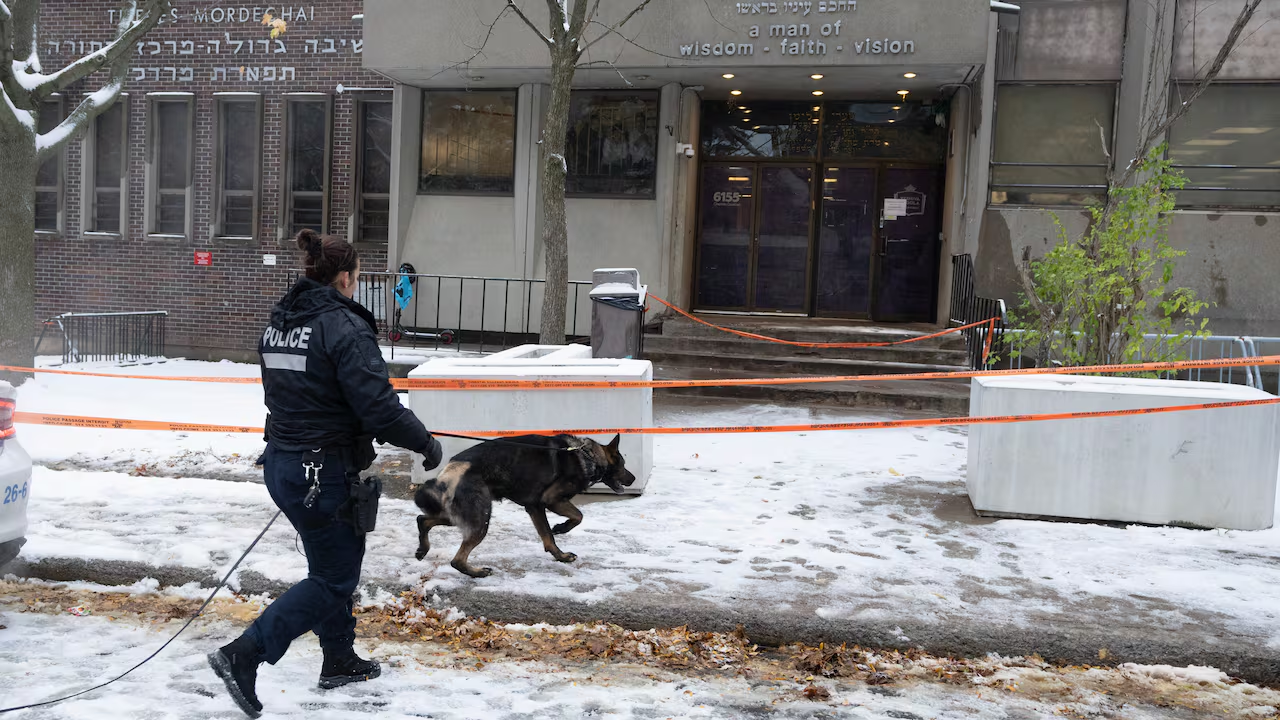
After October 7, 2023, bullets were fired into the entrances of both Talmud Torah Elementary School and Yeshiva Gedola in Montreal. Yeshiva Gedola was shot at again days later, Beth Tikvah synagogue in Dollard-des-Ormeaux was targeted by fire twice in just over a year and Federation CJA’s nearby offices were also damaged.
Jewish schools, synagogues and community buildings were attacked repeatedly, yet every incident was presented as though the attacker had invented the idea that morning.
More recently, police arrested two suspects following a series of attacks on Hasidic Jews in Outremont. In Toronto, Jewish businesses have been shot at. In New York, Jews leaving synagogues have been assaulted. Across the Western world, attackers are choosing Jewish targets and using violence to send the same message: You are not safe here.
Still, governments resist connecting the dots.
The excuse is always that officials do not want to frighten the population. They prefer reassuring language. They speak of community tensions, isolated offenders, possible hate motivation and the need to avoid speculation. They tell Jews that police patrols have been increased and that elected officials stand in solidarity with them…And then another synagogue burns.
The refusal to use the word terrorism does not calm the public. It calms the terrorists. It tells them that their actions will be minimized, compartmentalized and stripped of their political meaning. They can shoot at a Jewish school and be described as vandals. They can firebomb a synagogue and be described as arsonists. They can attack Jewish-owned businesses and be processed as hate criminals. Unless they leave behind a membership card from ISIS, the government pretends that the wider campaign does not exist.
That distinction is becoming even harder to defend. American authorities recently charged an alleged senior member of Kata’ib Hezbollah with helping to direct or encourage attacks against Jewish, Israeli and American targets in North America and Europe. The allegations include attacks in Canada and plans involving Jewish sites in the United States. This is not speculation about whether foreign terrorist organizations are attempting to use local actors, it is the basis of a federal terrorism prosecution.
There is a reason Jewish targets are chosen first. Terrorists know that governments will hesitate. They know that officials fear being accused of exaggerating, stereotyping or inflaming tensions. They know that an attack on a synagogue will often be debated as a Jewish community issue rather than treated as an attack on the country itself.
The murder of Rabbi Kahane should have ended that habit in 1990. Authorities had an opportunity to recognize that the killing was connected to an emerging jihadist network operating in the United States. Instead, they saw a controversial rabbi, a political grievance and a lone gunman. The larger truth was allowed to grow in the background until a bomb exploded beneath the World Trade Center.
Montreal had its opportunity with Ressam. It had another with the Talmud Torah arson. Another with the firebombing of the Y, another when bullets struck Jewish schools, and yet another when a synagogue was attacked for the second time.
How many opportunities are required before the incidents stop being called isolated?
Governments do not protect the population by concealing the nature of the threat, they protect their own political comfort. Acknowledging a terrorism campaign would require serious action. It would require governments to examine foreign financing, extremist networks, online radicalization, ideological incitement and the organizations that provide moral cover for violence. It would require police and intelligence agencies to connect cases across jurisdictions instead of closing each file within municipal boundaries.
It would also require political leaders to say something they desperately do not want to say: The campaign against Jews is not simply the unfortunate overflow of a distant conflict, it is a domestic security threat.
The people attacking Jewish schools and businesses are not confused about what they are doing. They understand the power of the target, they know that every bullet hole in a school door frightens hundreds of families, they know that a fire at a synagogue reaches every Jew who has ever prayed there and they know that an attack on a bakery tells Jewish business owners that their names, identities and customers may make them targets.
The terrorists understand terrorism; it is the government that insists on pretending not to.
There will eventually be an attack that authorities cannot minimize. There will be mass casualties, arrests, intercepted communications and evidence of a network. Officials will hold sad apologetic press conferences and announce that the threat had been developing for years. Reports will be commissioned, experts will explain that the warning signs were visible, and everyone will ask how it was allowed to happen.
We already know the answer, it will have been allowed to happen because governments were more afraid of naming terrorism than terrorists were of committing it. It’s quite simple, a government that refuses to name terrorism when it targets Jews is not preventing panic, it is postponing recognition until the funerals are plentiful enough to make denial impossible.


Discover more from The Montreal Jewish News
Subscribe to get the latest posts sent to your email.