





By Howie Silbiger
I had almost forgotten about Keeping Up with the Steins until I came across it again recently. It came out in 2006 and it is not one of the great Jewish films of all time. It is corny, some of the jokes are very much from 2006, and it occasionally beats you over the head with what it is trying to say. Still, I watched it differently this time because I knew something about the kid playing the bar mitzvah boy that I didn’t know when I first saw it.
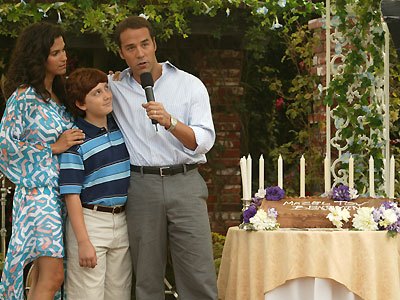
The movie stars Daryl Sabara, then best known as the kid from Spy Kids, as Benjamin Fiedler, a 13-year-old preparing for his bar mitzvah in Los Angeles. His father, played by Jeremy Piven, has just watched a business rival throw his son an absolutely ridiculous Titanic-themed bar mitzvah aboard a ship, complete with an iceberg, and decides that his own son’s celebration has to be bigger. Before long he is talking about renting Dodger Stadium and bringing in celebrities. Benjamin, meanwhile, is much less concerned with whether Neil Diamond is available than with the uncomfortable realization that he doesn’t really understand much of what he is supposed to be doing.
That is the joke running through the movie, except it isn’t really a joke. The adults have built an entire production around a Jewish religious milestone while the Jewish kid at the center of it is still trying to understand the milestone, and while that was happening on screen, real life started imitating the movie.
Sabara himself was approaching bar mitzvah age while the film was being made. He and his twin brother Evan had not grown up with much formal Jewish education, but they began studying with Rabbi Baruch Hecht at Chabad of Brentwood and spent about six months preparing. Hecht told the Jewish Journal that the boys arrived knowing very little about Judaism. They could easily have done what generations of bar mitzvah kids have done, memorize some Hebrew phonetically, get through the service and concentrate on the party. Instead, they wanted to understand what they were learning. They studied Hebrew, Torah, the purpose of and how to put on tefillin, Jewish holidays and their heritage. Sabara’s own explanation was much simpler: he didn’t want a big party, he wanted the bar mitzvah to mean something.
There is something about that story that has stayed with me, especially because Sabara was an actor, memorizing words he didn’t understand and delivering them convincingly was literally something he was trained to do for a living. If anybody could have faked his way through a Torah portion, smiled for the photographs and moved on, it was him. Instead, the movie about a boy discovering that there should be more to a bar mitzvah than an expensive party carried directly into his own life. The Haftorah he chants in the movie was his real portion, and when his actual bar mitzvah came, it was small and relatively simple. Sabara later talked about people overdoing these celebrations and forgetting that becoming bar mitzvah is supposed to be about accepting responsibility, a fairly impressive conclusion for a 13-year-old to reach while surrounded by Hollywood.
There is another part of Keeping Up with the Steins that I had forgotten, and it means more to me now than it did twenty years ago. Garry Marshall plays Benjamin’s estranged grandfather, Irwin. He is the old hippie who has been largely absent from his son’s life, wanders back into the family at precisely the wrong moment and ultimately becomes one of the people who helps Benjamin see past the circus that has been constructed around him.
Marshall wasn’t Jewish. After his death in 2016 there were Jewish obituaries explaining precisely that because so many people simply assumed he was. He was Italian and English, grew up in the Bronx surrounded by Jewish and Italian families, knew enough Yiddish as a young camp counsellor that he was once put in charge of Jewish campers and improvised services for them in the woods, and spent a career creating and playing characters that often felt unmistakably Jewish.
That made him a perfect Irwin. He wasn’t representing observant Judaism; the character represents memory, family and the older generation that carries pieces of a family’s history whether the younger generation wants to hear them or not. Watching Marshall play Irwin also reminded me of another television grandfather, Albert “Pops” Solomon on The Goldbergs, played by the late George Segal.
Segal was Jewish, but he grew up in an almost completely secular home. He said his family was not observant, he never had a bar mitzvah, did not attend religious school and described himself as coming from an assimilated family. Yet there he was for eight seasons as Pops, the grandfather who was forever hanging around the Goldberg house, dispensing questionable advice, getting himself involved in the grandchildren’s lives and, underneath all the comedy, functioning as the family’s connection to another generation and to a Jewish past that the rest of the family barely understood. The real grandfather upon whom Pops was based had himself come from a Russian immigrant background and became a central pillar of the Goldberg family.
Neither The Goldbergs nor Keeping Up with the Steins is particularly religious, but it’s amazing that different generations of Hollywood writers, who were not trying to make religious programming, understood that something disappears when the grandparents disappear, when the stories disappear and when there is nobody left in the room who remembers how the family got there.
We talk a great deal today about Jewish values, usually without ever defining them. The phrase has become wonderfully convenient because almost anything can be placed underneath it. Kindness is a Jewish value. Education is a Jewish value. Social justice is a Jewish value. Family is a Jewish value. Community is a Jewish value. All true, but none of those belongs exclusively to Jews, and at some point, there has to be something underneath the slogan.
Sabara understood at 13 that the party could not be the whole thing. Don’t get me wrong, there is nothing wrong with throwing your kid a beautiful bar mitzvah. Spend the money if you have it. Hire the band, serve the sushi, invite the cousins you haven’t seen since the last family simcha and make a night of it. Jews have been finding excuses to eat together for several thousand years, and I have no intention of arguing against that tradition. The problem comes when the celebration becomes the substance.
Somewhere between our grandparents’ and great-grandparents’ generations and ours, success began to change what we thought we owed our children. People who grew up with very little wanted their children to have more. Their children wanted their children to have even more, and eventually “I want my children to have what I didn’t have” quietly became “I don’t want my children ever to be uncomfortable.”
Garry Marshall spoke about that while promoting the film. His observation was that immigrant generations worked enormously hard to give their children opportunities they themselves never had, and later generations responded by giving their own children too much.
That isn’t only a Jewish problem, but Jewish tradition has a very direct answer to it. Judaism never promised children that life should be comfortable, in fact, bar mitzvah says the opposite.
At thirteen, the Jewish boy is not traditionally handed a new set of privileges. He is handed obligations. He becomes responsible for mitzvot. More is expected of him than was expected the day before. We throw him a party to celebrate the fact that, according to Jewish tradition, life has just become more demanding. That is wonderfully out of step with almost everything else children hear today.
We have become very good at telling kids how special they are. We are less comfortable telling them that sometimes they have to do things because they are responsible for doing them. Help your family, visit someone who is sick, give tzedakah even when there is something you would rather buy. Show respect to somebody you don’t particularly like, apologize when you are wrong. Get up and go to synagogue when sleeping another hour sounds considerably better. Learn something even when there is no grade attached to it. Put on tefillin every day, even when nobody is watching.
The older generation did not always explain Judaism perfectly, and they certainly did not package it very well, but they lived it. There were expectations, obligations, family traditions, holidays, meals, synagogue, grandparents, stories and a sense that being Jewish came with responsibilities. You did not have to sit around discussing your Jewish identity, because, for better or worse, Judaism was the way the family lived.
That is what makes Sabara’s story worth remembering twenty years later. He walked onto a movie set playing a kid whose bar mitzvah had become an expensive production for the adults around him, and he walked away understanding that his own bar mitzvah had to be about something more. He went to Chabad, learned, kept the celebration simple and focused on what becoming bar mitzvah actually meant.
For all the excess surrounding him, Sabara seems to have understood the simplest part of the whole thing: becoming bar mitzvah meant that Judaism was now his responsibility too.


Discover more from The Montreal Jewish News
Subscribe to get the latest posts sent to your email.