




By Joseph Marshall
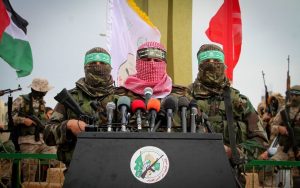
United States President Donald Trump announced Thursday evening that an agreement had been reached for the complete disarmament of Hamas and every other armed group in Gaza, potentially clearing the way for the terrorist organization to surrender its weapons and give up control of the territory.
Trump described the agreement as a historic breakthrough that would prevent Gaza from again being used as a base for attacks against Israel. Hamas, however, had not publicly confirmed the announcement as of Thursday evening, and it remained unclear whether the organization had formally signed the agreement or accepted every part of the proposed disarmament plan.
The announcement followed months of negotiations between Hamas, Trump’s Board of Peace and mediators from Egypt, Qatar and Turkey. Two American officials said Hamas had agreed to the terms, although other officials familiar with the talks cautioned that final approval had not yet been given and that the negotiations could still collapse.
Under the proposed agreement, Hamas and other terrorist organizations would give up their heavy and light weapons over a period of six to eight months. Hamas would also be required to provide detailed maps of its tunnel network, weapons factories and arms depots throughout Gaza.
The weapons would not be handed directly to Israel. They would instead be placed in storage under the supervision of the National Committee for the Administration of Gaza, a Palestinian technocratic government backed by the United States, and an International Stabilization Force expected to deploy inside the territory.
Control of Gaza would be transferred section by section. Before the new government assumes authority over an area, international officials would verify that Hamas weapons, tunnels, production facilities and military infrastructure had been removed or dismantled.
A new Palestinian police force would then be deployed in those areas. Its members would be vetted by Israel’s Shin Bet security service before receiving training and authorization to operate. The proposal is based on the principle that Gaza would have one government, one legal system and one recognized security authority.
The agreement would also disarm Palestinian militias that fought Hamas during the war and received weapons or support from Israel. Gazans who voluntarily surrender privately held weapons would be eligible to receive payments through an internationally funded weapons buyback program.
Hamas members who surrender their weapons would receive amnesty and be permitted to remain in Gaza. The agreement does not appear to require the mass expulsion or prosecution of Hamas members who agree to stop participating in armed activity.
In return, Israel would withdraw its forces to the Yellow Line established after the October 2025 ceasefire. Israel would also halt targeted killings of Hamas members unless it determined that an individual posed an immediate threat. Any further Israeli withdrawal would be tied directly to the disarmament process. Israeli troops would not completely leave Gaza until Hamas had surrendered its weapons and the territory had been verified as demilitarized.
Earlier Thursday, an Israeli official said Israel had rejected the 15-point document being negotiated in Egypt because it did not guarantee the complete removal of every Hamas weapon from Gaza. The official said Israel would not withdraw until Hamas was fully disarmed and the territory completely demilitarized. Sources close to Hamas had said the organization was prepared to confine and store its heavy weapons under the control of a Palestinian authority, but questions remained about light weapons and firearms carried by individual Hamas members.
The apparent disagreement may reflect different versions of the agreement or changes made during negotiations Thursday. It may also reflect the gap between Trump’s announcement of complete disarmament and the details Hamas is prepared to accept. Hamas has resisted disarmament since the ceasefire took effect in October 2025. It has argued that it will not surrender its weapons without guarantees that Israel will end its military operations and withdraw from Gaza.
Earlier this month, Hamas announced that it had dissolved its de facto government and was prepared to transfer civilian authority to the Palestinian technocratic committee. Israel dismissed the move as an attempt by Hamas to surrender administrative responsibility while keeping its weapons and military power.
Egypt, Qatar and Turkey have placed heavy pressure on Hamas to accept the disarmament agreement. Iran has reportedly urged Hamas to delay signing and continue negotiating. American officials believe Hamas has been weakened by military pressure, a growing financial crisis and efforts to cut off its remaining sources of funding.
The proposed agreement would represent the first time Hamas has accepted a process requiring it to surrender its weapons, dismantle its military infrastructure and give up security control of Gaza. Whether that process has actually begun will depend on what Hamas signs, what Israel accepts and whether the weapons, tunnels and armed forces Hamas spent nearly two decades building are ultimately surrendered.


Discover more from Montreal Jewish News
Subscribe to get the latest posts sent to your email.