


By Howie Silbiger
Every time something happens at Concordia University in Montreal involving Israel, there is another round of concern about what has happened to the university, how things have become so polarized and how Jewish students suddenly find themselves caught in the middle of it. I have been hearing variations of that discussion for more than 30 years, because I was a student at Concordia in the early 1990s and the anti Israel rhetoric was already there. It was not as loud, there were no phones recording every confrontation and posting it online within minutes, and most of what happened in student politics never travelled much farther than the Hall Building, but Israel was already treated differently and Jewish students who supported it learned very quickly that they were expected to defend its existence as much as its policies.
I studied political science, so arguing about politics was part of the reason I was there, and I certainly wasn’t looking for a campus where everyone agreed with me. There were plenty of legitimate arguments to have about Israeli governments, settlements, the Palestinians and the peace process, especially in the early 1990s when Oslo was taking shape and people genuinely believed the conflict might finally be heading somewhere. What bothered me then, and became much worse later, was the shift from arguing about Israel to arguing against Israel, with Zionism increasingly spoken about as though Jewish self determination was some particularly offensive political idea that required Jews to apologize for supporting it.
By 2001, Concordia student politics had moved a long way from the debates I remembered as a student. The Concordia Student Union published its infamous Uprising handbook, which praised the Palestinian intifada, talked openly about revolution. The handbook also carried an image of an airplane crashing into a boardroom, the kind of thing that was controversial when it was printed and became considerably harder to explain after September 11. I wrote about the handbook for The Suburban, because by then the CSU was producing material that deserved attention well outside the small world of student politics.
Laith Marouf and Tom Keefer were two names that came up constantly during that period. Marouf was the CSU vice president internal when he was caught spray painting anti Israel and pro Palestinian slogans on Concordia property, and the confrontation with security that followed eventually resulted in both Marouf and Keefer being banned from campus. I covered that story for The Suburban, including a press conference they held in the basement of a church while fighting the ban. The university later lifted the bans after an appeals process, although its own panel specifically said it was doing so without condoning their actions.
Marouf did not disappear. More than 20 years later Canadians heard his name again when the federal Liberal government funded an anti racism project involving an organization for which he worked as a consultant, then pulled the funding after his comments about Jews became public. Apparently, the journey from being expelled for spray painting anti Israel slogans at Concordia to being paid through a federal anti racism program to train journalist on how not to be racist was possible in Canada, at least until somebody bothered to Google Marouf’s name.
Yves Engler was another major player from that period and another name that never really went away. He was part of the pro Palestinian political movement at Concordia, became a CSU vice president, participated in the Netanyahu protest and later made attacking Israel and Zionism a significant part of his writing and activism, including a book called Canada and Israel: Building Apartheid. Engler still proudly describes the old CSU as anti Zionist and in 2025 defended both the movement that stopped Netanyahu from speaking and the latest CSU handbook controversy, writing that the criticism of the new handbook reminded him of Uprising. At least nobody can accuse him of changing the subject.
Aaron Maté was also right in the middle of those battles, serving as a CSU vice president and becoming one of the most visible pro Palestinian voices at Concordia. I had Maté on The Howie Silbiger Show on Radio Shalom, where he debated Steven Rosenshein, who was there representing Hillel and defending the other side. Rosenshein’s story became interesting later because he moved into CSU politics himself, joined the anti Israel side and eventually became a CSU executive.
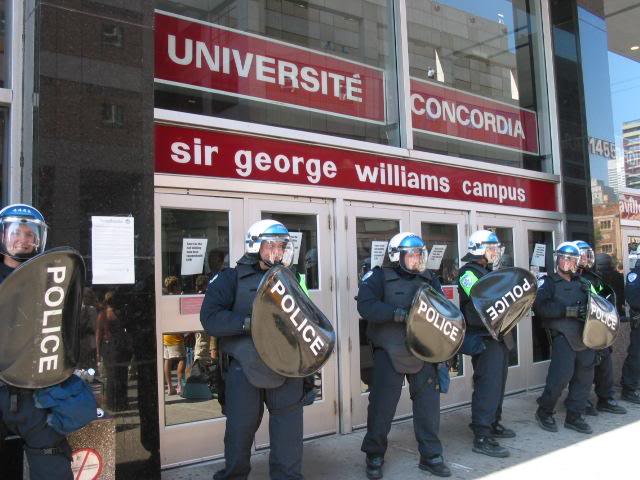
By the time Benjamin Netanyahu arrived in Montreal on September 9, 2002, nobody who had been paying attention to Concordia should have been surprised that there was going to be trouble. The protesters had openly said their intention was to prevent him from speaking and they arrived early, positioning themselves around the entrances while hundreds of ticket holders tried to get into the Hall Building. This was not a demonstration that accidentally became a little too enthusiastic. The stated objective was to stop Netanyahu from speaking, and that is exactly what happened.
Thomas “Tommy” Hecht, a Holocaust survivor and longtime Montreal Jewish community leader, was pushed, spat on and kicked in the groin while trying to get inside. Rabbi Howard Joseph, then rabbi of the Spanish and Portuguese Synagogue, and his wife Norma Joseph, who taught at Concordia, were also hit and spat on, while other people trying to enter were shoved, screamed at and had their kippahs knocked off. The riot squad was already there and, from what I saw, stood by while people trying to attend the event were being roughed up. Hecht later said, “I felt as though I was in Bratislava in 1939 again,” and summed up his offence rather simply: “I was guilty of wanting to hear a speech.”
Netanyahu was not sitting comfortably at the Ritz waiting to find out whether Concordia would let him come. He was ready to speak and had made it into the corridor leading toward the Hall Building when the university and his security people decided the situation had become too dangerous and cancelled the event. Hundreds of people were already sitting inside H 110 waiting for him. The people protesting outside had said they were going to stop the speech, people were assaulted trying to get into the building. Eventually, against the will of both Hillel, the organizers of the event and Netanyahu himself, the university cancelled the speech, and Netanyahu never made it to the microphone.
Things inside the Hall Building deteriorated quickly. Protesters got inside, furniture came down from the mezzanine, a window was smashed and police eventually used pepper spray and tear gas, some of which came into the lobby. I was there when the window was smashed and when the gas came into the building. Jewish students and community members were locked inside the room for their own safety, and ended up being trapped there for hours. I was allowed out because I was a journalist covering the event for the Montreal Jewish News.
I, along with Joel Goldenberg from The Suburban walked through the broken glass in the Hall Building lobby, went out onto the street and eventually made our way to the Ritz Carlton, where Netanyahu was holding a press conference.
Netanyahu was furious and did not bother with the usual language about dialogue and healing. He described the protesters as having a “totalitarian mentality” and said Concordia needed to be “cleaned up.” He had flown to Montreal to give a speech at a university and ended up giving a press conference at a hotel explaining why a mob had succeeded in preventing him from speaking. I can understand why he was angry.
The university imposed a moratorium on Middle East political activity afterward, investigated what happened and began disciplinary proceedings, while the CSU continued fighting with the administration and defending activists caught up in the riot. Yves Engler was among those disciplined in the aftermath and eventually received a suspension after violating the university moratorium. Months after Jewish students had been locked away “for their own protection”, the CSU then went after Hillel itself, turning the Jewish student organization into another enemy in Concordia’s endless Israel war.
Years passed and I eventually found myself back at Concordia as a student again. In 2016 I walked into the Hall Building wearing my kippah when a young man approached me and told me to take it off because I should not be wearing one in “an Islamic university.” At first I ignored him, then he came closer and demanded again that I remove it, so I told him that if he wanted it off my head, he was welcome to try taking it himself. He decided not to. This happened three years before Quebec passed Bill 21 and became officially interested in what religious symbols people were wearing, although in this case I don’t think the young man’s concern was the neutrality of the state.
A year later I was back in the Hall Building covering an Israel Apartheid Week event for the Montreal Jewish News when two pro Israel men interrupted a panel and began arguing with the speakers. I was standing quietly in the back filming what was happening. I was not with the men, I did not participate in their protest, and I did not disrupt the event, but CSU executives and SPHR activists quickly became involved and security eventually escorted the protesters away. A group that included CSU members followed them out, while I left and went to class.
That should have been the end of my involvement, except Concordia security and two SPHR members who were recording followed me to my classroom. Security demanded my identification and told me that a complaint was being filed against me without telling me what I was supposed to have done. The Concordian covered the incident and reported that I had stood quietly at the back, had not taken part in the disruption and cooperated with security. I called it racial profiling at the time, because being followed into my classroom after doing absolutely nothing other than standing there wearing a kippah and holding a camera left very few other explanations.
Then came October 7, and once again we were supposed to believe that something new had happened at Concordia. During a November 2024 protest, a woman named Mai Abdulhadi was filmed giving pro Israel demonstrators a Nazi salute and telling them that the “Final Solution is coming your way.” Abdulhadi was not some anonymous person who disappeared into the crowd afterward. She operated two kosher Second Cup franchises inside the Jewish General Hospital. Second Cup terminated its franchise agreement and shut the locations after identifying her in the videos, and Abdulhadi was subsequently charged with uttering threats.
There is only so much creativity available when trying to explain how a Nazi salute and a reference to the Final Solution are really about Israeli government policy, but Concordia has provided plenty of practice over the years. Protesters could keep saying Israel, Zionism, resistance and Palestine, but by this point Jewish students were hearing the language of the Holocaust directed at them while standing on a Montreal street.
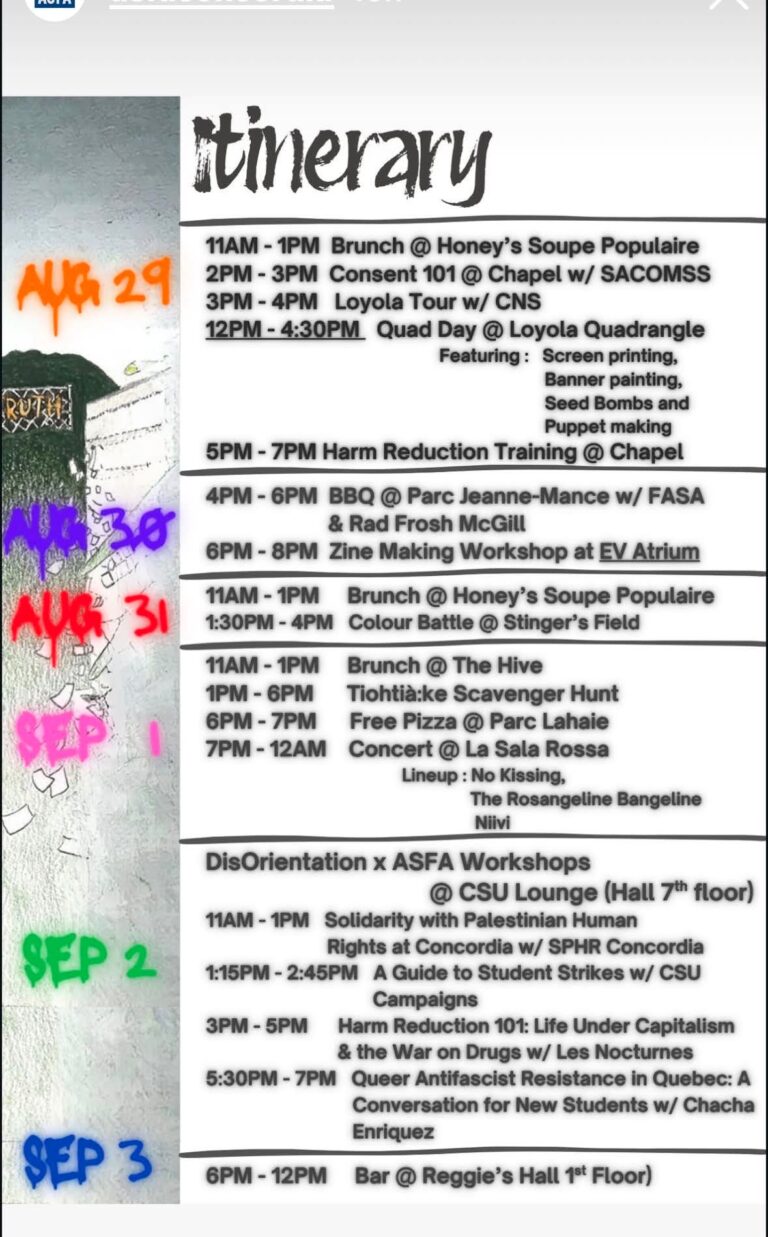
Then, almost as if somebody at the CSU had found an old copy of Uprising and decided the idea deserved another try, the Concordia Student Union released its 2025 to 2026 student handbook. The 194 page publication featured pro Palestinian imagery and devoted substantial space to protest politics, including a “Strike Guide” advocating what it called “hard picketing” and a “Guide to Countering Repression” that included advice on concealing identity during confrontational situations. The handbook also devoted so much attention to the Israeli Palestinian conflict that Hillel Concordia later filed a formal complaint arguing that it created a hostile environment for Jewish and Israeli students.
This time even Concordia University publicly distanced itself from its own student union, posting a warning that portions of the handbook were “not in keeping with Concordia’s Code of Rights and Responsibilities and related policies.” A motion inside the CSU to declare the handbook harmful and replace it with a neutral student resource was defeated, with 64 percent voting against it. One CSU executive defending the handbook was remarkably straightforward about the union’s responsibility to students who did not share its politics: “it’s not our obligation to represent every single student.” For a student union that happily takes fees from all students, that is quite a sentence.
Hillel later took the handbook complaint to the CSU Judicial Board, arguing that its political content, encouragement of hard picketing and advice about concealing identities made Jewish and Israeli students feel unsafe expressing themselves. The complaint was ultimately dismissed in January 2026 after Hillel’s representatives did not appear at the hearing, leaving the CSU’s defence uncontested. The ruling did not somehow transform the handbook into a neutral student planner, and Concordia University’s own warning about its contents remained on the university website.
So, 24 years after the CSU published Uprising, with its intifada politics another Concordia Student Union was once again handing students an agenda loaded with political activism and pro Palestinian messaging.
The two handbooks bookended the Netanyahu riot, the banning of Hillel, Israel Apartheid Week, the kippah incident, years of protests after October 7, vandalism, threats and a woman who operated kosher coffee shops inside the Jewish General Hospital standing outside Concordia giving Jews a Nazi salute and talking about the Final Solution among many other reported and unreported anti-Jewish incidents at Concordia.
I first started dealing with this at Concordia in the early 1990s. More than 30 years later, it amazes me that Jew haters at Concordia are still using the same playbook and still haven’t been stopped.


Discover more from The Montreal Jewish News
Subscribe to get the latest posts sent to your email.