
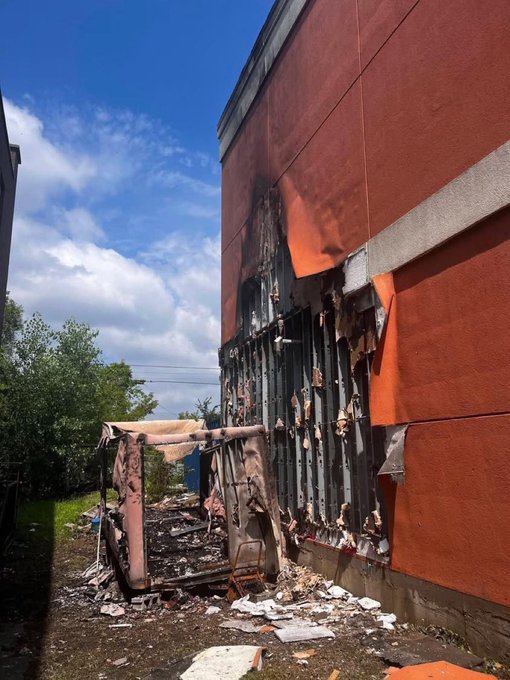
When Shabbos ended in Montreal on Saturday night, I turned my phone on and saw what was left of Nöam Restaurant. Later, when The Suburban posted it, I watched a surveillance video showing the arsonist approach the restaurant in the middle of the night, pour something against the building and set it on fire. There was no confusion about what happened. Somebody arrived at Nöam intending to burn it to the ground and left with the restaurant in flames.
Nöam was not simply a business that happened to serve kosher food. It was one of ours. Jewish families ate there, people met friends, celebrated birthdays and sat around tables talking long after they had finished eating. On Friday evening, while most Montreal restaurants were filling up, Nöam was closed for Shabbos. A few hours later, someone set it on fire.
Then I learned that a mosque had also been attacked by fire around the same time, only a few blocks away. Part of the Baitul Mukarram Mosque on de Courtrai Avenue was badly damaged, and that fire was also being investigated as a possible arson. Two buildings associated with two religious communities burned in the same neighbourhood within hours of each other.
I would be lying if I said the two stories struck me exactly the same way. Nöam is part of my community. I knew what Jewish Montrealers were feeling when they saw those pictures because I felt it too. The mosque was not mine. I did not have the same memories attached to it or know the people who prayed there, but that does not make it somebody else’s problem.
There were Muslim families looking at photographs of their damaged mosque and asking many of the same questions Jewish families were asking about Nöam: Who did this? Why this building? Is there another attack coming? Will it be safe to go back? Are my family and children safe in our house of worship?
We do not yet know whether the fires were connected or whether either building was chosen because of the religion associated with it. Those answers belong to the police investigation. What we do know is that fire was brought deliberately to at least one building, while another religious site only blocks away burned at almost the same time.
That should disturb everyone in this city.
My school has been shot at twice. Both times, the building was empty, nobody was injured, and we repaired the damage, increased security and brought the children back. Still, a school changes after somebody fires bullets at it. The classrooms remain classrooms and the children eventually stop talking about what happened, but the adults notice more. An unfamiliar car parked outside gets a second look, a loud noise near the entrance makes somebody pause, and the doors are checked more often than they used to be. You do not live in constant panic, you simply lose the luxury of assuming nothing will happen.
The Muslim community in Montreal knows that feeling too. It knows what it is to worship behind locked doors, to hire security and to wonder whether someone staring at the building is merely passing by. Quebec Muslims buried six people after a gunman walked into a Quebec City mosque and opened fire during evening prayers.
There should be no competition over whose fear is more legitimate, a burned mosque does not lessen what happened at Nöam, and a burned kosher restaurant does not lessen what happened at the mosque.
Both should make us angry.
We have spent years in Quebec watching our government treat religion as though it is something wrong that should be hidden from public view. Religious clothing is debated as a threat, while religious people are often spoken about as though their beliefs make them less modern, less loyal or less Québécois. Legislation has been passed banning religious dress and religious observance in public places and government buildings. Religious people became the enemy, and the Quebec government has tried to legislate them out of existence.
While the draconian, dictatorial Quebec laws were not the cause of the fires, they helped create an atmosphere in which an attack on a religious place can be dismissed as a problem belonging only to the people who worship there.
It does not.
Earlier in the week, a man in Sarasota, Florida, threw a brick through the window of a Chabad synagogue. When police questioned Brayton Laschinger, he admitted that he had chosen the building because it was Jewish and reportedly told detectives that propaganda he had seen on social media had made him angry. There was no complicated political theory behind it, he watched propaganda, became angry and found a synagogue.
At almost the same time, British singer Boy George released a song remembering the victims of the Nova music festival and included the words, “I stand with the Jews.” Those words brought condemnation, threatened protests and a controversy that followed him into a London production of Jesus Christ Superstar.
One man absorbed what he saw online and threw a brick through the window of a Jewish place of worship. Another looked at the same poisoned atmosphere and said he stood with the Jews.
The second man became the scandal.
That is difficult to ignore after watching someone set Nöam on fire. Boy George’s song is not going to end Jew hatred, repair a synagogue window in Florida or rebuild a restaurant in Montreal. I do not even know whether I will listen to it a second time, but the line stayed with me because there was no qualification attached. He did not say he stood with Jews only after reminding us of every disagreement he had with Israel, and he did not ask us to prove that we were sufficiently innocent before offering support. He saw people being isolated and stepped toward them instead of away.
The mosque fire forces Jews to decide what those words mean when another community is attacked. We cannot ask people to stand beside us while walking past a burned mosque. We cannot demand that others recognize the fear created by attacks on Jewish institutions and then pretend not to recognize that same fear in Muslim families.
Standing with Jews does not require silence when Muslims are attacked, and standing with Muslims does not require blaming Jews or Israel for every event in the Middle East. There is enough room in Montreal to protect a synagogue, a mosque and a kosher restaurant without turning their safety into a political argument.
When I first saw Nöam, I thought about my school, the bullet holes, the police, the parents and the children who had to return the next day. When I learned about the mosque, I thought about the people who would eventually have to walk back inside that building and pray beneath the damage.
Two communities went into the weekend believing their buildings would still be intact when they returned. Unfortunately, they were wrong.
The police will decide whether the fires were connected and whether hatred was involved. But that cannot become another excuse to say nothing until every box has been checked.
Montreal has become very good at cleaning up after these incidents. We replace the broken glass, scrub off the graffiti, repair the buildings, hire more guards and reopen the doors. Then we listen to politicians tell us once again that there is no place for this in Montreal.
But they are lying.
There is a place for it here. We keep seeing it.
We have lost faith in the politicians and police who deliver the same hollow statements after every attack. So, we swallow our fear, go back inside and pray that when the next attack comes, the building is still empty.
Photo: MP Anthony Housefather – X




Leave a Reply