



By Mayer Wochyniak
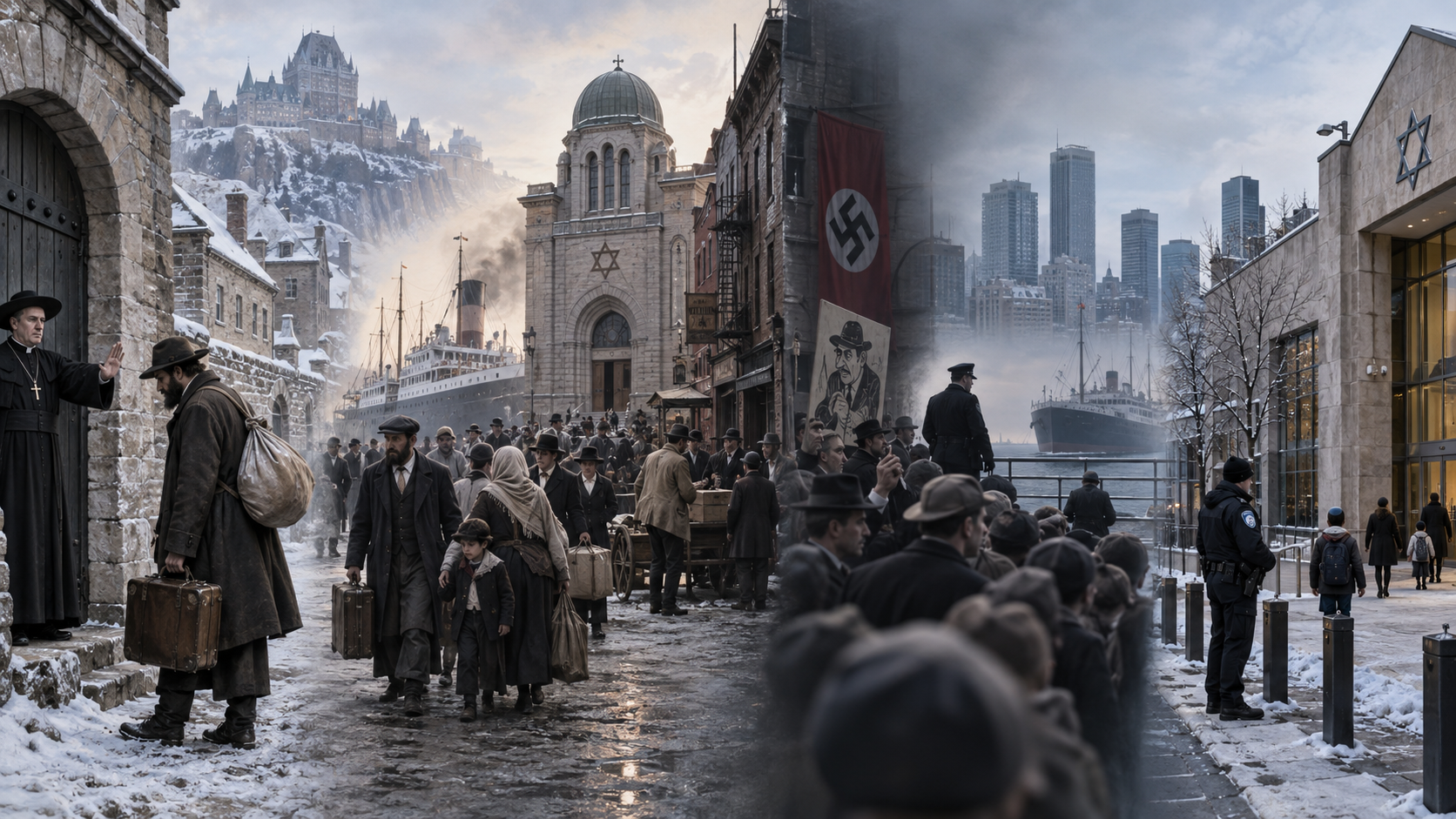
Canada’s relationship with its Jews got off to a fairly simple start. Jews were not particularly welcome. Under New France, the colony was officially Catholic, and anyone who was not Catholic had a rather limited selection of options. They could convert or they could leave. Esther Brandeau found that out in 1738 when she arrived in Quebec disguised as a young man named Jacques La Fargue. Once authorities discovered that she was both a woman and a Jew, she was arrested and eventually sent back to France. A Jew who would not convert had no place in New France. Brandeau did not convert, so back to France she went.
Things changed after the British conquest, although that should not be confused with everybody suddenly embracing the Jews. Jewish settlers began establishing themselves permanently in Montreal, and in 1768 a small group founded Shearith Israel, the Spanish and Portuguese congregation, the first Jewish congregation in Canada. The first synagogue building followed on Notre Dame Street in 1777. In the space of a few decades, Jews had gone from not being permitted to remain in the colony as Jews to establishing an organized community of their own.
Then came Ezekiel Hart, who was elected to represent Trois Rivières in the Legislative Assembly of Lower Canada in 1807. There was one problem. He was Jewish. The oath he had taken was challenged because of his religion, and the Assembly refused to let him take his seat. Hart offered to take the oath again and was expelled anyway. The people of Trois Rivières responded by electing him again. The Assembly responded by throwing him out again in 1809. Apparently the voters of Trois Rivières were perfectly capable of choosing their own representative until they chose a Jew.
Then, surprisingly, Lower Canada did something remarkably progressive. In 1832, legislation was passed giving Jews the same civil and political rights as other subjects in the province. This came roughly 25 years before Jews achieved comparable political emancipation in Britain. There is no reason to pretend every part of Canadian Jewish history was terrible. Lower Canada had denied Ezekiel Hart his seat a generation earlier, then became one of the earliest places in the British world to formally recognize Jewish political equality.
The law changed. Society was a little slower. Beginning in the 1880s, large numbers of Jews arrived from Eastern Europe, fleeing pogroms, persecution and poverty. Montreal became one of the great centres of Jewish life in North America. Between 1880 and 1914, tens of thousands of Ashkenazi Jews arrived in the city. They built synagogues, schools, charities, newspapers, businesses and labour organizations, and created much of the Jewish Montreal that still exists today.
They also discovered an arrangement that Jews would become very familiar with in Canada. You could live here, work here, pay taxes here, build businesses, employ people and contribute to the country, while respectable society quietly found ways to remind you that there were limits. There were jobs Jews could not get, clubs they could not join, neighbourhoods where they were not wanted, resorts where they were not welcome and universities that suddenly became very concerned about academic standards when too many Jews started getting in. Advertisements could openly say “Gentiles only” or “Christians only.” Restrictive property covenants were used to keep Jews and other unwanted groups from buying or occupying property.
One of those cases eventually reached the Supreme Court of Canada in Noble and Wolf v. Alley, involving a covenant intended to prevent Jews and other racialized groups from owning or occupying property at an Ontario vacation development. The Supreme Court struck the covenant down in 1951, but did so on property law grounds. Canada did not suddenly wake up one morning and decide that excluding Jews from neighbourhoods was morally repugnant. The legal mechanism simply stopped working.
Montreal’s universities were hardly sitting on the sidelines. Jewish enrolment at McGill grew rapidly in the early twentieth century. Jews represented about 7 percent of the student body in 1913 and roughly 25 percent by the mid 1920s. The administration became concerned that there were too many Jewish students, so admission became a little more difficult if your name happened to sound Jewish. Jewish applicants were eventually required to have entrance marks of 70 and then 75 percent while non Jewish applicants needed 60 percent. Medicine imposed a ceiling of roughly 10 percent on Jewish students. In Law, Jewish enrolment dropped from around 40 percent in the late 1920s and early 1930s to about 5 percent by the middle of the decade.
There was not much effort to hide what was going on. Ira MacKay, who became Dean of Arts at McGill and helped push restrictions on Jewish admissions, wrote that “the Jewish people are of no use to us in this country” and that Jewish traditions did not fit his idea of civilization in Canada. McGill eventually removed his name from a student award. That took a little longer than the discriminatory admission policies did.
Medicine was not much better. Jewish doctors and nurses faced discrimination at Montreal hospitals, one of the reasons the Jewish community created institutions of its own. Jewish physicians had trouble obtaining appointments and Jewish nurses faced limited opportunities. The Jewish General Hospital opened in 1934, built with money raised by Montreal’s Jewish community. Having watched Jews being excluded elsewhere, the hospital opened its doors to patients regardless of religion, ethnicity or background. Jews built a hospital because other hospitals discriminated against Jews, and then treated everybody. Draw whatever conclusion you like from that.
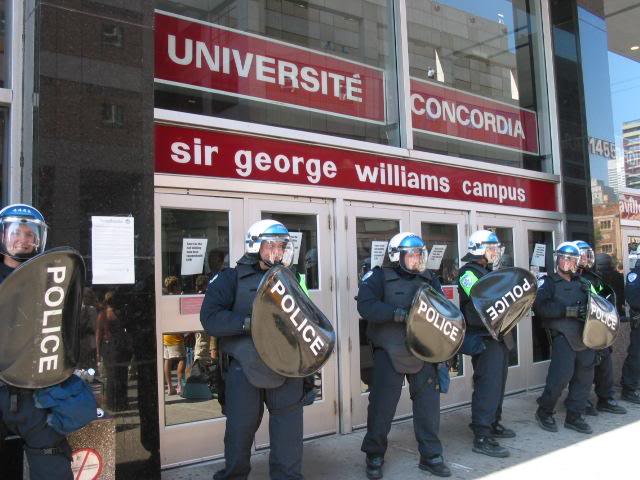
Outside the universities and hospitals, Jew hatred was becoming considerably less polite. Toronto had its Swastika Clubs. In August 1933, only months after Hitler came to power in Germany, a swastika banner was displayed following a baseball game involving a team with many Jewish players at Christie Pits. Fighting broke out and thousands of people became involved in one of the worst outbreaks of racial violence in Toronto’s history. The men carrying the swastika were not visitors from Berlin. They were Canadians.
Montreal had Adrien Arcand, a journalist who became one of Canada’s most notorious fascists and an open admirer of European fascism. Anti Jewish newspapers circulated openly, political movements made Jew hatred part of their message and respectable Canadians could talk about the “Jewish problem” without having to hide behind an anonymous internet account. Arcand was not some obscure crank mumbling to himself in a basement. He published newspapers, organized political movements and remained active for decades.
Then Hitler began doing in Europe exactly what he had been saying he intended to do. European Jews desperately searched for countries willing to let them in. Canada was not particularly interested.
Between 1933 and 1945, Canada admitted only about 5,000 Jewish refugees. Five thousand. During the period when Jews were being stripped of their rights, robbed of their property, driven from their homes, packed into ghettos, deported and murdered across Europe, one of the largest countries in the world somehow could not find very much room.
The MS St. Louis became the symbol of that policy. In 1939, the ship carried more than 900 mostly Jewish refugees fleeing Nazi Germany. Canada turned them away. The ship returned to Europe, and hundreds of those passengers later died in the Holocaust. Canada eventually apologized for the decision in 2018, along with an apology for the broader immigration policy that became associated with the phrase “none is too many.”
There was another absurd chapter waiting. Canada had been reluctant to admit Jews who were trying to escape Nazi Germany, but during the war Britain sent thousands of German and Austrian nationals to Canada, including Jewish refugees who had already fled Hitler. Some of those Jews ended up interned here as enemy aliens. They escaped the Nazis, crossed the Atlantic and wound up behind Canadian barbed wire because their passports came from the wrong country. Canada has apologized for that too.
After the Holocaust, Canada changed considerably. Survivors and refugees came here. Later waves brought Jews from Hungary, the Soviet Union, North Africa and the Middle East. Jewish communities grew in Montreal, Toronto, Winnipeg, Vancouver and elsewhere. Jews became judges, doctors, professors, politicians, business leaders, artists and public figures. Open quotas disappeared. Restrictive covenants disappeared. Human rights legislation expanded. The Charter of Rights and Freedoms eventually made religious equality part of Canada’s constitutional framework.
Canada became very good at telling that part of the story. This became the tolerant Canada, the multicultural Canada, the country where everybody lived together. Politicians discovered Jewish holidays were wonderful opportunities for photographs and statements about diversity. Holocaust remembrance became part of official Canadian life. Governments funded security programs and education. Everybody agreed that the ugly Canada of the 1930s belonged safely in history books and museum displays.
Then somebody forgot to tell the people who hate Jews.
Statistics Canada recorded 492 police reported hate crimes targeting Jews in 2021. That rose to 527 in 2022 and then to 959 in 2023. There were 943 in 2024 and another 788 in 2025. The 2025 number was lower than the previous two years, which is obviously preferable to another increase, but Jews were still the target of 788 of Canada’s 1,115 police reported hate crimes motivated by religion. Muslims, the next most targeted religious group, were the victims of 204.
Those are not numbers produced by a Jewish advocacy group. They are Statistics Canada figures based on incidents reported by police services covering virtually the entire Canadian population. They also only include incidents that become police reported hate crimes. They do not include every Jew screamed at on the street, every swastika scratched into a wall, every Jewish student harassed on a campus, every child targeted at school, every synagogue threatened or every piece of garbage posted online.
In 1738, Esther Brandeau arrived in Quebec and discovered that being Jewish was incompatible with remaining in New France unless she converted. In 1807, Ezekiel Hart was elected by his fellow citizens and told that being Jewish prevented him from sitting in their legislature. In 1832, Lower Canada became one of the earliest jurisdictions in the British world to give Jews full political rights. A century later, Canadian universities were manipulating admission standards because too many Jewish students were getting in, neighbourhoods were writing Jews out of property agreements, doctors were being denied opportunities, Swastika Clubs were operating in Toronto and Canada was shutting its doors to Jews running for their lives.
Canada changed. Of course it changed. Pretending otherwise would be as dishonest as pretending the rest of this history never happened. Jews today enjoy rights in Canada that earlier generations could only have imagined. We vote, hold public office, build institutions, practise Judaism openly and participate in every level of Canadian society. There is no government quota keeping Jews out of McGill. There is no law preventing a Jew from sitting in Parliament. Nobody at the border can legally tell a Jew to convert or leave.
Instead, Jewish schools and synagogues require security. Police park outside religious institutions. Community buildings have reinforced doors, cameras, bollards and guards. Jewish parents think about security when they send their children to school, and Jewish institutions spend money protecting themselves in a country that constantly reminds us how safe and tolerant it is.
Canada has spent decades celebrating how far it has come. Jews have spent much of the last three centuries learning not to become too comfortable with that sentence.


Discover more from The Montreal Jewish News
Subscribe to get the latest posts sent to your email.