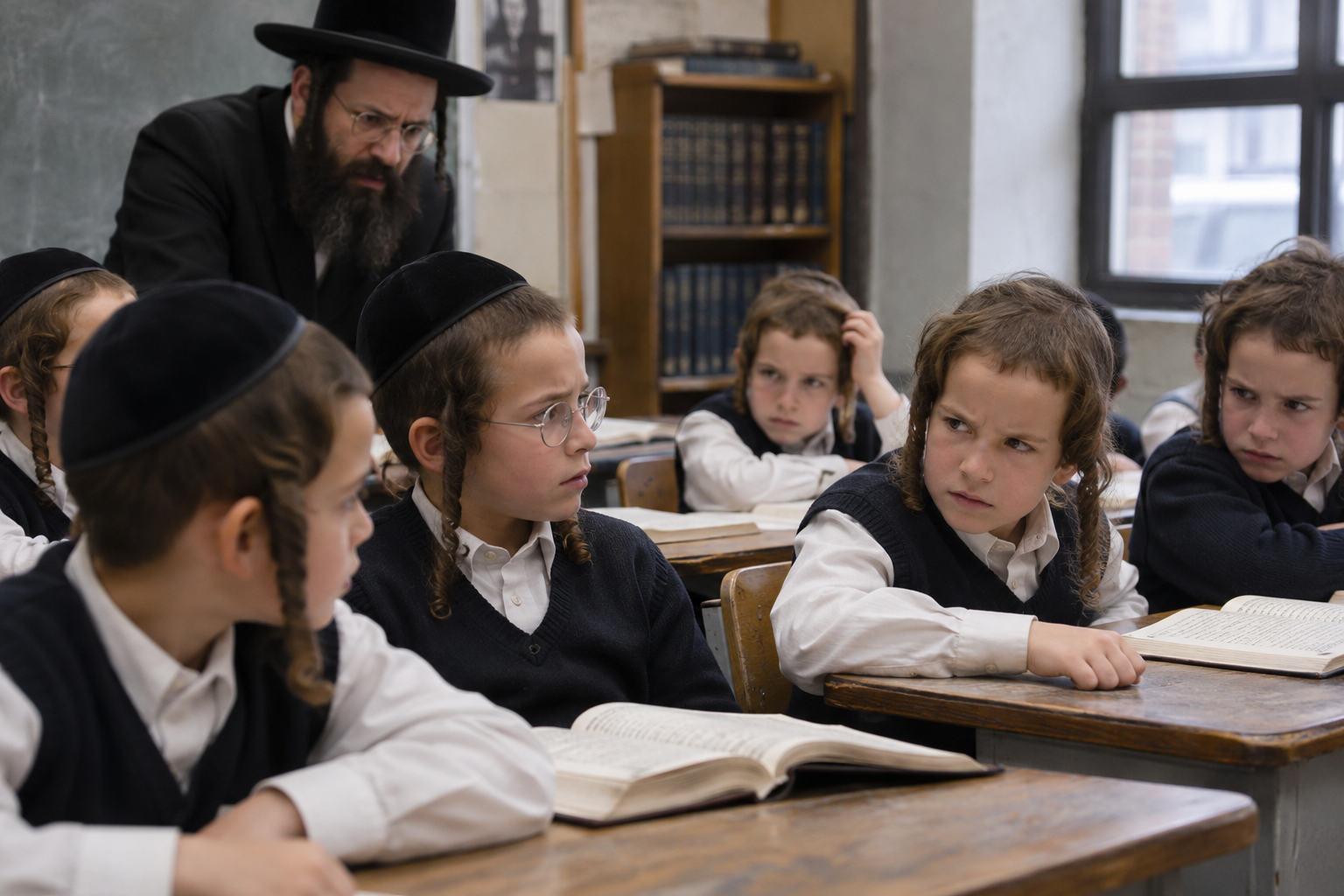
Quebec’s new Parti Québécois government is preparing to ban elementary school children from wearing religious symbols, a move that could have serious consequences for Montreal’s Jewish schools and yeshivas. The government has made it clear that kippas, hijabs and turbans are among the religious items it wants removed from elementary classrooms, but it has yet to explain whether the restrictions will extend to private religious schools.
For Jewish families, particularly those sending their children to Orthodox and Chassidic yeshivas, that is no small detail. A Jewish boy who has worn a kippa since he was three years old does not suddenly become less Jewish when he enters his secular studies classroom. Yet that is precisely the sort of situation Quebec’s latest secularism proposal could create if private schools are included.
Premier Paul St-Pierre Plamondon’s government reaffirmed its intention to prohibit conspicuous religious clothing and symbols worn by elementary students following its October election victory. Education Minister Joël Arseneau was emphatic about the government’s plans on October 28, declaring the proposal non-negotiable.
The commitment was originally announced during the election campaign on September 27, when the PQ promised to prohibit all elementary students from wearing clothing or symbols that immediately identify their religious affiliation. The party also promised to end certain forms of financing for religious schools and prohibit partnerships between schools and places of worship.
For a government that has spent years defending restrictions on religious expression in public institutions, the latest proposal marks another significant expansion. Quebec’s existing laws already prohibit many teachers and school employees from wearing religious symbols, including staff at subsidized private schools. The proposed legislation would extend that prohibition to the children sitting in their classrooms.
Montreal Rabbi Lisa Grushcow of Temple Emanu-El-Beth Sholom criticized the proposal in an October 30 interview with CBC, explaining that religious observance is not simply a matter of displaying one’s beliefs.
“To wear certain religious garb and do certain things, that’s just part of who we are,” Grushcow said.
The National Council of Canadian Muslims also condemned the proposal, with CEO Stephen Brown making a particularly pointed observation about Jewish children during an October 29 demonstration outside the premier’s Montreal office.
“It’s not the bully down the hall that’s telling them to take off their kippah … It’s the premier of the province,” Brown told CityNews.
The remarks highlight a problem that has received relatively little attention in the broader debate. While much of the discussion has concentrated on Muslim girls wearing hijabs, the proposed legislation would also affect Jewish boys whose families consider wearing a kippa an everyday religious obligation.
In Montreal’s Orthodox yeshivas, the kippa is worn throughout the school day. Students may spend their mornings studying Torah, Chumash and Talmud before attending classes in mathematics, French, English and other subjects required by Quebec’s Ministry of Education. Their religious observance does not end when the secular curriculum begins. The same child who wears his kippa during morning prayers continues wearing it during his afternoon mathematics lesson.
And that is where the province may find itself confronting a particularly complicated situation.
Under Quebec’s existing Law 9, adopted in April, subsidized private schools are already subject to expanded secularism requirements. The legislation prohibits covered school employees from wearing religious symbols, although certain existing employees are protected by grandfathering provisions. It also prohibits educational institutions from requiring students to wear religious symbols, but does not generally prevent students from wearing them voluntarily.
The new proposal would go considerably further by prohibiting elementary children themselves from wearing those symbols.
That could create an extraordinary situation inside a Jewish school. An institution established to provide Jewish education could find itself required to prevent its own students from wearing kippas during secular instructional hours. Schools that divide their religious and secular programs into separate portions of the day could face particular difficulties if the law applies to them.
The government has not yet clarified whether private religious schools will be covered, whether subsidized and unsubsidized institutions will be treated differently, or whether religious-school exemptions will be available. No implementing legislation has yet been adopted, and Jewish children are not currently subject to the proposed general prohibition.
The uncertainty comes as Quebec’s Jewish schools are already adjusting to another significant change in provincial legislation.
Beginning April 2, 2029, subsidized private schools will face additional requirements to retain their subsidy accreditation. Under the existing legislation, schools whose educational services are based on religious principles, that transmit religious convictions through the regulated curriculum, or that select students and staff according to religious criteria could lose their eligibility for government funding.
The PQ has also promised to stop financing religious schools through arrangements involving religious-organization tax credits. That is a separate election commitment, and the government has not yet provided the details necessary to determine how it would affect individual Jewish institutions.
The consequences could extend well beyond whether students are permitted to wear kippas. Jewish schools depend on a combination of tuition, donations and, in many cases, government subsidies to provide their educational programs. Changes to provincial funding rules could increase costs for families already paying substantial amounts to send their children to Jewish schools.
Montreal’s yeshivas have also been dealing with increased regulatory scrutiny concerning curriculum, instructional hours and teacher qualifications.
In August, Montreal Jewish News reported that Quebec had ordered three sections of the Belz school system to close, potentially affecting 582 boys. The Ministry of Education cited problems involving teacher qualifications, instructional time, curriculum compliance and building conditions.
The affected sections subsequently had their operating licences and funding reinstated, according to an August 18 MJN follow-up based on information from a source close to the matter. The source cautioned that the reinstatement might be temporary or subject to conditions, and MJN had not obtained the government’s formal decision.
The Belz dispute was unrelated to the proposed religious-symbol ban, but it demonstrated the extent to which provincial authorities already regulate religious education.
The government’s latest proposal has also attracted opposition from civil liberties organizations and school administrators. On November 17, the Canadian Civil Liberties Association called on members of the National Assembly to reject the proposed prohibition, arguing that children’s access to education should not depend on whether their religious expression meets government approval.
The PQ maintains that its secularism policies are intended to protect freedom of conscience, prevent religious pressure on children and encourage integration into Quebec society. St-Pierre Plamondon has cited the Bedford school controversy as evidence of the need for stronger protections against religious influence in education.
But there is a considerable difference between protecting children from being forced to participate in religious activities and prohibiting them from following the religious traditions practised by their families.
The legislation also faces political obstacles. The PQ holds a minority government and will require support from opposition parties to pass its proposed ban. The Quebec Liberals and Québec solidaire have indicated their opposition, while Conservative Leader Éric Duhaime has left open the possibility of supporting the measure, depending on its wording and enforcement provisions.
For Jewish schools, the immediate issue remains whether the government intends to apply the new restrictions to institutions whose entire purpose includes religious education. Quebec already determines the compulsory subjects, instructional hours, qualifications of teachers and conditions under which private schools qualify for government funding. It is now considering restrictions on the religious clothing worn by the children attending those schools.
The government has not explained how it expects an Orthodox yeshiva to function if its students are prohibited from wearing kippas during the school day, or whether it intends to create an exemption for precisely that situation.
Until those details are made public, Montreal’s Jewish schools cannot know how extensively the proposed ban could affect their operations.
What is already clear is that Quebec’s secularism debate has moved beyond the religious practices of adults working in education. The government now wants to regulate the religious expression of elementary school children, including boys who have been wearing kippas for practically their entire lives.
Whether those same children will be allowed to continue wearing them inside their own Jewish schools is a question the government has yet to answer.



Leave a Reply