
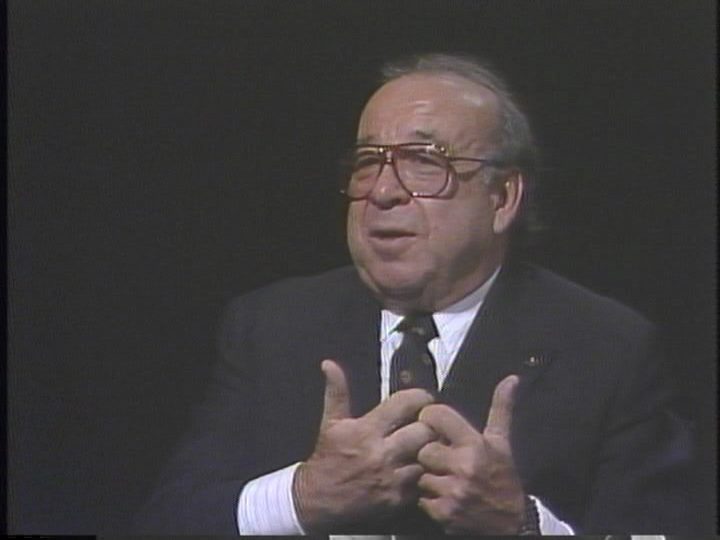
Thomas Otto Hecht, a Holocaust survivor who escaped Nazi-occupied Europe as a child and went on to become one of Montreal’s most prominent Jewish community leaders, businessmen and philanthropists, died Saturday, November 14, 2026. He was 97.
Known to friends and colleagues as Tommy, Hecht spent decades involved in Jewish communal affairs, Canadian business and public institutions. His career included leadership positions with the Combined Jewish Appeal, Israel Bonds, Concordia University and several major hospitals. He was also a prominent supporter of Israel whose involvement in Jewish community affairs sometimes placed him directly in the middle of controversy.
Born in Brno, Czechoslovakia, in 1929, Hecht moved with his family to Bratislava before the Second World War. When Nazi Germany dismantled Czechoslovakia in 1939, his family fled to France and eventually Portugal, escaping Europe aboard the refugee ship Serpa Pinto in November 1941.
The family arrived in Montreal in December 1941, where Hecht encountered a different form of discrimination. Although he spoke French, he was unable to attend the province’s French Catholic schools because he was Jewish and was instead enrolled in an English Protestant school, despite not speaking the language.
He eventually attended Sir George Williams College, now part of Concordia University, and McGill University, studying political science. He later taught international relations at Concordia before entering the family pharmaceutical business.
As chairman and CEO of Continental Pharma Cryosan Inc., Hecht helped develop the company into an international pharmaceutical and blood-products business operating in Canada, the United States and Europe. The company’s activities included supplying blood plasma to manufacturers of medical products used by patients suffering from hemophilia.
That business would later become part of one of Canada’s most serious public health scandals.
During the 1980s, Continental Pharma purchased blood plasma collected from prisoners in Arkansas and Louisiana and sold it to pharmaceutical manufacturers, including Toronto-based Connaught Laboratories. Some of that plasma was used to manufacture clotting products administered to Canadian hemophiliacs.
The prison-plasma trade became a major issue during investigations into Canada’s tainted-blood scandal, which resulted in thousands of Canadians contracting HIV or hepatitis C through contaminated blood and blood products.
The 1997 report of the Krever Commission documented Continental Pharma’s role in the supply chain, including a 1983 incident involving plasma collected from donors who had previously tested positive for hepatitis B. The commission found that Continental Pharma had not promptly informed Connaught of the problem because it considered the risk insignificant. By the time the information reached Connaught, hundreds of additional vials of potentially affected blood products could no longer be recovered.
In January 1999, hemophiliacs launched a class-action lawsuit against Continental Pharma, Connaught Laboratories and the federal government over the importation and use of prison plasma. The plaintiffs alleged that the companies and government regulators had failed to adequately protect patients from contaminated blood products.
Hecht defended his company’s conduct in interviews at the time, maintaining that Continental Pharma had supplied government-licensed products and had not concealed their origins. He also disputed the suggestion that the scientific knowledge available at the time established that prison plasma presented a greater risk.
The controversy became an important and troubling chapter in an otherwise highly successful business career. The blood scandal ultimately led to a restructuring of Canada’s blood system, including the establishment of Canadian Blood Services and Héma-Québec.
Beyond his business activities, Hecht became an influential figure in Canadian Jewish communal life. He served as chairman of Montreal’s Combined Jewish Appeal, president of the United Israel Appeal of Canada and president of Israel Bonds in Canada. He was also involved with the Canada-Israel Committee, an organization that represented Canadian Jewish concerns relating to Israel.
His commitment to Israel led him to establish the Begin-Sadat Center for Strategic Studies at Bar-Ilan University in 1993. The centre became an important institution for research into Israeli national security and Middle Eastern affairs, with Hecht serving for many years as chairman of its International Advisory Committee.
In Montreal, Hecht served on the boards of Concordia University, the Jewish General Hospital, St. Mary’s Hospital and the Association des hôpitaux du Québec. His involvement in Quebec’s financial establishment included appointments to the boards of the Caisse de dépôt et placement du Québec and the Société Générale de Financement.
One of the most disturbing incidents of his later life took place on September 9, 2002, when Hecht was physically assaulted during the violent riot at Concordia University that prevented former Israeli prime minister Benjamin Netanyahu from delivering a scheduled speech.
Hecht, then 73, was attempting to enter the university when he was confronted by pro-Palestinian protesters who had gathered to prevent Netanyahu from speaking. He was pushed, spat upon and kicked in the groin. Other Jewish attendees were also assaulted, including Rabbi Howard Joseph and his wife Norma.
The violence escalated inside the Hall Building, where protesters smashed windows, threw furniture and clashed with police. The university eventually cancelled Netanyahu’s appearance.
For Hecht, who had escaped Nazi persecution more than sixty years earlier, the experience brought back painful memories of his childhood.
“I felt as though I was in Bratislava in 1939 again,” he said following the attack.
He summed up the incident with another observation: “I was guilty of wanting to hear a speech.”
The incident became one of the most notorious examples of violence directed against Jewish students and community members on a Canadian university campus. Montreal Jewish News revisited the events in a detailed retrospective published on the riot’s 24th anniversary.
Hecht continued his involvement in Jewish communal activities and Holocaust education in the years that followed. He volunteered as a speaker at the Montreal Holocaust Museum, sharing his family’s experiences with students and visitors and recounting the difficulties of escaping Europe and rebuilding a life in Canada.
In 2007, he published his autobiography, Czech Mate: A Life in Progress, describing his family’s journey from Czechoslovakia to Canada and his development from a young refugee into a businessman and community leader.
Throughout his career, Hecht received numerous honours for his contributions to business, philanthropy and Jewish communal life, including the Herzl Prize, the Jerusalem Prize, the Samuel Bronfman Medal and honorary doctorates from Israeli universities.
Following news of his death, condolences began appearing on the Paperman and Sons website from longtime friends, business associates and members of Montreal’s Jewish community.
The Bienenstock family described him as a pillar of Montreal’s pharmaceutical, political and Jewish community and recalled a relationship spanning more than four decades. Sidney Margles remembered travelling with Hecht in Israel shortly after the Six-Day War in 1967, including a visit to the Egyptian armistice line and a meeting with Menachem Begin.
Hecht is survived by his wife, Riva Heft; his children Marion, Judy and Robert; and his grandchildren Sam and Olivia. He will also be remembered by Riva’s children, Robert, JoAnn and Nina, and her grandchildren. He was previously married to the late Erika Hecht, the mother of his children. His sister Madeleine Feher and brother-in-law André Feher predeceased him.
Hecht belonged to a generation of European Jewish refugees who arrived in Montreal with little more than the opportunity to begin again and eventually became part of the city’s business and institutional establishment. His career brought considerable recognition and influence, but also controversy, particularly over his company’s involvement in the tainted-blood scandal. His outspoken support for Israel and Jewish communal causes made him a familiar figure in the community for much of his adult life.
His death closes a long chapter in Montreal Jewish communal history, one that began with a Jewish child fleeing Nazi Europe and continued through decades of business, politics, philanthropy and public service.
Funeral services will take place Tuesday, November 17, at 12 noon at Paperman and Sons, 3888 Jean Talon Street West, followed by burial at Congregation Shaar Hashomayim Cemetery in Outremont. Shiva will be observed Tuesday at 1700 Doctor-Penfield Avenue, following burial until 4 p.m. and again from 7 to 9 p.m., with evening services at 7:30 p.m.
Memorial contributions may be made to the Thomas O. Hecht Memorial Fund through the Jewish General Hospital Foundation or to the Montreal Holocaust Museum.
Baruch Dayan Ha’emet.





Leave a Reply