

Nearly four in ten students surveyed did not consider denying or exaggerating the extent of the Holocaust to be anti-Jewish. More than half did not recognize the centuries-old accusation that Jews have too much influence over the economy as a form of Jew hatred, while 45 per cent did not consider boycotting a business simply because its owner is Jewish to be anti-Jewish discrimination.
The federally commissioned report, Campus Antisemitism and Student Experiences II (CASE II), was produced by the Association for Canadian Studies and the Metropolis Institute. Researchers Jack Jedwab and Paul Holley surveyed 755 non-Jewish postsecondary students from across Canada between December 9 and December 21, 2025.
As Montreal Jewish News reported in August, the first phase of the study found that 96 per cent of Jewish students surveyed had experienced or witnessed anti-Jewish hostility on campus. The second phase of the study found that 42 per cent of non-Jewish respondents had witnessed at least one form of anti-Jewish hostility at their university over the previous year.
Nearly a third had witnessed anti-Jewish remarks or gestures, 27 per cent reported witnessing vandalism motivated by Jew hatred and 25 per cent had witnessed discriminatory treatment of Jews. More than one in five had witnessed intimidation, bullying or physical violence directed at Jews, while 19 per cent had witnessed Jews being excluded from campus events or groups.
What is particularly interesting about the second report is that researchers went beyond asking students what they had witnessed. They presented students with specific examples of conduct directed at Jews and Jewish institutions in Canada and asked them whether they considered that conduct anti-Jewish.
Fifty-four per cent did not consider protesting outside Jewish houses of worship to be anti-Jewish. The same percentage did not consider boycotting Jewish-owned businesses because of their perceived connection to Israel to be a manifestation of Jew hatred. Forty per cent did not consider scrawling anti-Israel graffiti on Jewish community buildings to be anti-Jewish, while 36 per cent failed to identify vandalizing a Jewish-owned business in protest against Israel as such.
The survey does not establish that all these students would personally engage in or condone such activities. It does, however, demonstrate how many of them fail to recognize the anti-Jewish nature of the conduct.
The researchers also examined the relationship between attitudes towards Israel and more traditional forms of Jew hatred. Among respondents who did not consider calling for the elimination of Israel to be anti-Jewish, 68 per cent also failed to recognize the accusation that Jews have too much influence over the economy as anti-Jewish. Among those who did consider calls for Israel’s elimination to be anti-Jewish, that figure dropped to 28 per cent.
An even more pronounced difference emerged when students were asked about Jewish businesses. Among those who did not consider boycotting Jewish-owned businesses to protest Israel to be anti-Jewish, 69 per cent also failed to recognize the vandalism of those businesses as anti-Jewish. Among those who recognized the boycott as anti-Jewish discrimination, 92 per cent also recognized the vandalism as such.
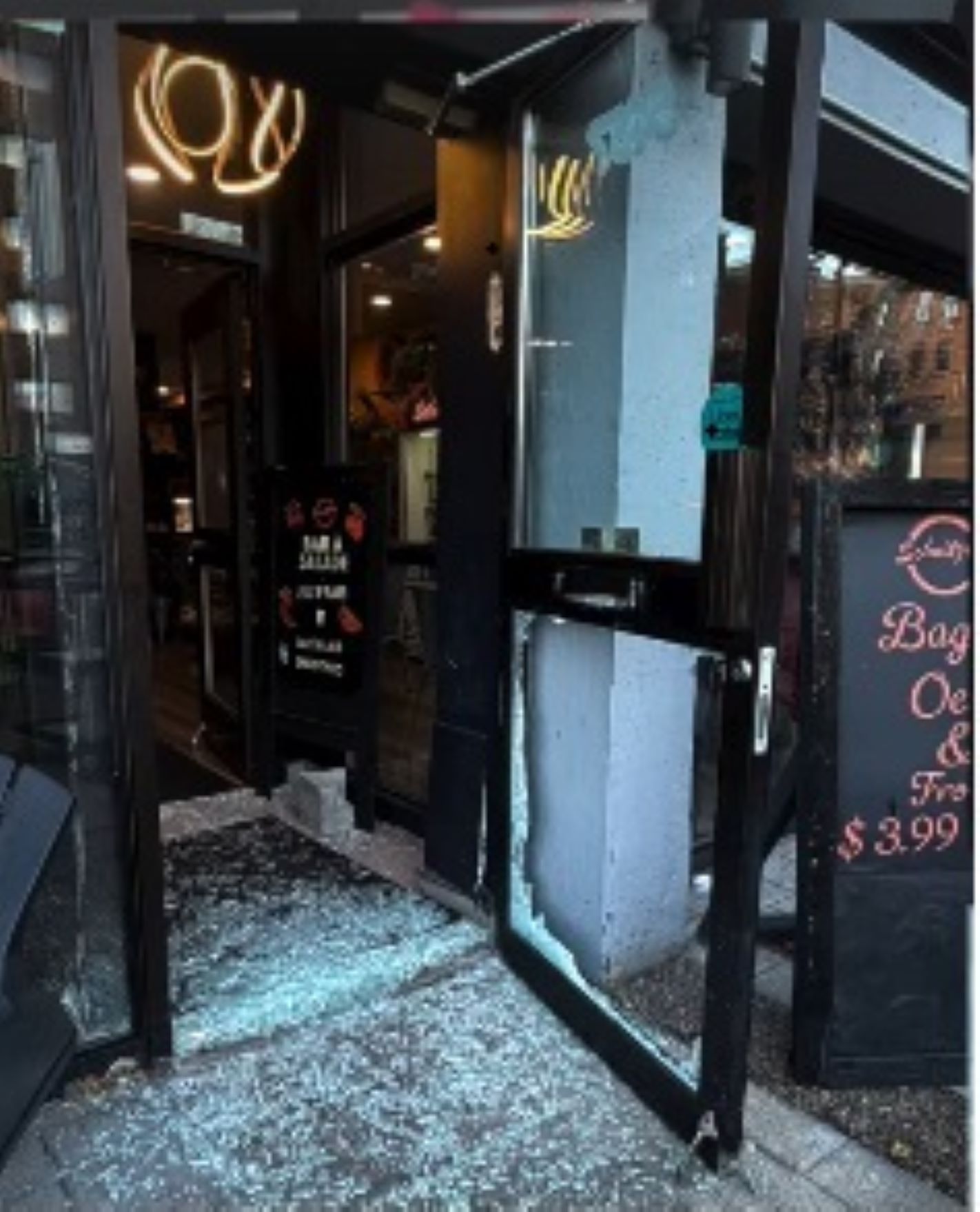
The findings are particularly relevant in Montreal, where Jewish businesses and institutions have been subjected to vandalism and demonstrations since October 7, 2023. They also lend some insight into the debate over where legitimate criticism of Israeli government policy ends and the targeting of Jews because of their real or perceived association with Israel begins.
As Montreal Jewish News reported in September, McGill students backed a motion calling for a boycott of Hebrew University in Jerusalem. Students for Palestine’s Honour and Resistance at McGill celebrated the vote using the slogan “Long Live the Student Intifada.” McGill’s administration has maintained its opposition to institutional boycotts of Israeli universities.
The problem documented in the federal reports is not limited to student activists. Both Jewish and non-Jewish respondents identified members of university faculties, teaching assistants and administrative personnel as having been involved in anti-Jewish incidents. Among Jewish respondents who supplied details about incidents, 28 per cent identified faculty members as having been involved, compared to 11 per cent of non-Jewish respondents who answered the corresponding question.
Perhaps equally troubling is the number of students who have given up reporting incidents. Among Jewish students who experienced or witnessed anti-Jewish conduct, only a third reported it. The most common reason given by Jewish students who did not report an incident was that they did not believe reporting it would help.
The federal report comes just a week after the release of a separate study conducted in partnership with Federation CJA, the Centre for Israel and Jewish Affairs (CIJA) and Hillel Montreal. That study, which examined the experiences of Jewish students at Montreal universities before and after October 7, found that nearly three-quarters of respondents felt less safe on campus following the Hamas attack on Israel and that more than half reported an increase in anti-Jewish incidents connected to their Jewish identity.
On Wednesday, McGill University’s working group on anti-Jewish hostility released its final report following more than 30 consultation sessions. Jewish and Israeli members of the McGill community described experiences of exclusion and hostility, as well as a loss of confidence in the university’s willingness or ability to address their complaints.
The working group issued 12 recommendations. McGill President Deep Saini and Provost Angela Campbell committed to implementing measures to address the findings and promised to publish a progress report in January 2027.
CIJA, Hillel Montreal and nine other Jewish organizations issued a joint statement Thursday calling on governments and university administrations to enforce existing rules and hold institutions accountable when they fail to protect students and staff. The organizations also expressed concern about the relationship between anti-Jewish conspiracy theories and the radicalization of young Canadians.
“These findings are profoundly disturbing,” said B’nai Brith Canada CEO Simon Wolle, who called on Canadian universities to take immediate action. Wolle expressed particular concern that historically dangerous accusations against Jews were being dismissed or accepted within the very institutions responsible for educating the next generation of Canadians.
The federal researchers also asked respondents whether they would be interested in attending a workshop aimed at combating Jew hatred. Only 25 per cent expressed an interest. Thirty-six per cent were undecided and 39 per cent said they were not interested.
The findings are based on a weighted online survey that included current students and recent graduates. The researchers caution against treating the results as precise estimates of the entire Canadian postsecondary population. The relationship documented between certain anti-Israel attitudes and traditional anti-Jewish stereotypes also establishes an association, rather than proving that one causes the other.
What Canadian universities now have before them are two federally commissioned reports documenting the problem from both sides. Jewish students have told researchers what they have experienced, their non-Jewish counterparts have confirmed witnessing many of those incidents, and a considerable proportion of Jewish respondents have indicated that they no longer see much point in reporting them.
University administrations can no longer claim that the experiences of Jewish students are unknown to them. The question now is what they intend to do about them.





Leave a Reply