
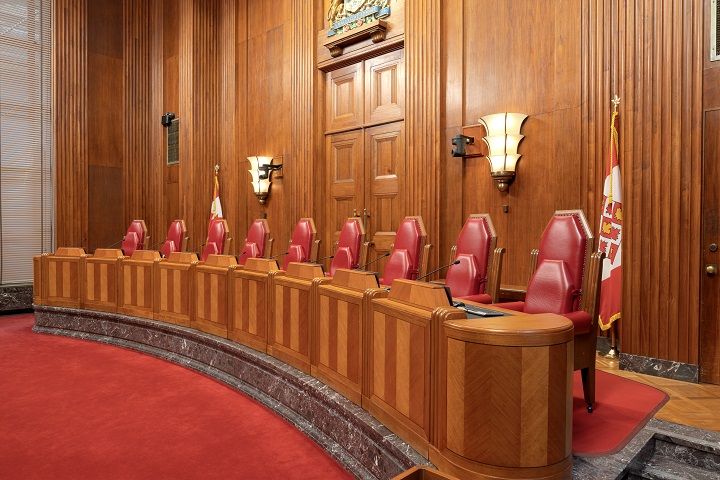
The decision comes at a particularly troubling time for Montreal’s Jewish community. While the courts were debating whether Quebec had the constitutional authority to prohibit teachers from wearing religious symbols, the province was expanding its secularism legislation to subsidized private schools. Quebec’s new Parti Québécois government is now preparing to extend the prohibition to elementary school students.
Bill 21, adopted in June 2019 by François Legault’s Coalition Avenir Québec government, prohibits public school teachers, police officers, Crown prosecutors and certain other public employees from wearing religious symbols while performing their duties. The government invoked the notwithstanding clause of the Canadian Charter of Rights and Freedoms to shield the legislation from constitutional challenges based on several fundamental rights, including freedom of religion.
In Friday’s decision, Supreme Court Chief Justice Richard Wagner said the legislation was rooted in “Quebec’s legitimate and historical commitment to ensuring the laicity of the state in a free and democratic society.”
As Montreal Jewish News previously reported, the English Montreal School Board (EMSB) argued that the legislation interfered with its constitutionally protected right to manage its own educational institutions. In April 2021, Quebec Superior Court Justice Marc-André Blanchard exempted English-language school boards from certain provisions of the law. That exemption was overturned by the Quebec Court of Appeal in February 2024, a decision upheld Friday by the Supreme Court.
While the Supreme Court acknowledged that Bill 21 could restrict the ability of English-language school boards to hire, retain and promote employees, it concluded that it had not been demonstrated that those restrictions undermined the specific linguistic or cultural interests of Quebec’s English-speaking minority.
EMSB chairman Joe Ortona expressed disappointment with the ruling but defended the more than $1 million the school board spent fighting the legislation.
“We stood for vulnerable and marginalized people and I think we taught a good lesson to our students that everybody matters and we fought the good fight and you can’t put a price tag on that,” Ortona told CTV News.
Ortona pointed out that Quebec now has a minority government and that the province’s invocation of the notwithstanding clause will come up for renewal in 2029.
“This isn’t the end of the road; this is the end of the legal road,” he told reporters in Ottawa.
Montreal lawyer Michael Bergman, a longtime advocate for minority and language rights, was considerably less optimistic. Speaking at the Supreme Court following the ruling, Bergman described the Canadian Charter of Rights and Freedoms as an “empty shell,” arguing that governments could, “with a magic wand, make fundamental rights go away.”
The Canadian Civil Liberties Association, which also challenged the legislation, said Bill 21 had already denied a generation of Quebecers the opportunity to pursue their chosen careers in public service because of their religious beliefs. The association vowed to continue fighting the growing use of the notwithstanding clause to override fundamental freedoms.
The Supreme Court did strike down one provision of the legislation as it applies to elected members of the National Assembly, ruling that Quebec cannot prevent an elected representative from participating in the legislature because that person’s religious beliefs require them to cover their face. There are currently no members of the Quebec National Assembly who wear religious face coverings.
The court also determined that governments can invoke the notwithstanding clause pre-emptively, before a court has even determined whether legislation violates the Charter. Judges retain the authority to declare that legislation violates Charter rights despite the use of the notwithstanding clause, although such a declaration would not invalidate legislation protected by the clause. The Supreme Court declined to issue such a declaration in the case of Bill 21.
In another significant part of Friday’s ruling, the Supreme Court rejected a challenge by the Fédération autonome de l’enseignement (FAE) concerning two surveys conducted by Quebec’s Education Ministry in November 2018 and January 2019, before Bill 21 was adopted. The ministry had asked school authorities to identify how many employees wore religious symbols and to provide information about religious, linguistic and ethnocultural accommodation requests. The employees wearing religious symbols were not notified that the information was being collected. The Supreme Court concluded that the exercise had not been shown to violate their fundamental rights and freedoms.
Prime Minister Mark Carney said his government was studying the ruling closely, including its potential implications for the rest of Canada.
Both the Centre for Israel and Jewish Affairs (CIJA) and B’nai Brith Canada have previously expressed opposition to Quebec’s religious symbols ban. Federation CJA also opposed the extension of secularism legislation to private Jewish schools last November.
For Montreal’s Jewish schools, however, Bill 21 is no longer the only concern.
Earlier this year, Quebec adopted Law 9, extending restrictions on religious symbols to employees of subsidized private educational institutions, subject to certain exceptions and grandfathering provisions. Additional provisions scheduled to take effect in April 2029 could jeopardize government funding for private schools whose educational programs are based on religious principles.
As Montreal Jewish News reported last week, Premier Paul St-Pierre Plamondon’s Parti Québécois government intends to go even further, prohibiting elementary school children from wearing visible religious symbols. The government has yet to clarify whether that prohibition would extend to children attending private Jewish schools and yeshivas.
Neither Law 9 nor the proposed prohibition targeting elementary school students was before the Supreme Court. Friday’s ruling, however, could have significant implications for any future constitutional challenge to Quebec’s expanding secularism legislation, particularly if the government chooses to invoke the notwithstanding clause to protect those measures.
When Bill 21 was introduced in 2019, the government justified the prohibition by arguing that people in positions of authority should appear religiously neutral. That was the premise upon which Quebec sold the legislation to the public. Seven years later, the province is preparing to impose similar restrictions on children as young as six, children who hold no position of authority and exercise no power over anybody.
For seven years, the English Montreal School Board fought for the right of a Jewish teacher to wear a kippa in his classroom. With that legal battle now over, Montreal’s Jewish community could find itself fighting for the right of the child sitting in front of him to wear one too.




Leave a Reply