





By Joseph Marshall
Prime Minister Mark Carney is expected to outline Ottawa’s next steps today in the fight against antisemitism, as Jewish organizations warn that anti-Jewish hate in Canada has moved far beyond ugly words and into open threats, intimidation and violence.
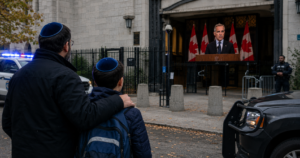
Carney is scheduled to speak in Toronto at 5 p.m. The Prime Minister’s Office said he will outline how the federal government plans to combat antisemitism and hate, following months of pressure from Jewish groups calling for stronger action from Ottawa.
For Canadian Jews, the question is no longer whether antisemitism is rising. That has already been answered in police reports, community security alerts, synagogue attacks, school lockdowns and the growing fear many Jews now feel in public spaces.
The question is how many incidents it takes before Jewish safety becomes a national priority, not just another line in a government anti-hate strategy.
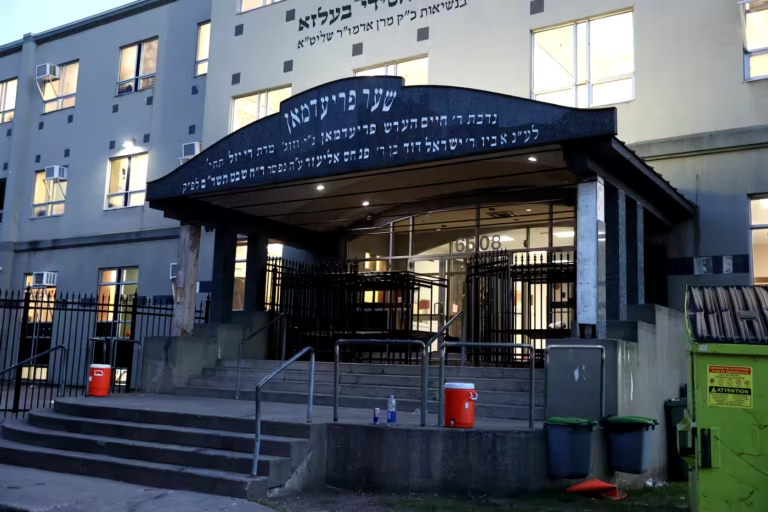
The latest federal attention comes after another disturbing incident in Toronto. Police said three visibly Jewish people were shot at with an imitation firearm outside Congregation Chasidei Bobov, near Bathurst Street and Highway 401, on May 7. One person was struck and suffered minor injuries.
Toronto police later arrested 18-year-old Ruslan Novruzov of Vaughan. He was charged with four counts of assault with a weapon and two counts of possession of a weapon for a dangerous purpose. Police said the incidents are being investigated as suspected hate-motivated offences.
Police said the same suspect is also connected to an April 30 incident near Bathurst Street and Lawrence Avenue West, where three visibly Jewish people were walking when someone in a vehicle allegedly fired an Orbeez-style imitation firearm at them.
The incidents are part of a wider pattern that Jewish groups say has become impossible to dismiss as isolated.
B’nai Brith Canada reported more than 6,800 antisemitic incidents in 2025, the highest number the organization has recorded since it began tracking antisemitism in 1982. The group said the number represents an average of more than 18 incidents per day.
B’nai Brith has also warned that violent antisemitic incidents in Canada in the first months of 2026 had already surpassed the total recorded for all of 2025.
The Centre for Israel and Jewish Affairs said ahead of Carney’s address that extremists in Canada and foreign actors abroad have used the conflict in the Middle East to fuel hatred and violence against Jewish Canadians.
CIJA CEO Noah Shack said the Prime Minister has an opportunity to set the tone from the highest office in the country and make clear that nothing justifies the intimidation, hatred and violence being directed at Canadian Jews.
That is the test facing Carney.
Jewish institutions across the country have spent the last two and a half years increasing security. Synagogues have needed police cars outside. Jewish schools have relied on guards, cameras and locked doors. Jewish students on university campuses have been forced to think twice before wearing a kippa, a Magen David or anything with Hebrew writing on it.
What was once described in political language as “rising hate” has become a daily security concern for Jewish families.
Ottawa has already made some moves. In January, the federal government released its National Commitments to Combat Antisemitism, following a national forum on antisemitism held in 2025. The commitments included funding for hate-crime training, RCMP resources, better coordination and public progress reports.
The government has also introduced Bill C-9, the Combatting Hate Act, which proposes changes to the Criminal Code. The bill would create new offences related to hate-motivated crimes, intimidation and blocking access to places of worship, schools, community centres and other spaces used by identifiable groups.
Supporters say the legislation is needed because Jewish Canadians are being targeted in places where they should be safe. Critics have raised concerns about freedom of expression and religious freedom, making the bill one of the more politically sensitive pieces of Ottawa’s anti-hate agenda.
Carney’s address also comes at a complicated moment in Canada’s relationship with Israel. His government has taken a more critical tone toward Israel in recent weeks over the war in Gaza, settlement expansion and the treatment of Gaza flotilla activists.
Jewish groups have argued that political arguments over Israel do not excuse the targeting of Jews in Canada. They have also warned that anti-Israel rhetoric is increasingly spilling over into intimidation of Jewish Canadians at synagogues, schools, campuses and community events.
That is why today’s announcement will be watched closely.
The issue is not whether Carney condemns antisemitism. Every federal leader does that.
The issue is whether Ottawa is prepared to treat Jewish safety as a real security problem, with real consequences for those who threaten, harass or attack Jews in this country.
For more than two years, Canadian Jews have been told they are seen, heard and supported. Today, many will be listening for something more than that.


Discover more from Montreal Jewish News
Subscribe to get the latest posts sent to your email.