


By Howie Silbiger
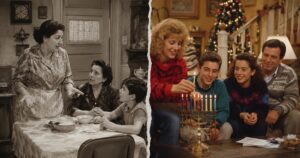
There were two shows called The Goldbergs. They were not connected, at least not officially. Different creators, different eras, different families, different Americas. Still, it is not hard to imagine the newer Goldbergs as Molly Goldberg’s grandchildren, or maybe her great-grandchildren, after the Bronx apartment and after the long climb into the American middle class.
Molly Goldberg lived in a world where the old country was still in the room. You heard it in her voice, you saw it in the apartment and you felt it in the way everybody knew everybody else’s business and nobody seemed especially bothered by that. She leaned out the window, shouted to neighbours, fussed, pushed, cooked, worried, meddled and somehow held the whole family together. The original Goldbergs was funny, but there was always something heavier underneath it. These were people becoming American, but not yet American enough to forget what they had been.
One episode has Molly and Tante arguing over a baby’s name. The argument is not simply over which relative should be honoured or which side of the family gets priority, it is over whether the baby should have a Jewish name or a non-Jewish name. In other words, it is an argument over how much Jewishness a child should be made to carry in public; A name can open a door, or at least make the door easier to open, a name can also announce a family before the child has even said a word.
That was not an abstract debate about identity, that was immigrant life. Parents made those decisions in kitchens, bedrooms, hospital rooms and shouting matches. What will make things easier for him? What will sound too foreign? What will sound too Jewish? What will the teacher say when she reads it out loud? What will a future employer think? What kind of America is this child going to have to face?
People like to clean up the immigrant story and turn it into a nice family legend. The grandparents came with nothing, worked hard and built something. The children went to school and the next generation moved to a better neighbourhood, everybody became successful and grateful. Much of that is true. But there was also embarrassment in that story. There were names changed because the originals were too heavy. There were parents whose accents made their children wince. There were languages pushed into the kitchen and then into memory. There were children who loved their parents and still spent years trying not to sound like them.
The later Goldbergs lives on the other side of that climb. Adam F. Goldberg’s family is not trying to become American. They already are. Their world is suburban, loud, comfortable and soaked in 1980s pop culture. There are malls, movies, school dances, mixtapes, big sweaters, bigger hair and a mother who turns love into a full-contact sport. The family is Jewish, but they are not immigrant Jews. They are not translating themselves at the door, they are already inside.
Then comes the Chanukah episode, where Beverly looks around at Christmas and decides Chanukah needs a serious upgrade. Christmas is everywhere, the lights, the songs, the specials, the stores, the school decorations, the commercials, the whole December machine. So Beverly invents “Super Chanukah,” a Jewish mother’s attempt to answer the pull of Christmas with more noise, more colour, more gifts and more excitement.
Every Jewish parent in North America knows some version of that feeling. Christmas does not just exist here. it fills the air for a month. Jewish parents can explain Chanukah, teach Chanukah, celebrate Chanukah, love Chanukah, and still see the look on a child’s face when the entire world outside the window is wrapped in red, green, lights, music and presents. So they compensate. More gifts. More decorations. More excitement. A little extra noise around a holiday that was never meant to carry that much weight.
Molly’s family argues over the child’s name. Beverly’s family argues, in its own way, over the child’s desire. The first question is whether the baby should enter America with a name that sounds Jewish. The second is whether the child, already fully American, will still feel that Jewish life is enough.
The old immigrants wanted their children to have easier lives. They wanted better homes, better schools, better jobs, better futures. They wanted their children to walk into rooms without being treated like outsiders, they wanted them to belong. No parent crosses an ocean hoping their children will inherit every humiliation they escaped.
But belonging always has a price.
Sometimes it is paid in small coins, a name softened, an accent hidden, a language answered in English until the older language disappears. Maybe even a holiday stretched into something it was never meant to be, because the children are jelous about what’s happening across the street. What ends up happening is a family still calling itself Jewish while quietly dropping the parts that make Jewishness inconvenient.
None of this happens all at once. Assimilation does not usually come in wearing a uniform and kicking down the door. It comes in gently, it sounds sensible. The kids are busy, the neighbourhood is different, the old ways do not fit anymore. Hebrew school costs a lot and the days are long. Shul is boring. One skipped holiday won’t “really” matter. Marriage does not need to become a whole issue, come on, the world is different now.
Most of the time, nobody thinks they are walking away from anything, they are just making life easier, and that’s exactly how the centre hollows out. The house still feels Jewish for a while, the jokes are still there, the last name is still there, the food is simialr and someone still tells stories about a grandmother who was very Jewish. But the grandmother becomes the evidence instead of the core. Eventually it becomes, “My grandmother was an orthodox Jew and my grandfather was a rabbi”.
Unfortunately, that is not enough to carry a people.
The baby-name episode in the original Goldbergs works because it catches assimilation at the front door, before the child has a career, before he has friends, before he has a place in the world, the adults are already wondering how Jewish he should sound. The “Super Chanukah” episode catches it much later, after the family has made it, after the house is comfortable, after the children belong so naturally to American life that Jewishness has to be repackaged for them with extra sparkle.
Both episodes are funny, Jewish life without comedy would be unbearable. But the comedy is doing real work. One family is trying to decide whether a Jewish name will make life harder, while the other is trying to make a Jewish holiday feel big enough beside Christmas. Different rooms. Same unease.
The old world was not perfect. Immigrants lived in crowded apartments, poverty, fear, pressure and had extreme anxiety. You can’t really blame them, there was plenty to escape from. But once you realize that the whole point of the immigrant climb was to build something better, you realize how much later generations have failed them. The immigrans did not live in poverty, fight for their rights, work their knuckles to the bone and sacrifice to make Judaism lighter and eventually disappear. They worked so hard to make the world a little safer than what they had.
The problem starts when safer becomes weaker and when comfort starts doing what open hostility could not do; obliterate the religious connection while trying to melt in the pot.
Somewhere between Molly Goldberg’s window and Beverly Goldberg’s kitchen, Jews got the house, the comfort, the safety and the confidence. That was the dream, but it has also become the nightmare. It turned out that the price of arriving became so comfortable that Jewish life had to beg for attention in its own home,
The later Goldbergs made it, but they made it on the backs of the earlier ones. They got the house, the neighbourhood, the confidence, the money, the ease. Molly Goldberg’s generation would have understood the beauty of that, but they would also have understood the sadness, because Molly Goldberg understood the dangers of assimilation, which is why she fought so hard for her grandchild to have a Jewish name, for her children to hold on to old world traditions, for Judaism to be the center of her and her families existence.
At the end of the Christmas episode, the newer Goldberg grandfather watched his daughter’s Jewish house turn into a Jewish Christmas house and got angry. To teach his grandchildren that Jewish tradition matters, he came into the house dressed up as Hanu clause bearing gifts. His daughter and her children cheered when he walked in, but learned a valuable lesson when they were given their gifts from his “sack of shame”.
Some of the gifts included a picture of great grandpa Solomon who “came to America with $2 in his pocket only so his granddaughter can dismantle his dream.” An empty jar that stores all the Jewish traditions handed down to her children.
The grandfather remembered the immigrant experience, because he lived it.
Immigrants like Molly Goldberg never imagined that Jews making it meant melting away. In their minds, it was supposed to mean standing taller as Jews, not learning how to make Jewish life easier to ignore.
If the name has to be changed, and the holiday has to be dressed up, and the children have to be convinced that their own inheritance is worth wanting, then the old fight is not over. It has only moved from Molly’s poor immigrant window to Beverly’s comfortably rich kitchen.
Howie Silbiger is the host of The Howie Silbiger Show on truetalkradio.com and Political Hitman on israelnewstalkradio.com. He is the Editor in Chief of The Montreal Jewish News


Discover more from The Montreal Jewish News
Subscribe to get the latest posts sent to your email.