



By Howie Silbiger
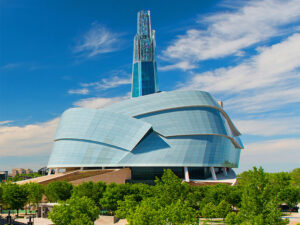
The Canadian Museum for Human Rights is about to open an exhibit on the Nakba. What’s interesting isn’t even the exhibit itself, it’s the confidence.
Nobody at the museum seems particularly worried about presenting one of the most disputed political narratives in the modern world under the banner of human rights education. Nobody appears especially concerned that a lot of Jewish Canadians might see the exhibit very differently than the people who put it together. There doesn’t seem to be much interest in explaining how the museum arrived at its conclusions either.
A few weeks ago, a lecture at the British Museum dealing with ancient Israel and Judah became controversial. Ancient Israel and Judah. Archaeology. Inscriptions. Kingdoms that disappeared thousands of years ago. Somehow that was enough to trigger protests and disruption.
While Jewish history increasingly requires a disclaimer, the Nakba apparently requires an exhibit.
The Canadian Museum for Human Rights describes its new exhibit as an exploration of Palestinian displacement, memory and lived experience, history, however, is usually a little messier.
The word Nakba means catastrophe. Within the modern Nakba narrative, the catastrophe begins with the creation of Israel, everything else grows from there. Once you start with Israel being a catastrophe, certain details tend to drift offstage. The Arab rejection of the 1948 partition plan, the war of independence, the invasion by surrounding Arab armies, the fact that the Jewish leadership accepted a two-state solution while Arab leaders rejected one.
While those details never completely disappear, but they somehow stop being central. Eventually the conclusion arrives first and the history scrambles along behind trying to catch up. The museum has every right to tell Palestinian stories, but what strikes me is how little curiosity there seems to be about the rest of the story.
A visitor will learn about Palestinian displacement. Will he learn about the Jewish communities that vanished from Iraq, Syria, Egypt, Libya and elsewhere? Will he learn that hundreds of thousands of Jews ended up as refugees in the years that followed? Will he learn why the war happened in the first place?
Maybe.
The museum’s public material leaves plenty of room for speculation.
Ten or fifteen years ago, I suspect a national institution would have approached a subject like this much more cautiously. There would have been panels, consultations, competing viewpoints, advisory committees and probably a few consultants billing by the hour. Above all, there would have been a visible effort to show that the museum understood it was stepping into a historical and political minefield.
That caution seems to have disappeared. The truth is that Canada has changed, Ottawa has changed. The federal Liberal government recognized a Palestinian state before the successful conclusion of any negotiated peace agreement. Whether one agrees with that decision or not is almost beside the point, it signalled a shift.
Over time certain assumptions become fashionable, then respectable, and eventually so widely accepted that people stop noticing them altogether. A museum opens an exhibit, a university hosts a conference, a city council debates a motion. Each decision is defended on its own merits, viewed one at a time, they seem unrelated. After a while, though, it becomes difficult not to notice that everyone appears to be walking in roughly the same direction. That is what makes this exhibit worth paying attention to.
The debate stopped being about a museum in Winnipeg a long time ago. The real question is whether Canada’s cultural institutions still see themselves as places that explore ideas or whether they now see themselves as places that affirm them.
The Canadian Museum for Human Rights may not see much of a distinction, but increasingly, a lot of Canadians do.
Howie Silbiger is the host of The Howie Silbiger Show on truetalkradio.com and Political Hitman on israelnewstalkradio.com. He is the Editor-in-Chief of The Montreal Jewish News.


Discover more from Montreal Jewish News
Subscribe to get the latest posts sent to your email.